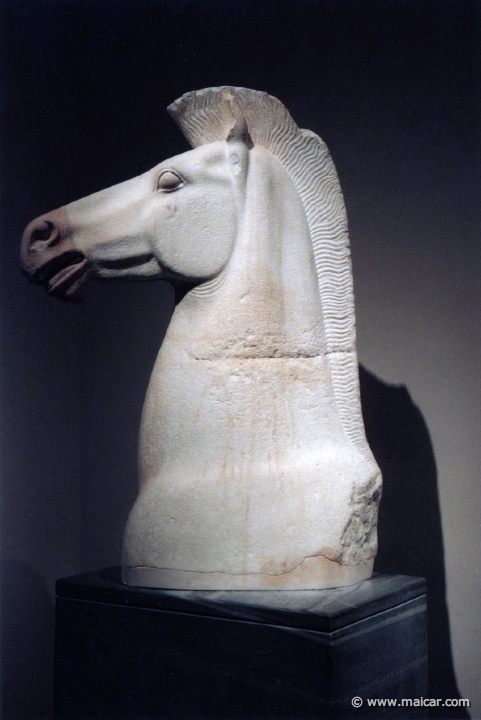
Abraxas.
One of the horses of Helius.
Hyg.Fab.183.
ACTAEON'S DOGS.
When Artemis in the summertime was bathing in a stream, Actaeon sought the same place for cooling himself and the dogs which he had exercised in chasing wild beasts. He then caught sight of the goddess, and to keep him from telling of it, she changed him into a stag. As a stag, then, he was mangled by his own hounds.
Aetha.
A mare given to Agamemnon by Echepolus 2 and yoked by Menelaus during the funeral games in honour of Patroclus 1.
Hom.Il.23.295; Pau.5.8.3.
Aethion 2.
One of the horses of Euneus 1, son of Jason and Hypsipyle, in the chariot-race at Opheltes 1's funeral games.
Stat.Theb.6.464.
Aethiops.
Flaming. One of the horses of Helius.
Hyg.Fab.183.
Aethon 1.
One of the horses of Hector 1.
Hom.Il.8.185.
Aethon 2.
Blazing. One of the horses of Helius.
Hyg.Fab.183; Ov.Met.2.153.
Aethon 4.
The horse of Pallas 6, an ally of Aeneas in Italy.
Vir.Aen.11.89.
Agdistis.
A demon with two sexual organs, male and female. The gods cut off the male organ and an almond tree grew up from it, the fruit of which was taken by Sangarius' Daughter who became pregnant.
Pau.7.17.10.
Amalthea.
A Naiad, nurse of Zeus, who owned a horn which could supply food in abundance. She is also said to have been a goat or to have owned a she-goat who suckled Zeus.
Apd.2.7.5; Ara.Phae.162; Cal.Ze.48; Dio.5.70.3; Hyg.Ast.2.13; Hyg.Fab.139; Nonn.27.298; Ov.Fast.5.115.
ANTS.
These ANTS were transformed into men by Zeus as Aeacus was alone in the Island of Aegina. Thus was Aegina populated.
Apd.3.12.6.
Argus 1.
The All-seeing.
Argus 6.
This is Odysseus' old dog which was able to recognize his master after his long absence.
Hom.Od.17.292ff.
Arion 1.
This dark-maned horse is the offspring of Poseidon and Demeter, or of Gaia, or of Zephyrus 1 and Podarge. It is said that when Demeter was looking for her daughter Persephone, she was followed by Poseidon, and in order to avoid him she turned into a mare. However, Poseidon changed himself into a stallion and enjoyed Demeter, who gave birth to the horse Arion 1. This happened in Thelpusian territory in Arcadia, which belonged to Oncius, son of Apollo. When later Heracles 1 waged war against Elis, he asked the horse to Oncius and was carried to battle on its back when he took Elis. Afterwards the horse was given by Heracles 1 to Adrastus 1. Adrastus 1 survived the war against Thebes (see SEVEN AGAINST THEBES), saved by his own horse Arion 1.
Apd.3.6.8; Pau.8.25.9; Prop.2.34.37; QS.4.569; Stat.Theb.4.43, 6.424ff.
Aschetos.
One of the horses of Amphiaraus in the chariot-race at Opheltes 1's funeral games.
Stat.Theb.6.463.
Ass.
The saddle-ass of Silenus. Contended with Priapus on a matter of physique, or by giving out an ill-timed roar, prevented Priapus from making love to Lotis.
Hyg.Ast.2.23; Ov.Fast.1.433.
ASSES 1.
The two asses who carried Dionysus 2 when he wanted to reach the temple of Zeus in order to recover his sanity.
Hyg.Ast.2.23.
ASSES 2.
The asses who rode the SILENS and the SATYRS when they came to assist Zeus in his war against the GIANTS. These asses were so terrified that they let out a braying such as the GIANTS had never heard, thus frightening them.
Hyg.Ast.2.23.
ASSES 3.
The asses who devoured Lycius 2. This Lycius 2, son of Clinis and Harpe 1, wished, along with his brother Harpasus, sacrifice asses against Apollo's will. He was devoured by his father's asses and turned into a white raven that became black at once.
Lib.Met.20.
Balius 1.
One of Achilles' immortal steeds, the other being Xanthus 1. It served Poseidon first, and next Peleus, Achilles and Neoptolemus. This horse is the offspring of Zephyrus 1 (the West Wind) and Podarge (one of the HARPIES). These horses were the reward that Dolon 1 wished to receive for spying in the Achaean camp during the Trojan War.
Apd.3.13.5; Eur.Rhe.184; Hom.Il.16.150; QS.3.755ff.
Bear.
This is the bear, which Polyphonte, inspired by Aphrodite, fell in love with. From their union the giants Agrius 6 and Orius 3 were born.
Lib.Met.21.
BIRDS.
All birds (see Myths of Creation).
Ari.Birds.683ff.
BIRDS STYMPHALIAN.
Man-eating birds who used their feathers as arrows. They were chased away by Heracles 1. Some of them were also found by the ARGONAUTS (see LABOURS).
Apd.2.5.6; Hyg.Fab.20; Pau.8.22.4; QS.6.227.
Boar 1 Erymanthian.
This Boar ravaged Psophis, and was trapped by Heracles 1 and brought to Mycenae.
Apd.2.5.4; QS.6.220; Soph.Tra.1097.
Boar 2 Calydonian.
This Boar, offspring of the Sow Crommyonian, had great size and strength. Artemis, in her wrath, sent it to prevent the land to be sown, and destroy cattle and people. It was killed by Atalanta who shot it first, Amphiaraus who next shot it in the eye and Meleager who killed it by a stab in the flank (see CALYDONIAN HUNTERS).
Apd.1.8.2; Hes.CWE.98; Hom.Il.9.543; Strab.8.6.22.
Boar 3.
This is the Boar which killed Idmon 2 (one of the ARGONAUTS) in the land of the Mariandynians; it was killed by Idas 2.
Apd.1.9.23; Arg.2.830.
Boar 4.
Killed Adonis.
Apd.3.14.4.
Boar 5.
Sent by Zeus. Killed Attis.
Pau.7.17.10.
Boar 6.
Killed Hyas, son of Atlas, during a hunt (see also CONSTELLATIONS).
Hyg.Fab.192.
Boetis.
A she-goat with wich Zeus consorted and Aegipan 2 was born.
Hyg.Fab.155.
Bronte.
Thunder. One of the female horses of Helius.
Hyg.Fab.183.
Bull 1.
Sent to Minos 2 by Poseidon. Pasiphae had intercourse with this bull and the Minotaur was born (see also Heracles 1).
Apd.2.5.7, 3.3.3-4; Hyg.Fab.38; Pau.1.27.10.
Bull 2.
This bull is Zeus. Zeus turned himself into a bull, mounted Europa on his back and conveyed her through the sea to Crete.
Apd.3.1.1; Hyg.Ast.2.21; Ov.Fast.5.605.
Bull 3 Marathonian.
Killed Androgeus, son of Minos 2. This could be the same as Bull 1.
Apd.3.15.7; Apd.Ep.1.5; Dio.4.59.6; Hyg.Fab.38; Pau.1.27.10.
Bull 4.
Ravaged Arcadia. Killed by Argus 1.
Apd.2.1.2.
Bull 5 (and 6).
A gift of Hephaestus to Aeetes. They were brazen-footed and puffed fire from their mouths. Aeetes promised Jason, Captain of the ARGONAUTS, to give him the Golden Fleece if he could yoke them and sow Dragon 2's teeth, half of which he had got from Athena.
AO.870; Apd.1.9.23; Hyg.Fab.22; Pin.Pyth.4.224ff.; Val.7.547ff.
Bull 7.
Provoked the death of Hippolytus 4, son of Theseus.
Apd.Ep.1.19.
Bull 8.
Sacrificed in Aulis. A young bull that Artemis produced to be sacrificed instead of Iphigenia (see also Deer).
Lib.Met.27.
Bull 9's hide.
This bull had been sacrificed by Hyrieus when he received Zeus, Hermes and Poseidon. As Hyrieus was childless and asked the gods for children, they urinated in the hide of the sacrificed bull, buried it in the earth and from it Orion was born.
Hyg.Fab.195; Ov.Fast.5.535.
Bull 10.
This bull is Zeus. Zeus in the likeness of a bull mated with Io who had been transformed into a cow by Hera.
Aes.Supp.300.
Bull 11.
The Bull that, chased by gadflies sent by Selene, became infuriated and threw Ampelus off his back, thus causing his death.
D:Nonn.11.197ff.
Cacus.
A fire-breathing half-human creature who ate human flesh and nailed the heads of men in the doors of his cave. Offspring of Hephaestus. Was killed by Heracles 1.
DH.1.39.4; Ov.Fast.1.577; Prop.4.9.16; Vir.Aen.8.195ff.
Caerus 1.
Offspring of Gaia. One of the horses of Adrastus 1. Was one of the horses of Amphiaraus in the chariot-race at Opheltes 1's funeral games.
Pau.8.25.9; Stat.Theb.6.524.
Campe.
The jaileress in Tartarus of the CYCLOPES and the HECATONCHEIRES. Double-shaped, she appeared a woman to the middle of her body, with clusters of poisonous serpents for hair. Her giant form, from the chest to the parting-point of the thighs, was covered with sea-monster's scales. The claws of her hands were curved like a crook-talon sickle. Over her shoulders a scorpion coiled upon itself. Zeus killed her when he needed the help of the CYCLOPES and the HECATONCHEIRES in his fight against the TITANS.
Apd.1.2.1; Nonn.18.237.
CENTAURS.
Hybrid creatures.
CENTAURS CYPRIAN.
Horned generation of CENTAURS. Once Zeus chased Aphrodite but could not catch her. Instead of her bed, he dropped his seed on the ground, and they grew out of the earth.
Nonn.14.193ff., 32.72.
CENTAURS HORNED.
Offspring of the NYMPHS LAMUSIDES. Because of an enchantment they became creatures with long ears, and a horse's tail sticking out straight from the loins; from the temples cow's horns sprouted out, long teeth grew out of their jaws and a strange kind of mane covered their necks with rough hair. The Horned Centaurs were: Aesacus 2, Amphithemis 2, Ceteus 2, Eurybius 3, Gleneus 2, Nomion 3, Orthaon, Petraeus 3, Phanes 3, Phaunus 2, Riphonus, Spargeus.
Nonn.14.168ff.
Cerberus 1.
Hound of Hades (see Heracles 1, HERACLES 1's LABOURS, and Underworld).
Apd.2.5.12; Eur.Her.25, 611; Hes.The.310ff.; Hom.Od.11.617ff.; QS.6.261; Stat.Theb.2.27, 8.56,; Strab.8.5.1.
Charybdis.
Sea-monster.
Chimera.
Hybrid monster (see Bellerophon).
Apd.2.3.2; Hes.CWE.7; Hes.The.319ff.; Hom.Il.6.179; Hyg.Fab.151; Pin.Oly.13.90.
Cow 1 Delphian.
Led Cadmus to the place in which he settled founding Thebes. Was sacrificed by Cadmus (see also Ox).
Arg.3.1179; Nonn.5.5.
Cow 2 Ilian.
Ilus 2 went to Phrygia finding games held there by the king. And as a prize for having been victorious in wrestling the king gave him also a cow and bade him found a city wherever the animal should lie down. And when she was come to the hill of the Phrygian Ate, she lay down; there Ilus 2 built a city and called it Ilium (Troy).
Apd.3.12.3.
Crab.
Helped the Hydra and was killed by Heracles 1. It was promoted by Hera to the rank of a constellation (see also CONSTELLATIONS).
Apd.2.5.2; Hyg.Ast.2.23.
Crow 1.
This crow had to guard Coronis 2 and told Apollo that she had wedded Ischys. Cursed by Apollo, became black instead of white.
Apd.3.10.3; Hes.CWE.89; Hyg.Ast.2.40; Hyg.Fab.202.
Crow 2.
Athena gave the babe Erichthonius 2 in a chest to the daughters of Cecrops 1 to guard, but the girls opened the chest and this crow gave the secret away. The girls, driven mad by the goddess, threw themselves into the sea.
Hyg.Fab.166.
Crow 3.
This Crow that had to fetch water and bring it to Apollo, but returned without it and with a lying tale about a Serpent (Serpent 16) that had prevented him from filling the Bowl with water. Since then these three constellations are seen together.
Ov.Fast.2.243ff.
CYCLOPES.
One-eyed creatures.
Cydon 5.
One of the horses of Hippodamus 2 in the chariot-race at Opheltes 1's funeral games.
Stat.Theb.465.
Cygnus.
One of the horses of Amphiaraus in the chariot-race at Opheltes 1's funeral games.
Stat.Theb.6.463.
Deer.
Was sacrificed in Aulis instead of Iphigenia (see also Bull 8).
Apd.Ep.3.22; CYP.1; Hyg.Fab.98.
Delphyne.
She-Dragon, a half-bestial maiden, who guarded the sinews of the hands and feet of Zeus which Typhon had severed. Killed by Apollo.
Apd.1.6.3; Arg.2.706; Nonn.13.28.
Dolphin.
Persuaded Amphitrite to marry Poseidon.
Hyg.Ast.2.17.
Dragon 1. (See Ladon 4.)
Dragon 2.
Guarded the spring of Ares. Cadmus sowed its teeth which rose from the ground as armed men and were called the SPARTI.
Apd.1.9.23, 3.4.1; Nonn.4.358ff., 4.415, 4.421ff.; Val.7.610.
Dragon 3.
Guarded the Golden Fleece, but was lulled to sleep by Medea.
Apd.1.9.23; Arg.2.1209; Pin.Pyth.4.244ff.; Val.8.70ff.
Dragon 4.
Devastated Thespiae. Youths should be offered to it every year. Killed by Menestratus.
Pau.9.26.7.
Dragon 5.
Devoured Opheltes 1. Killed by Adrastus 1 (see also Serpent 10).
Hyg.Fab.74.
Dragon 6.
The GIANTS threw it against Athena. Fixed in the stars by Athena.
Hyg.Ast.2.3.
DRAGONS 1.
Yoked to the car of Triptolemus.
Pau.7.18.3.
DRAGONS 2.
Yoked to the chariot of Medea. Born from the TITANS' blood.
Ov.Met.7.398.
Eagle 1 Caucasian.
Offspring of Typhon and Echidna or perhaps fashioned by Hephaestus. Devoured the liver of Prometheus 1. Killed by Heracles 1.
Apd.2.5.11; Dio.4.15.2; Hes.The.527; Hyg.Ast.2.15; Hyg.Fab.31; QS.10.200.
Eagle 2.
Snatched Ganymedes.
Apd.3.12.2; Hyg.Ast.2.16.
Eagle 3 Omen.
Was seen by Zeus as an omen for attacking the TITANS.
Hyg.Ast.2.16.
Eagle 4.
Took Aphrodite's sandal to Hermes.
Hyg.Ast.2.16.
Eagle 5.
This Eagle is Zeus who took this form to approach Aegina.
Nonn.33.297.
Eagle 6.
The eagle who brings back the thunderbolts of Zeus.
Man.5.486.
Eagle 7.
This eagle swooped down and carried the spear of Amphiaraus up to a height and then let it drop. The spear became fixed in the earth and turned into a laurel. At that very spot Amphiaraus was swallowed up with his chariot, where now is the city called Harma.
Plu.PS.6.
Echidna.
Hybrid monster, half girl half snake. Daughter of Tartarus and Gaia, or of Piras 2 and Styx, or of the sea-deities Phorcus and Ceto 1. Echidna produced a generation of monsters after consorting with Typhon: Chimera, Ladon 4, Cerberus 1, Orthus, Sphinx, Hydra, Scylla 1, Lion 2, Eagle 1, Sow, Gorgon, HARPIES. Others say she had the Sphinx by Orthus. Echidna was caught asleep and slain by Argus 1.
Apd.2.1.2, 2.3.2, 2.5.10ff., 3.5.7; Apd.Ep.1.1; Hes.The.294ff., 310ff., 326ff.; Hyg.Fab.151; Hyg.Pre.; Pau.8.18.2; Val.4.428.
Eous.
Orient. One of the horses of Helius.
Hyg.Fab.183; Ov.Met.2.153.
ERINYES.
Avenging spirits.
Eripha.
One of the mares of Marmax, the first suitor of Hippodamia 3, wife of Pelops 1).
Pau.6.21.7.
Eurynomus 3.
One of the demons in Hades, who eats off all the flesh of the corpses, leaving only the bones.
Pau.10.28.7.
Fish.
Rescued Isis (see also CONSTELLATIONS).
Hyg.Ast.2.41.
Gadfly.
This gadfly was sent by Hera to torment Io who had been turned into a cow.
Aes.Pro.823ff.; Aes.Supp.540ff.; Apd.2.1.3; Ov.Met.1.722.
Geryon.
Offspring of Chrysaor and Callirrhoe 1. He had the body of three men grown together and joined in one at the waist, but parted in three from the flanks and thighs. Heracles 1 took his cattle away and killed him (see HERACLES 1' LABOURS).
Aes.Aga.870; Apd.2.5.10; DH.1.39.1; Dio.5.17.4; Hdt.4.8; Hes.The.287, 979; Hyg.Fab.151; Pau.10.17.5; Vir.Aen.6.289.
GIANTS.
For their attack against heaven see also Gigantomachy.
GORGONS.Serpent-haired monsters, offspring of Phorcus and Ceto 1.
GRAEAE.
Sisters of the GORGONS and old women from birth. The three had but one eye and one tooth, and these they passed to each other in turn. The GRAEAE are: Dino, Enyo 1, and Pephredo.
Aes.Pro.794; Apd.2.4.2; Nonn.25.63.
|
|
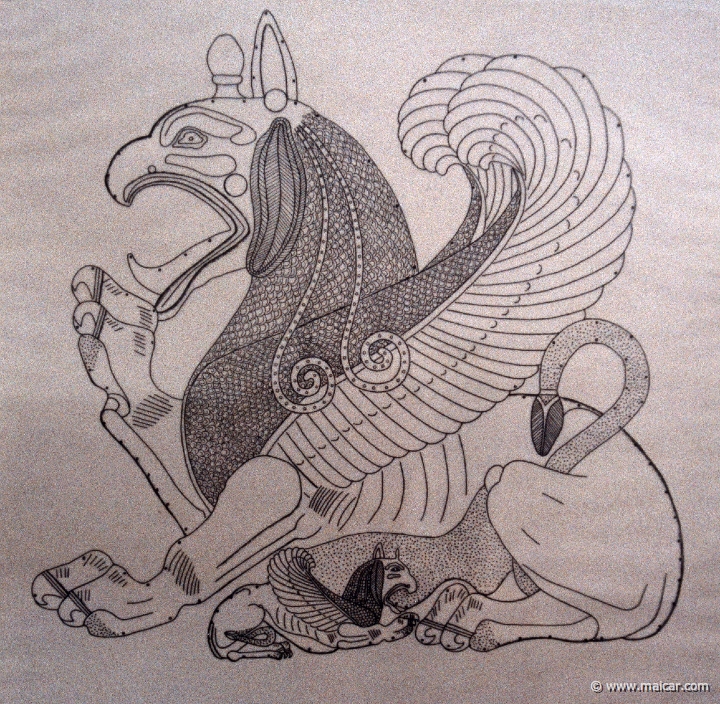
6729: Female griffin (gryph, or gryphus) suckling her offspring. Probably the facing of a metope. Drawing of a bronze sheet. Work of a Corinthian workshop. End of 7th Century BC. Archaeological Museum, Olympia.
|
|
Griffin.
The griffin, gryph, or gryphus, an animal that appears to have come originally from the east, has been widely depicted in ancient Greek art and in later times as well. Not seldom the griffin (a beast like a lion but with the beak and wings of an eagle), being harnessed by gods or other mythical figures, is seen driving chariots. The griffin does not appear very often in ancient literature, but Aeschylus, Herodotus, Pausanias, Flavius Philostratus, and Strabo are among those who mention it. The Issedones are reported to have asserted that the one-eyed Arimaspians, who inhabited a land near that of the Scythians, used to steal gold from the griffins:
"But in the north of Europe there is by far the most gold. In this matter again I cannot say with assurance how the gold is produced, but it is said that one-eyed men called Arimaspians steal it from griffins." (Herodotus, History 3.116.1).
and
"Of these too, then, we have knowledge; but as for what is north of them, it is from the Issedones that the tale comes of the one-eyed men and the griffins that guard gold; this is told by the Scythians, who have heard it from them; and we have taken it as true from the Scythians, and call these people by the Scythian name, Arimaspians; for in the Scythian tongue "arima" is one, and "spou" is the eye." (Herodotus, History 4.27.1).
and
"There is also a story related in a poem by Aristeas son of Caustrobius, a man of Proconnesus. This Aristeas, possessed by Phoebus, visited the Issedones; beyond these (he said) live the one-eyed Arimaspians, beyond whom are the griffins that guard gold, and beyond these again the Hyperboreans, whose territory reaches to the sea." (Herodotus, History 4.13.1).
Similar things are told by Pausanias:
"I have also heard that the griffins have spots like the leopard, and that the Tritons speak with human voice, though others say that they blow through a shell that has been bored. Those who like to listen to the miraculous are themselves apt to add to the marvel, and so they ruin truth by mixing it with falsehood." (Pausanias, Description of Greece 8.2.7).
and
"These griffins, Aristeas of Proconnesus says in his poem, fight for the gold with the Arimaspi beyond the Issedones. The gold which the griffins guard, he says, comes out of the earth; the Arimaspi are men all born with one eye; griffins are beasts like lions, but with the beak and wings of an eagle. I will say no more about the griffins." (Pausanias, Description of Greece 1.24.6).
|
|
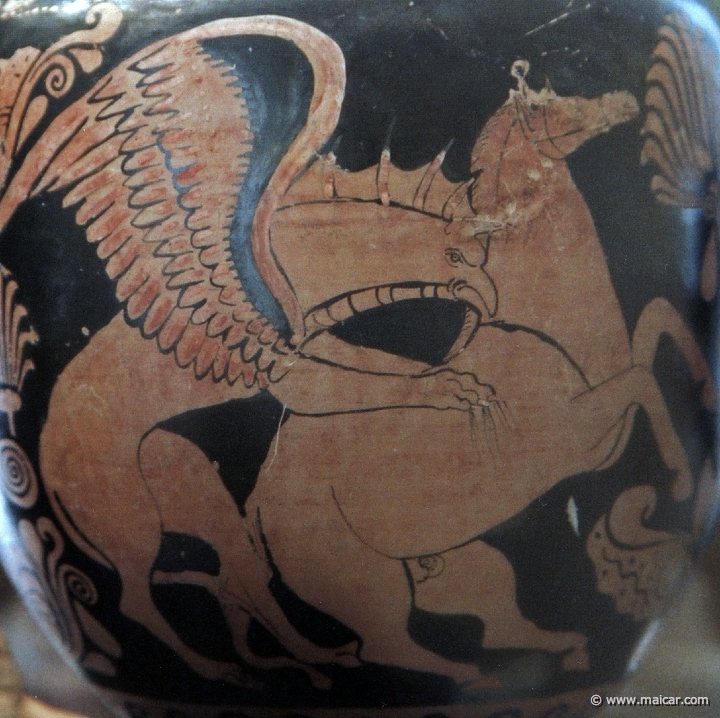
Griffin attacking a horse. 10009: Un grifo ataca a un caballo. Ànfora de Lucania (Magna Grecia) 350 a.C. Museo Arqueológico Nacional, Madrid.
|
|
Already in old times the griffins were used to adorn buildings or works of art:
"He had in the city of the Borysthenites a spacious house, grand and costly (the same house I just mentioned), all surrounded by sphinxes and griffins worked in white marble ..." (Herodotus, History 4.79.2).
and
"The Samians took six talents, a tenth of their profit, and made a bronze vessel with it, like an Argolic cauldron, with griffins' heads projecting from the rim all around; they set this up in their temple of Hera, supporting it with three colossal kneeling figures of bronze, each twelve feet high. What the Samians had done was the beginning of a close friendship between them and the men of Cyrene and Thera." (Herodotus, History 4.152.4).
and
"In the temple of Artemis Alpheionia are very famous paintings by two Corinthians, Cleanthes and Aregon: by Cleanthes the "Capture of Troy" and the "Birth of Athena," and by Aregon the "Artemis Borne Aloft on a Griffin." (Strabo, Geography 8.3.12).
The griffins were to be feared, and this is how Prometheus 1 warns Io:
"But now listen to another and a fearsome spectacle. Beware of the sharp-beaked hounds of Zeus that do not bark, the gryphons, and the one-eyed Arimaspian folk, mounted on horses, who dwell about the flood of Pluto's stream that flows with gold. Do not approach them." (Aeschylus, Prometheus Bound 804).
It has been said that the griffins could dig up gold and were—in India—sacred to the Sun. Concerning their size and strength it is told that they resemble lions, but since they have wings they have an advantage over them, as well as over elephants and dragons. Yet they cannot fly more than birds of short flight. For they have not feathered wings; instead the palms of their feet, so they say, are webbed with red membranes which they expand to make a flight and fight from the air. The tiger alone, because of its swiftness, could escape the griffin.
Aes.Pro.804; Hdt.3.116.1, 4.13.1 4.27.1, 4.79.2, 4.152.4; Pau.1.24.6,8.2.7; Phil.VA.3.48; Strab.8.3.12.
Hare.
Flees the hunter Orion in the sky.
Hyg.Ast.2.33.
HARPIES.
Hybrid monsters called sometimes the hounds of Zeus. They were bird-bodied and girl-faced, and snatched away both things and living beings. They were the children of Thaumas 1 and Electra 1, or of Typhon, or of Thaumas 1 and Ozomene. The HARPIES were Aello 1, Celaeno 4, Ocypete 2 and Podarge. (See also ARGONAUTS and Phineus 2.)
Apd.1.2.6; Arg.2.234; Hes.The.267; Hom.Od.1.241, 20.61-78; Hyg.Fab.14, 19; Val.4.428; Vir.Aen.3.212.
HECATONCHEIRES.
The HECATONCHEIRES (hundred-handed) are Briareus, Cottus and Gyes.
Hind Cerynitian.
A hind with golden horns captured by Heracles 1. This hind had originally been consecrated to Artemis by Taygete.
Apd.2.5.3; Eur.Her.378; Pin.Oly.3.28; QS.6.223.
Hydra Lernaean.
Serpentlike monster offspring of Typhon and Echidna. Had a huge body with countless heads, or with nine heads one of which was immortal, or with one hundred heads, or only one head. Killed by Heracles 1 (see also LABOURS).
Apd.2.5.2; Eur.Her.421; Hes.The.314ff.; Hyg.Ast.2.40; Hyg.Fab.151; Ov.Met.9.69; Pau.2.37.4; Soph.Tra.1094.
Iris 2.
One of the horses of Admetus 1 in the chariot-race at Opheltes 1's funeral games.
Stat.Theb.6.461.
Ladon 4. (Dragon 1.)
Offspring of Typhon and Echidna or of Phorcus and Ceto 1. Guardian snake with one hundred heads who kept the golden apples of the HESPERIDES. Either it was immortal or was killed by Heracles 1.
Apd.2.5.11; Arg.4.1396; Eur.Her.394; Hes.The.333; Hyg.Ast.2.3; Hyg.Fab.151.
Laelaps 2.
The dog of Procris 2. It was given by Zeus as a guardian for Europa. Later came to Minos 2 who gave it to Procris 2 (or else Artemis gave her the dog). This dog was so swift that no beast could escape it. This dog was turned into stone by Zeus while hunting a fox, which was so swift that it could outrun all dogs (see Amphitryon).
EPIG.2; Hyg.Ast.2.35; Hyg.Fab.189; Lib.Met.41; Ov.Met.7.681ff., 7.755; Pau.9.19.1.
Lamb Golden.
Atreus once vowed to sacrifice to Artemis the finest of his flocks; but when a golden lamb appeared, he neglected to perform his vow. The lamb was later taken away from Atreus and given by his wife to his brother, thus helping Atreus' brother to gain the kingdom of Mycenae.
Apd.Ep.2.11.
Lamia 2. (Sybaris 1.)
A monster devastating the country of the Delphians, to whom they had to sacrifice a youth, Alcyoneus 2. The monster was killed by Eurybatus.
Lib.Met.8.
Lampus 3.
One of the horses of Hector 1.
Lampus 4.
One of Eos' steeds.
Hom.Od.23.246.
Lion 1 Cithaeronian.
Harried the kine of Amphitryon and Thespius. Was killed by Heracles 1 or by Alcathous 3, son of Pelops 1.
Apd.2.4.9; Pau.1.41.3.
Lion 2 Nemean.
Offspring of Typhon and Echidna, defeated by Heracles 1. When Heracles 1 tracked the lion, he first shot an arrow at it, but when he perceived that the beast was invulnerable, he heaved up his club and made after it. And when the lion took refuge in a cave Heracles 1 came upon it, and putting his arm round its neck held it tight till he had choked it. Later he brought the lion to Mycenae, but from then on Eurystheus forbade him to enter the city and ordered him to exhibit the fruits of his LABOURS before the gates.
Apd.2.5.1; Eur.Her.153; Hes.The.326ff.; Hyg.Ast.2.24; QS.6.208; Soph.Tra.1092; Vir.Aen.8.295.
Lion 3.
Monstrous lion subdued without spears, through wrestling, by Cyrene.
Pin.Pyth.9.25.
Lion 4 Cyrenaean.
At the sight of this lion, Battus 2, colonizer of Libya was cured of his stammering, when he was compelled to cry out in a clear and loud voice.
Pau.10.15.7.
Lioness 1 Libyan.
Killed Hyas during a hunt.
Hyg.Ast.2.21; Hyg.Fab.192.
Lioness 2.
Killed Mermerus 1 while he was hunting on the mainland opposite Corcyra.
Pau.2.3.9.
Lioness 3 Ambracian.
Was sent by Artemis against Phalaecus while he was hunting.
Lib.Met.4.
Maera 2.
The dog of Icarius 2 who led Erigone 2 to her father's dead body.
Apd.3.14.7; Hyg.Ast.2.35.
MARES MAGNESIAN.
Mothers of the CENTAURS.
MARES OF DIOMEDES 1.Man-eating mares who killed Abderus, and were mastered by Heracles 1. They were destroyed on Mount Olympus by the wild beasts (see also LABOURS). The names of these mares were: Dinus, Lampon, Podargus 1, and Xanthus 2.
Apd.2.5.8; Eur.Her.380.
MARES OF LAOMEDON 1.
These horses had been given by Zeus to Tros 1 in compensation for the abduction of Ganymedes. They could run over water and over the heads of standing grain. Heracles 1 promised to save Hesione 2, who had been exposed as a prey to be devoured by Sea-Monster 2, on condition of receiving from Laomedon 1 these mares. On Laomedon 1's saying that he would give them, Heracles 1 killed the monster and saved Hesione 2. But when Laomedon 1 would not give the stipulated reward, Heracles 1 threatened to make war on Troy. For the sake of these mares Heracles 1 with only six ships and a little army sacked the city of Troy and made waste her streets.
Apd.2.5.9; Hom.Aph.5.202ff.; Hom.Il.5.265ff., 5.638ff.; Pau.5.24.5.
Minotaur.
Bull-headed man.
Orthus.
Two-headed hound offspring of Typhon and Echidna. Watch-dog of the cattle of Geryon. The Sphinx is the offspring of Orthus and Echidna. It was killed by Heracles 1.
Apd.2.5.10; Hes.The.309, 326.
Ox.
The ox that led Cadmus to the place in which he settled, founding Thebes. (See also Cow 1 Delphian.)
Hyg.Fab.178.
|
|
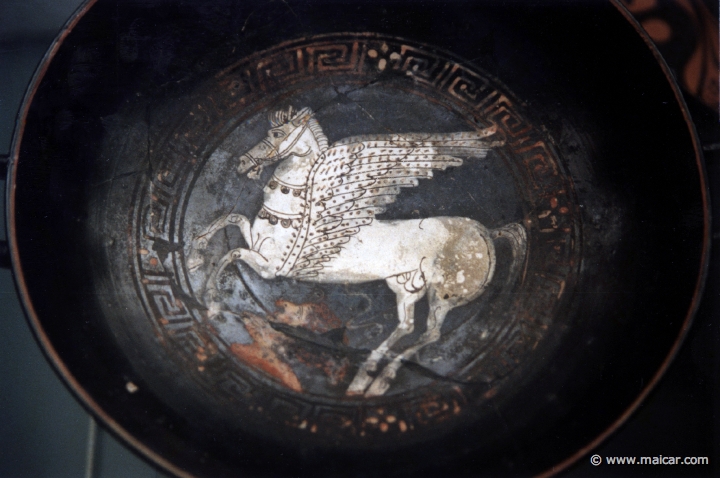
8223: Black cup (kylix) with added colour showing Pegasus in the tondo and youths on the exterior. Faliscan c. 350 BC. British Museum, London.
|
|
Parthenia.
One of the mares of Marmax, the first suitor of Hippodamia 3, wife of Pelops 1. Oenomaus 1 slew the mares after Marmax, but granted burial to them also.
Pau.6.21.7.
Pedasus 2.
Achilles' mortal horse killed by Sarpedon 1 at Troy.
Hom.Il.16.148, 16.467.
Pegasus.Winged horse offspring of Poseidon and Medusa 1. This horse opened up a spring on a mountain by striking the rock with its hoof. Bellerophon mounted it when he went to kill the Chimera. It is said to have leapt forth from the teeming neck of the slain Medusa 1, its mane bespattered with blood.
Apd.2.3.2; Ara.Phae.218; Hyg.Ast.2.18; Nonn.25.40, 31.20; Ov.Fast.3.450; Pin.Oly.13.64.
Phaethon 2.
One of Eos' steeds.
Hom.Od.23.246.
Phlegon.
One of the horses of Helius.
Hyg.Fab.183; Ov.Met.2.154.
Phoenix the bird.
Hdt.2.73ff.; Ov.Met.15.391.
Pholoe 2.
One of the horses of Admetus 1 in the chariot-race at Opheltes 1's funeral games.
Stat.Theb.6.461.
Podarces 3.
One of the horses of Thoas 9 in the chariot-race at Opheltes 1's funeral games.
Stat.Theb.6.466.
Podargus 2.
One of the horses of Hector 1.
Hom.Il.8.185.
Podargus 3.
One of the mares that Menelaus yoked during the games in honour of Patroclus 1.
Hom.Il.23.295.
Procyon.
Orion's dog (in Canis Minor, see CONSTELLATIONS).
Hyg.Ast.2.36.
Pyrois.
One of the horses of Helius.
Hyg.Fab.183; Ov.Met.2.153.
Python.
The dragon, offspring of Gaia, which guarded Themis' oracle at Delphi. Killed by Apollo.
Apd.1.4.1; Hyg.Fab.140; Nonn.9.251; Ov.Met.1.438ff.; Stat.Theb.1.563.
|
|
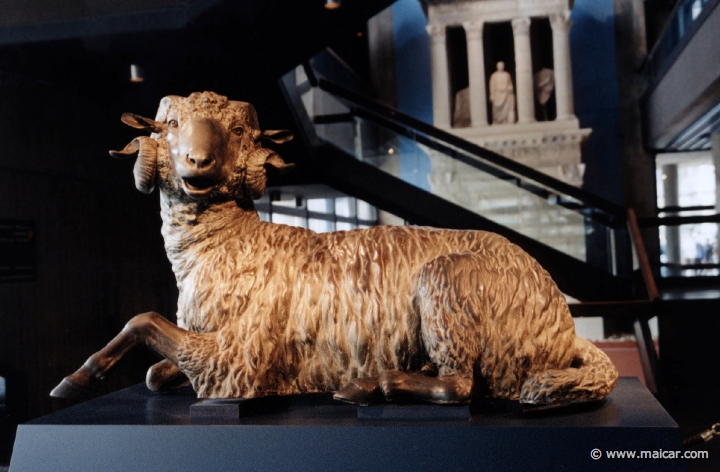
1103: Ram with the Golden Fleece. Sculpture. Römisch-Germanischer Museum, Köln.
|
|
Ram 1.
The Ram with the Golden Fleece, offspring of Poseidon and Theophane. Given to Nephele 2 by Hermes. It bore Phrixus 1 and Helle through the sky to Colchis. Sacrificed by Phrixus 1 to Zeus but it was made immortal. The fleece he gave to Aeetes who nailed it to an oak in a grove of Ares. This is the Golden Fleece which the ARGONAUTS fetched.
Apd.1.9.1; Hes.CWE.38; Hyg.Ast.2.20;Hyg.Fab.3.
Ram 2.
Led Dionysus 2's soldiers when he was attacking Africa, to the place in which there was an abundant supply of water.
Hyg.Ast.2.20.
Rhaebus.
The horse of Mezentius; killed by Aeneas.
Vir.Aen.10.862ff.
Scorpion.
Killed Orion. Was sent by Gaia or Artemis to kill him. Put in the sky by Zeus.
Ara.Phae.634ff.; Hes.Ast.4; Hyg.Ast.2.26.
Scylla 1.
Sea-Monster.
Scythian Monster.
Half damsel and half serpent. She would not restore the cattle of Geryon to Heracles 1 unless he had intercourse with her.
Hdt.4.9-10.
Sea-Monster 1.
Sent by Poseidon to take Andromeda as prey, for which purpose she was bound to a rock by her father. This monster was destroyed by Perseus 1.
Apd.2.4.3; Hyg.Ast.2.31; Man.5.612.
Sea-Monster 2.
Sent by Poseidon to devour Hesione 2. Killed by Heracles 1 and Telamon.
Apd.2.5.9; Dio.4.42.3ff.; Hyg.Fab.31, 89; QS.6.290.
Sea-Monster 3.
Sent by Poseidon to destroy the Teucrians during the time of Hierax 2.
Lib.Met.3.
Serpent 1 (and 2).
Sent by Hera to destroy Heracles 1 when he was eight months old, or put on his bed by Amphytrion to see which of the twins was his own. Heracles 1 killed them both.
Apd.2.4.8; Dio.4.10.1.
Serpent 3 (and 4).
Killed Laocoon 2 and his sons. Apollo sent them from Tenedos or else they were sent by Athena.
Hyg.Fab.135; QS.12.447ff.; SI.1.
Serpent 5.
Killed Orestes 2 at Oresteum in Arcadia.
Apd.Ep.6.28.
Serpent 6.
Offspring of Medusa 1's Blood. Killed Mopsus 1 in the desert.
Arg.4.1502ff.; Ov.Met.4.618.
Serpent 7.
Killed Aepytus 3.
Pau.8.4.7, 8.16.2.
Serpent 8.
Was followed by Antinoe 1, when she established a new settlement in Arcadia. It could have been a dragon.
Pau.8.8.4.
Serpent 9.
Gave the name of the Snake's Head to a place between Thebes and Glisas. Tiresias cut off its head.
Pau.9.19.3.
Serpent 10.
Killed Opheltes 1. Was killed by Adrastus 1 or by Capaneus (see also Dragon 5).
Apd.3.6.4; Stat.Theb.5.566ff.
Serpent 11.
Glided between Auge 2 and Telephus when she was about to kill him, thus preventing her from doing it.
Hyg.Fab.100.
Serpent 12.
The tutelary snake of Chryse 2 which bit Philoctetes (see also Water-Snake).
CYP.1; Soph.Phi.1326.
Serpent 13.
Was coiled about the babe Erichthonius 2, whom Athena gave in a chest to the daughters of Cecrops 1 to guard. When the girls, against instructions, opened the chest they were destroyed by the serpent (which could have been two in number).
Apd.3.14.6; Eur.Ion.20ff.
Serpent 14.
Killed Asterope 1, whom Aesacus 1 loved, when she tried to escape him.
Ov.Met.11.771.
Serpent 15 Salaminian.
A serpent of huge size that ravaged Salamis, destroying the inhabitants of the island. Was killed by Cychreus, who became king and acquired Fame because of having killed it.
Apd.3.12.7; Dio.4.72.4.
Serpent 16.
The Serpent that according to the lying tale told by Crow 3, was the cause of his delay in bringing water to Apollo. In memorial of this incident the constellations of the Serpent, the Bowl and the Crow sparkle side by side.
Ov.Fast.2.243ff.
Serpent 17.
This serpent killed Tylos and was killed by Damasen. But it was restored to life by its female partner Serpent 18 with the help of a lifegiving herb.
Nonn.25.455ff., 25.514ff.
Serpent 18.
With the help of a lifegiving herb she restored to life her male partner Serpent 17 which had been killed by Damasen.
Nonn.25.514ff.
Serpent 19.
The serpent that protected Chalcomede when Morrheus 1 was about to seize her.
Nonn.35.204ff.
Serpent 20.
Killed Munitus when he was hunting at Olynthus in Thrace.
Parth.16.4.
Serpent 21.
When the Achaeans were in Aulis, after a sacrifice to Apollo, this serpent darted from the altar beside a nearby plane-tree, in which there was a nest; and having consumed the eight sparrows in the nest, together with the mother-bird, which made the ninth, it was turned into stone. Calchas said that this sign was given them by the will of Zeus, and he inferred from what had happened that Troy was destined to be taken in a period of ten years.
Apd.Ep.3.15.
Serpent 22.
Ravaged Rhodes but was killed by Phorbas 2.
Hyg.Ast.2.14.
Serpent 23.
This serpent was sent by Demeter to plague Triopas 2 towards the end of his life. When he died Demeter put him among the stars with the serpent coiling round him.
Hyg.Ast.2.14.
Serpent 24.
The snake that threatened the life of Phalerus 1 and was killed by his father Alcon 1.
Arg.1.97; Val.1.398.
SIRENS.
Malevolent sea-monsters.
Sow Crommyonian.
Offspring of Typhon and Echidna. Fierce and hard to master, this sow was a beast that had killed many human beings. It was bred by Phaea and killed by Theseus.
Apd.Ep.1.1; Dio.4.59.4; Plu.The.9.1; Strab.8.6.22.
Sphinx.
Hybrid monster.
Stag.
Stag of Silvia 1.This stag was kept as a pet by Silvia 1 and her brothers, the boys of Tyrrheus. Because of its death war broke out. Killed by Ascanius 2, son of Aeneas.
Vir.Aen.7.483ff.
Sterope 6.
One of the horses of Helius.
Hyg.Fab.183.
Strymon 3.
One of the horses of Chromis 6 in the chariot-race at Opheltes 1's funeral games.
Stat.Theb.6.464.
Talos 1.
The brazen man.
Therbeeo.
One of the horses of Helius.
Hyg.Fab.183.
Thoe 4.
One of the horses of Admetus 1.
Stat.Theb.6.462.
Triton.
Hybrid sea creature, offspring of Poseidon and Amphitrite. His body, from the crown of his head, round his back and waist as far as the belly, was wondrously like that of the gods; but below his sides the tail of a sea-monster lengthened far, forking to this side and that. And he smote the surface of the waves with the spines, which below parted into curving fins, like the horns of the new moon. He assisted the ARGONAUTS and on another occasion blew his shell-trumpet, which he had invented, against the GIANTS putting them to flight. When Athena was born she was brought up by Triton.
Apd.3.12.3; Arg.4.1601ff.; Hes.The.930; Hyg.Ast.2.23; Pau.7.22.8.
TRITONS.
Sea creatures. Their body is rough with fine scales, and they have gills and a man's nose, though having a broader mouth and a beast's teeth. Under the breast and belly they have a tail like a dolphin's instead of feet. Or else they have limbs of two kinds, a human shape and a different body, green, from loins to head, but hanging from the trailing wet loins a curving fishtail, forked.
Nonn.6.270, 6.294; Pau.9.21.1.
Turtle.
Ate the passers-by whom Sciron had thrown into the sea. Sciron was killed by Theseus.
Apd.Ep.1.2.
Typhon.
Hybrid monster (for his attack against heaven see Zeus).
Aes.Pro.356ff.; Apd.1.6.3, 2.3.2, 2.5.10ff, 3.5.7; Apd.Ep.1.1; Hes.The.310ff., 326ff., 822; Hom.Apo.3.307; Hyg.Fab.151, 152; Hyg.Pre.; Nonn.1.155, 2.620; Ov.Fast.4.491; Pin.Pyth.8.16; QS.5.485; Strab.13.4.6; Val.2.23ff., 4.428.
Vixen Cadmean. (Fox Teumessian.)
Was so swift that it could outrun all dogs. Owing to the wrath of Dionysus 2 the beast was reared to destroy the Thebans. When about to be caught by the hound given by Artemis to Procris 2, the fox was turned into a stone, as was likewise the hound (see Amphitryon).
Apd.2.4.6; EPIG.2; Hyg.Ast.2.35; Lib.Met.41; Pau.9.19.1.
VULTURES.
Cycnus 7 asked Phylius to capture them.
Lib.Met.12.
Water-snake.
Bit Philoctetes and caused him a wound which would not heal (see also Serpent 12).
Apd.Ep.3.27.
Wolf 1.
Devoured the cattle that Peleus wished to give Irus 1 as the price for the death of Eurytion 1. It was transformed into a rock.
Lib.Met.38.
Wolf 2.
A she-wolf who visited the babes Romulus and Remus 1 and gave them suck.
DH.1.79.6; Plu.Rom.2.6.
Wolf 3.
When the twin children Lycastus 3 and Parrhasius were exposed this wolf suckled them.
Plu.PS.36.
Xanthus 1.
One of Achilles immortal horses, the other being Balius 1. Hera endowed it with human speech. It served Poseidon first, and next Peleus, Achilles and Neoptolemus. These horses were the reward that Dolon 1 wished to receive for spying in the Achaean camp during the Trojan War.
Apd.3.13.5; Eur.Rhe.164; Hom.Il.16.150, 19.405ff.; QS.3.755ff.
Xanthus 4.
One of the horses of Hector 1.
Hom.Il.8.185.
|