 |
|
| Delphi |
|
|
|
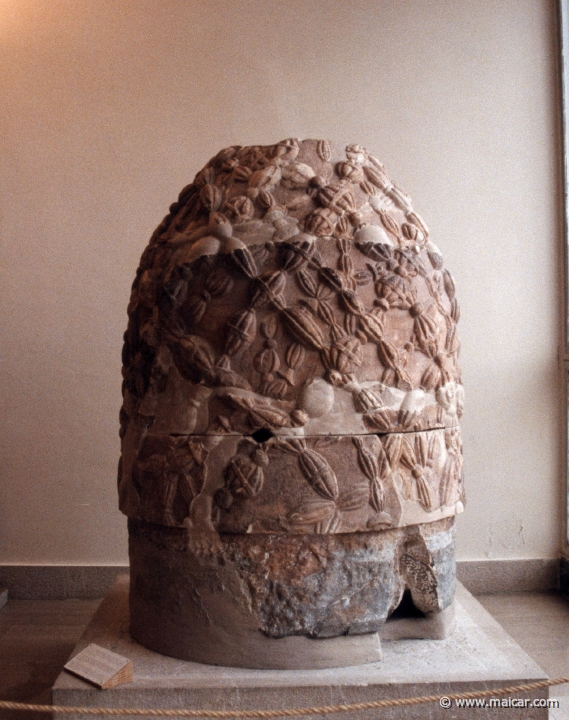
The Omphalos, symbol signifying that Delphi is the centre of the world: "… where Phoebus has at earth's navel his prophetic seat …" (Hermes. Euripides, Ion 5). 5932: The Omphalos, symbol of Delphi as centre of the world, was kept in the Temple of Apollo. Its surface is covered with a net of woolen bands.
|
|
|
These are the three maxims which the so-called Seven Sages, with laconic brevity, engraved upon a column at Delphi:
"Know yourself."
Some have believed that by this maxim they exhorted men and women to become educated and to acquire prudence. For, they say, those who are ignorant and thoughtless usually believe themselves to be very clever. And this disgraceful feature has been considered to be the worst of all kinds of ignorance, since such people consider wicked men to be good, and believe the honest to be of no account. It has also been remarked that some fail to follow this maxim by believing they own greater wealth than they do, or by believing they possess better physical qualities than it is the case, or by erring about the qualities of the soul, thinking themselves to be wiser than they are. Others have affirmed that to know oneself is to exploit the gifts one has got, and that only the man with self-knowledge will be able to love wisely. They have added that if nature has made him handsome, he should flash his best profile, that the good singer should sing, and the good drinker drink. This they believed to be Apollo's counsel.
"Nothing in excess."
Of this maxim it has been said that the Seven Sages wished mankind to observe due measure and proportion in all matters instead of making irrevocable decisions about any human affairs.
"A pledge, and ruin is near."
The Seven Sages are believed to declare with this maxim that ruin is near to such pledges as those made in relation to contracts and all other agreements in which money is involved. And Euripides is recorded to have said likewise. And yet it has been found pertinent to observe that by this maxim they do not mean to abstain from aiding a friend who needs help, but that they advise against strong decisions, against eagerness in giving pledges, and against decisions beyond recall. So also Diodorus:
"No pledge I give, observing well the loss
Which those incur who of the pledge are fond." (Diodorus Siculus, The Library of History 9.10.4).
It has also been remarked that whereas the treasures of Delphi have vanished, these maxims have been kept alive, and that being the fairest Pythian treasure, still survive stored up in the souls of men for all time.
|
|
|
|
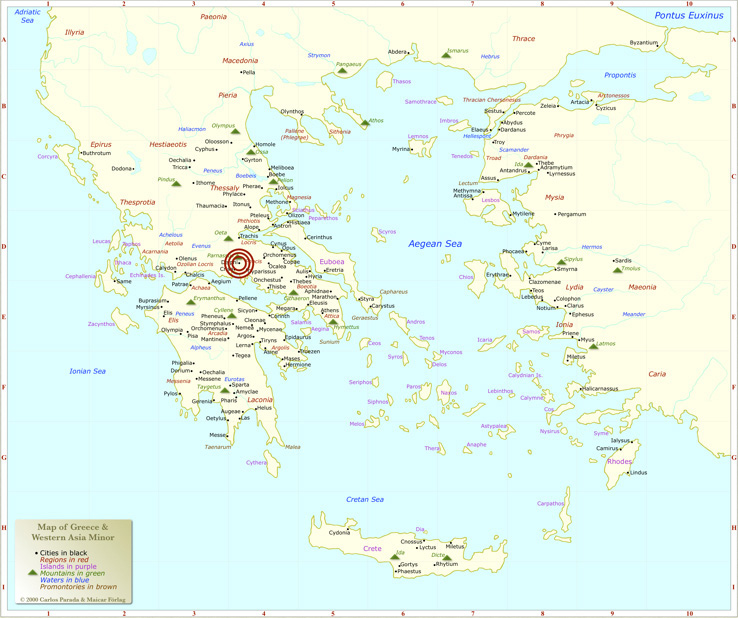
| Delphi is a city of Phocis in mainland Greece
that lies in the vale of the river Pleistus, and is
shut on one side by Mount Parnassus. The city
became famous because the oracle of Apollo was located in it.
Pytho
The celebrated city of Delphi, which on account
of its oracle, received countless visits during
many years, was originally called Pytho, and was
still called so at the time of the Trojan War, when it was held by Epistrophus 1 and Schedius 1, sons of Iphitus 2, son of Naubolus 1, or of Hippasus 3. Naubolus 1, who sometimes is called son of Hippasus 3, is otherwise called son of Ornytus 1. Some have said that the name Pytho comes from Pythes, son of Delphus, but others affirm that the city was called after Python, the dragon offspring of Gaia, who guarded Themis' Oracle at Delphi (more about this dragon at Leto).
Phocis and Parnassus
Phocis was called after Phocus 4, son of Ornytion, son of Sisyphus. Later Phocus 3 (son of Aeacus and Psamathe 1) and his sons settled in the land about Mount Parnassus. This mountain, they say, was called after Parnassus, son of Cleopompus and Cleodora 1 (a nymph), or as others say, son of Poseidon and Cleodora 1. Parnassus, who invented the art of foretelling the future from the flight of birds, is said to have founded the first city of Delphi, which was destroyed during the Flood of Deucalion 1.
Lycorus
Those who were able to escape the Flood followed the howls
of wolves and came to the top of Mount Parnassus.
And because they were saved by these beasts, they
called the new city Lycoreia, founding it above
Delphi. But others say that the city was named
after Lycorus, son of Apollo and Corycia, a
nymph after whom the Corycian cave was named.
Delphus
Lycorus, they say, had a son Hyamus, who had a daughter Celaeno 3, who had by Apollo a son Delphus, after whom the city received its famous name. But others have said that Delphus was son of Apollo and Thyia 1, a priestess of Dionysus 2 and the first to celebrate orgies in his
honour. She was daughter of Castalius, an autochthon from
Phocis. Still others say that Delphus was son of Apollo and Melaena,
daughter of the river god Cephisus. Her mother was
probably Liriope, who is also called mother of Narcissus.
First priests
It is said that after killing Python, a plague
for all men, Apollo established his oracle in the vicinity. He then
appointed Cretan sailors as the sanctuary's first
priests. For having seen a Cretan ship sailing from
Cnossus in Crete to Pylos in the Peloponnesus,
he turned himself into a dolphin and brought the
ship into the Crisaean Gulf, which is in the
Phocian section of the northern coast of the Gulf
of Corinth. So from
Crisa, the Cretan sailors conducted by Apollo came to Parnassus,
and having become priests of Apollo, they called the
city Delphi, for the god, having appeared to them
in the shape of a dolphin, told them:
"I sprang upon
the ship in the form of a dolphin, pray to me as Apollo Delphinius; also the altar itself shall be called Delphinius …" (Apollo to the Cretan
sailors. Homeric
Hymn to Pythian Apollo 495).
The oracle
Concerning the oracle, a Pythian priestess of Delphi says that the first to have prophetic powers was Gaia, who appointed Daphnis 4, a Mountain Nymph (Oread), as prophetess. After her came Themis, and then the Titaness Phoebe 1, who gave her seat at Delphi to Phoebus Apollo, called after her.
But others say that Gaia and Poseidon had the
oracle in common, and that it was Themis who gave the
oracle to Apollo as a
gift, and that Poseidon was compensated receiving Calaureia, that lies off Troezen, in exchange for
the oracle.
First prophetess
Phemonoe, they say, was the first prophetess of Apollo at Delphi, but the Delphian poetess Boeo says that the Hyperboreans Pagasus 1, Olen and Agyieus established the oracle of Apollo at Delphi and
that Olen was Apollo's
first prophet.
Temples
The most ancient temple was made of laurel, the
branches of which were brought from the laurel in
Tempe (a Thessalian valley through which the river
Peneus flows from the foot of Mount Pindus) where Apollo was once purified. According to the Delphians the second temple was
made by bees from bees-wax and feathers, though
others say that it was built by Pteras, who is
known for this. The third temple was made of bronze and some say
that it was destroyed through falling into a chasm
in the earth, but others have said that it was
melted by fire. The temple was then rebuilt a fourth time by Agamedes 1 and Trophonius, sons of King Erginus 1 of the Minyans by a young wife. Erginus 1, who was afterwards killed by Heracles 1, was son of Clymenus 2, son of Presbon, son of Phrixus 1 and Chalciope 2, daughter of King Aeetes of Colchis and the Oceanid Idyia. Phrixus 1 is son of Athamas 1 and Nephele 2.
|
|
Location of Delphi in Phocis, mainland Greece
|
|
Clever architects
Trophonius (who some say was son of Apollo and not of Erginus 1) and Agamedes 1, being regarded as talented architects, built both sanctuaries and palaces, as the temple in Delphi and the palace of wealthy Hyrieus, son of Poseidon and Alcyone 1, one of the PLEIADES. These two architects built Hyrieus treasury in such a way that they were able, by removing one of the stones from the outside, to drain Hyrieus' riches. The wealthy man was dumbfounded, for although all keys and seals were untampered the treasure kept shrinking. So he put traps to arrest anyone who should enter, and that is how Agamedes 1 was kept fast. But Trophonius, fearing that his brother should be tortured when day came and confess everything, cut off his head. Trophonius himself was later swallowed up by the earth.
Musical contests
Musical and poetical contests were held at
Delphi among singers and composers, and prizes were
offered to the best hymn to the god. A crown of
laurel was the prize for a Pythian victory on
account of the love of Apollo for Daphne 1, who turned
into a laurel tree, a branch of which the god made
into a wreath for himself.
The first contest was won by Chrysothemis 3, son of Carmanor, the man who purified Apollo after the latter
had killed the dragon Python, and the same who
received Apollo in his
house when the god consorted with Acalle
(Acacallis), the daughter of Minos 2.
The second contest was won by Philammon, who was
famous for his song and zither. Philammon was son
of Apollo by either Chione 2, Leuconoe 3, or Philonis, though others have called him son of Hephaestus. Chione 2 and Philonis are daughters of Daedalion (see Ceyx). Leuconoe 3 is daughter of Eosphorus, who is Lucifer, that is, the morning and evening star, or, in other words, the planet Venus. Eosphorus is son of Eos (Dawn). Philammon was
killed by an armed force of Phlegyans that marched
against the sanctuary at Delphi.
The third contest was won by Thamyris 1, son of Philammon and the Nymph Argiope 3. This Thamyris 1 is the same who loved Hyacinthus 1, being
the first man to fall in love with males. He is
also known for having engaged in a musical contest
with the MUSES. And when he lost, the wise daughters of Zeus took both his eyes and his minstrelsy in accordance with what they had agreed before the contest. In addition, he is still being punished in the Underworld for having opposed the goddesses.
Also Eleuther 1, son of Apollo and Aethusa
(daughter of Poseidon and the Pleiad Alcyone 1), is said to have won a Pythian victory for his loud and sweet voice. Eleuther 1 was father of Iasius 3, father of Chaeresilaus, father of Poemander, the founder of Tanagra in Boeotia.
The seat of the oracle
The seat of the oracle has been described as a cave hollowed out deep down in the earth with a narrow mouth, from which arose a breath that inspired a divine frenzy. Over the mouth a high tripod was placed, and when the Pythian priestess mounted it, she received the breath and uttered oracles, in both prose and verse. The oracle at Delphi was believed to be the most truthful, also because it was placed in the geographical centre of Hellas, or as some claimed, in the very center of the inhabited world. For this reason, Delphi came to be regarded as the navel of the earth, and many riches and spoils of war were deposited in treasure-houses there. So, for example, when the EPIGONI took Thebes, they sent a part of the booty to Delphi, besides the daughter of the seer Tiresias, who was a seeress herself. For they had sworn that, if they took the city, they would dedicate to Delphi the fairest of the spoils, and this was the daughter of Tiresias.
|
|
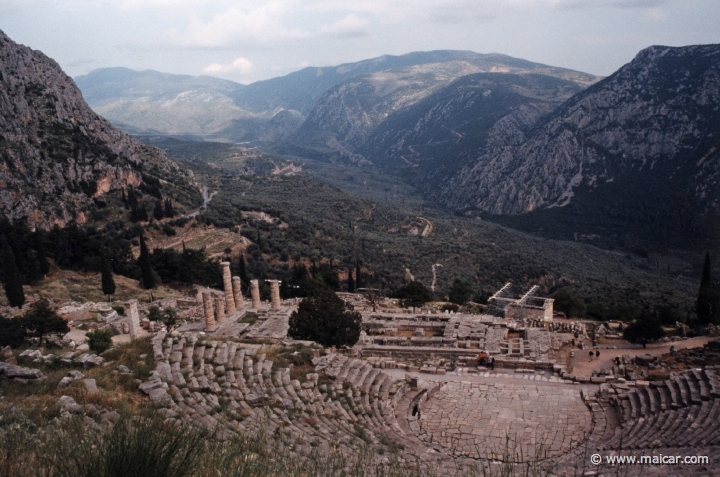
5921: View of Delphi, AD 2001: temple of Apollo, amphitheater, Treasure of the Athenians (being repaired).
|
|
The oracular site
The oracular shrine, they say, was accidentally
discovered by goats, and that is why goats were
regularly used as victims when consulting the
oracle. What came to be the forbidden sanctuary was
originally a chasm, and it is told that when goats
once came to that place and peered into the chasm,
they started leaping about in an unusual fashion,
emitting sounds completely different from what
goats normally emit. So when a herdsman approached the chasm to investigate the reason behind that strange phenomenon, he became as possessed as his goats, or even more, and began to foretell future events. Now, when everybody in the vicinity learned what was happening, they started coming in larger numbers visiting the chasm and testing its miraculous effects. Many became inspired and so the chasm was regarded as a marvel, and as the prophecy-giving shrine of Gaia herself. In this way,
and in a completely free manner, all who wished to
obtain a prophecy approached the chasm and made
their prophetic replies to one another. However, as an increasing number of people, not being able to control their frenzy, started to leap down into the chasm disappearing for ever, the people of the region decided to appoint one single prophetess for all and to have the oracles told by her. And then a contrivance with three supports (hence called a tripod) was devised so that the prophetess could safely mount it, and having become inspired, give prophecies to those who so desired or needed them. In ancient times, virgins delivered the oracles
because virgins, having their natural innocence
intact were supposed to guard the secrecy of the
oracles. But in historical times, as sexual
violence was offered against a prophetess, the
Delphians appointed an elderly woman to prophesy. Regular violence was also witnessed by the
Oracle of Delphi which itself was plotted against
many times. The Atrides Agamemnon and Menelaus, seized their uncle Thyestes 1 at Delphi, when they had come to inquire about him, and Thyestes 1, by chance, had come at the same time to consult about taking vengeance on his brother Atreus. Later in this
same city, Orestes 2 killed Neoptolemus as the latter was sacrificing to the god. And Heracles 1 was so
disappointed when the Pythian priestess did not
answer him by oracles, that he, after plundering
the temple, carried off the tripod to institute his
own oracle. Heracles 1 was however resisted by Apollo himself until Zeus parted them by throwing a thunderbolt.
|
| Examples of visits to Delphi |
|
|
Consultants and Visitors
Since the times of Deucalion 1, who
survived the Flood and
after coming to Mount Parnassus received
instructions from Themis as to how to populate the desolate earth, the
Oracle at Delphi received many inquiries, answering
them in both prose and verse. Even though the
oracles were clearly spoken by the Pythia, not
always were they properly understood.
|
|
|
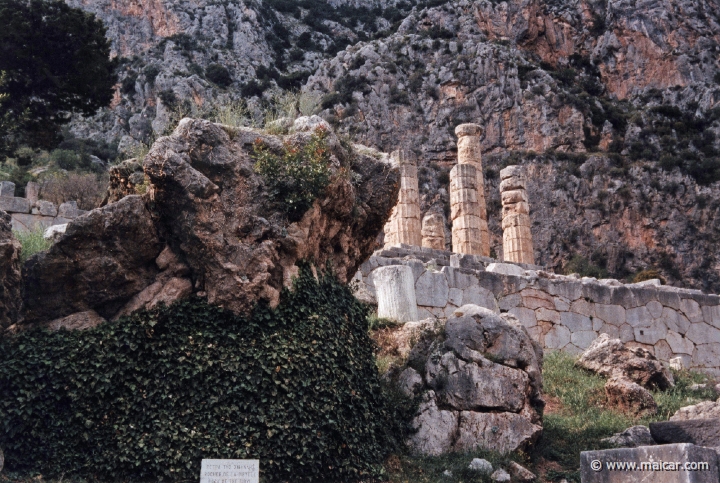
5916: The Rock of the Sibyl at Delphi. Behind are the remains of the Temple of Apollo
|
|
Manto 1. Manto 1, the daughter of Tiresias who was sent
to Delphi by the EPIGONI, was commanded by the Oracle to marry whomsoever she might meet, and the man she met was Rhacius (EPIG.3).
Aegeus 1 consulted the Oracle as to how he might have children, and he received the answer:
"The bulging
mouth of the wineskin, O best of men,
Loose not until thou hast reached the height of Athens." (Apollodorus, Library 3.15.6).
Erginus 1. King Erginus 1 of the Minyans, who was later
killed by Heracles 1,
inquired the Oracle about children, and having
received the answer
"Erginus, son
of Clymenus Presboniades,
Late thou camest seeking offspring, but even
now
To the old plough-tree put a new tip." (Pausanias, Description
of Greece 9.37.4).
… he took a young wife.
Cadmus founded Thebes, following
instructions he received from the oracle when he
came to inquire about his sister Europa. The oracle told
him not to worry about his sister and instead,
letting himself be guided by a cow, found a city in
the place where the animal should stop to rest.
Some say that Cadmus bought an ox which had a moon-shaped mark on its
side—as the oracle had predicted—and
driving it before him, he founded Thebes where the ox lay down to rest (Apd.3.4.1, Hyg.Fab.178, Pau.9.12.2).
Athamas 1 sent a servant to Delphi to inquire as how his kingdom might be delivered from the dearth, but the servant was bribed and brought back a false reply. Athamas 1, who having suffered two plots, had lost all his children, was then banished from Boeotia. Not knowing where to live he inquired the oracle, receiving the answer that he should dwell in whatever place he should be entertained by wild beasts (Apd.1.9.2).
Oedipus and Laius 1. Oedipus killed his
father Laius 1 in the
road to Delphi; the former came to inquire about
his parents and the latter about prodigies that
revealed that death at his son's hands was near.
Prior to that, an oracle had declared that if Laius 1 had a son by
Jocasta he would meet his death at his son's hands.
This is the reason why Oedipus was exposed (Eur.Phoe.17; Hyg.Fab.66; Pau.9.5.10; Pin.Oly.2.40; Soph.OT.714).
Orestes 2. It was the oracle at Delphi which gave Orestes 2 leave to kill
his mother and her lover, and later, when he was
pursued by the ERINYES,
the oracle advised him to sail to Tauris in order
to get rid of his mental disorder. At his return
from Tauris, Orestes 2 met at Delphi her sister Electra 2, who had come
to inquire about the fate of her brother. After his
death the oracle helped the Lacedaemonians to find
the place where the bones of this same Orestes 2 were buried.
Heracles 1. Alcides inquired at Delphi where he should
dwell, and he was called for the first time Heracles 1 by the
Pythian priestess who told him to dwell in Tiryns and serve Eurystheus. On a
later occasion, after having killed his wife and
children, Heracles 1 was told by the oracle that the cure for his
violent mental disease was for him to be sold as a
slave, and it was then that he was bought by
Omphale, Queen of Lydia in Asia Minor.
HERACLIDES. Also the HERACLIDES consulted the oracle, failing to understand the answers until three generations had passed. Their questions were related to their return to the Peloponnesus, which they first conquered but have to leave, when a year had elapsed, because of a plague (see HERACLIDES).
Robe & Necklace of Harmonia 1. The famous Robe & Necklace of Harmonia 1 were dedicated at Delphi by the sons of Phegeus 1, or as others say, by the sons of Alcmaeon 1 (see Robe & Necklace of Harmonia 1).
Podalirius. After the Trojan
War, Podalirius, son of Asclepius, settled in
the Carian Chersonese, following the instructions
he received at Delphi.
|
|
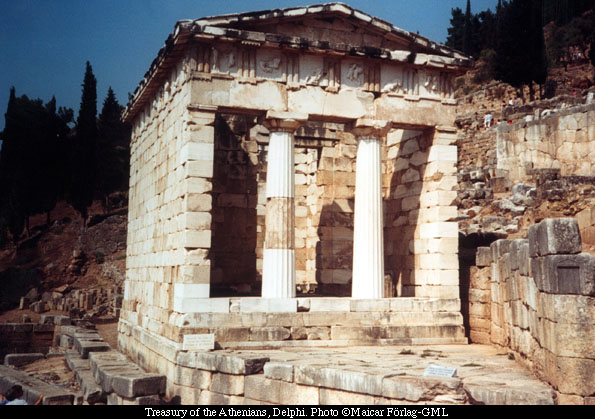
Remains of the treasury of
the Athenians at Delphi (AD 1983)
|
|
Inachus. Inachus' daughter Io told
her father that she had dreams by night, in which
visions told her to leave her maidenhood behind her
and yield to Zeus, who
loved her. Inachus then consulted the Oracle, and
the god speaking through it commanded him to banish
his daughter from home and land to roam over the
whole world, adding that if he disobeyed a
thunderbolt from Zeus would destroy his race (Aes.Pro.655ff.).
Aepytus 3. Aepytus 3, son of Elatus 2, son of Arcas 1, son of Zeus & Callisto, consulted the Oracle concerning the pregnancy of his adoptive daughter Evadne 3, to whom Pitana gave birth after having consorted with Poseidon. There he learned that Evadne 3's child was Apollo's, and when he came back the child Iamus had already seen the light. Iamus, who had been left on the ground by his distressed mother, was nursed by two serpents who gave him honey. From Iamus are descended the diviners called Iamides (Pau.6.2.5, Pin.Oly.6.28ff.).
Pelias 1. King Pelias 1 of
Iolcus was told by the Oracle to beware of a man
wearing one sandal. That man proved to be Jason, whom Pelias 1 sent to fetch the Golden Fleece, according to yet another oracle, which he said he had received and that urged him to make ready a ship for that purpose, and for the purpose of bringing the soul of Phrixus 1, son of Athamas 1 home (Apd.1.9.16, Hyg.Fab.12, Pin.Pyth.4.75, 4.164).
Tlepolemus 1, son of Heracles 1 and Astyoche 2, was beating a servant when Licymnius, bastard son of Electryon 1, son of Perseus 1 ran in between. Licymnius died and Tlepolemus 1 consulted the oracle, which told him to leave Argos and settle in Rhodes. Tlepolemus 1 became leader of the Rhodians against Troy (see also ACHAEAN LEADERS). (Apd.2.8.2, Dio.4.58.7, 5.59.5, Pin.Oly.7.32).
Acrisius. King Acrisius of Argos inquired of the oracle how he should get male
children, and the answer was that his daughter Danae would give birth to
a son who would kill him. That is why Danae was kept isolated,
but she nevertheless became pregnant and gave birth
to Perseus 1, who did kill Acrisius (Apd.2.4.1, Hyg.Fab.63).
Telephus. Also Telephus, son
of Heracles 1 and Auge 2, daughter of Aleus, son of Aphidas 1, son of Arcas 1, son of Zeus and Callisto, consulted the oracle concerning his parents, for he had been exposed as a child. On the ground of the information received at Delphi he went to Mysia in Asia Minor and was adopted by King Teuthras 1, or as others say, by Corythus 3. Telephus was wounded by Achilles when the
Achaeans attacked Mysia on their first expedition
against Troy. As the wound
would not heal, Telephus asked the
oracle, which replied that the wound would be cured
when the one who wounded him should turn physician.
That is why Telephus,
in a beggar's attire, sailed to Argos, where Achilles was staying,
begging to be healed by him and offering to show
the Achaeans the course to steer for Troy, as a reward. And Achilles healed him by scraping off the rust of his spear (Apd.Ep.3.20; Hyg.Fab.101).
Thyestes 1. In the course of the conflict between Atreus and his brother Thyestes 1, the latter consulted the Oracle about taking vengeance on his brother, which answered that he would be able to retaliate if he had intercourse with his own daughter (Apd.Ep.2.14; Hyg.Fab.87).
Alcmaeon 1 and the EPIGONI. When ten years after the expedition of the SEVEN, the EPIGONI marched against Thebes, they consulted the Oracle, which predicted victory if they fought under the leadership of Alcmaeon 1. This man, once he was chosen, consulted the Oracle himself regarding the campaign and the punishment of his mother, hateful Eriphyle. And the Oracle answered that he should make the expedition against Thebes, and also punish his mother, who was notorious for the bribes she had received (see Robe & Necklace of Harmonia 1). On account of those bribes Alcmaeon 1 killed his mother, but as this is a terrible kind of deed, he was followed by her ERINYES, which means that he went mad; for that is the effect of these avenging spirits. He then consulted the Oracle once more and was instructed to settle in a land that did not exist at the time of the murder. That is why Alcmaeon 1, having discovered the alluvial deposit of the river Achelous, settled there (Apd.3.7.2-5; Dio.4.66.3; Pau.8.24.8).
Theseus. When Theseus was
about to be sent to Crete as one of the youths that were to be offered to the Minotaur, he consulted
the Oracle, which commanded him to make Aphrodite his guide in
his journey. And this is certainly why Ariadne fell in love with him and revealed to him the secrets of the Labyrinth (Plu.The.18.2).
|
|
| Related sections |
Map of Greece, Apollo, Themis, Ion 1 |
|
|
Sources
Abbreviations |
Apd.1.4.1, 1.9.1, 2.4.12, 2.6.2, 3.4.1,
3.5.7, 3.7.4, 3.7.5, 3.7.6, 3.9.1; Apd.Ep.6.14, 6.16, 6.24;
Cal.Del.177; Hyg.Fab.2, 67, 120, 122,
123, 178, 190; Lib.Met.8; Nonn.4.290, 5.5;
Ov.Met.2.677, 9.332, 10.168, 11.304, 11.414.
|
|
|