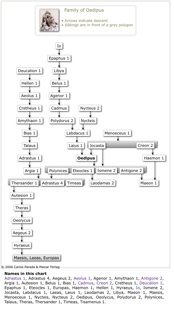
|
|
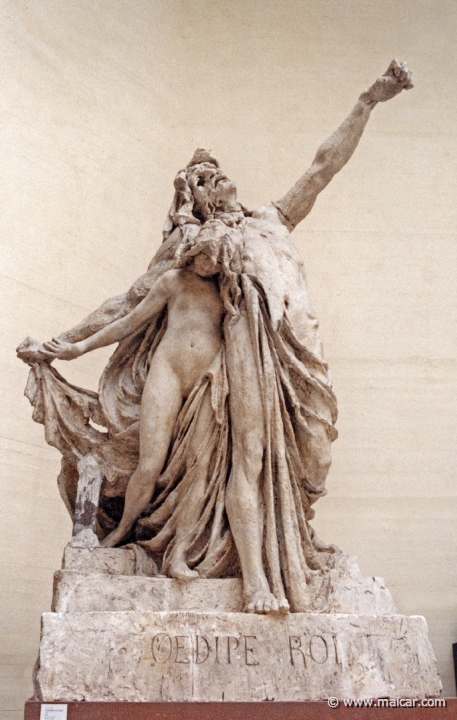
The blind Oedipus goes into exile led by his daughter Antigone 2. 1835: King Oedipus and Antigone. Statue by Rudolph Tegner, 1873-1950. Rudolph Tegners Museum, Denmark.
|
|
|
"Lord of Thebes, do not sow a furrow of children against the will of the gods; for if you beget a son, that child will kill you, and all your house shall wade through blood." (The Oracle of Delphi to Laius 1. Euripides, Phoenician Women 20).
"O citizens of a famous country, look at me; I am Oedipus, who solved the famous riddle, and was the greatest of men, I, who alone controlled the murderous Sphinx's power, am now myself driven from the land in dishonor and misery." (Oedipus. Euripides, Phoenician Women 1760).
Oedipus: I am the one who came into high songs of victory, because I guessed the baffling riddle of the girl, half-maiden.
Antigone 2: … Talk no more of past success. This misery was in store for you all the while, to become an exile from your country and die anywhere.
(Euripides, Phoenician Women 1730).
|
|
The child Oedipus was exposed by his parents on Mount Cithaeron, but having been found was adopted by Periboea 4, Queen of Corinth. He accidentally
killed his father, and after solving the riddle of
the Sphinx,
became King of Thebes,
where he unwittingly married his mother. Later, as
calamities accumulated, he was driven into exile
after having put out his eyes and cursed his sons.
The Times of
Oedipus
(for the times before him see Thebes)
Oedipus' birth
When Laius 1, having
become king of Thebes, married Jocasta, daughter of Menoeceus 1, an oracle came from Delphi warning
him not to have a son because that son was fated to
kill his own father. But Laius 1, who did not
share his predecessors' aversion to wine, disregarded the
oracle, and flushed with the divine beverage, had
intercourse with his wife, who conceived a son.
Oedipus abandoned and adopted When the child was born, however, Laius 1 remembered the oracle, and being determined to get rid of his newborn son, pierced his ankles with brooches or spikes before he gave him to a herdsman to expose him on Cithaeron, a mountain between Boeotia and Attica. There the horsemen of King Polybus 4 of Corinth found the child and brought him to the city, where the king's wife Periboea 4, after healing his ankles, adopted him and called him Oedipus, because of his swollen feet.
Oedipus in Corinth This is how Oedipus came to manhood in the court of King Polybus 4, and as he proved to be a corageous young man, his companions taunted him, out of envy, with not being the king's son because, they said, King Polybus 4 was so mild and Oedipus so assertive. So as the doubt grew in Oedipus' mind, he asked first Queen Periboea 4, but not being able to learn anything from her, he went to Delphi in order to
inquire of the oracle about his true parents. The
Oracle answered him not to go back to his native
land because, if he did, he would murder his father
and lie with his mother. Having heard the prophecy,
Oedipus left Delphi resolved to obey it, but believing himself to be
the son of the royal couple who had adopted him, he
did not return to Corinth.
First part of the oracle fulfilled
When on his way from Delphi, Oedipus drove his chariot in a certain narrow road—some say through the Cleft Road to Phocis—he met Laius 1, who was on his
own way to Delphi to inquire about some prodigies that had revealed that death at his son's hands was near, and to be reassured that the child he had exposed was dead. When they met in the narrow road, the king's herald Polyphontes 1 ordered Oedipus to give way; but as Oedipus delayed, the herald killed one of his horses, or as others say, the king urged on his own horses and a wheel grazed Oedipus' foot. In any case, the enraged Oedipus slew the herald, and dragging Laius 1 from the
chariot, killed him too.
The Sphinx
After the burial of Laius 1, performed by King Damasistratus of Plataea
(a city between Attica and Boeotia), Jocasta's
brother Creon 2 became
regent in Thebes. It is
during his rule that a new and heavy calamity
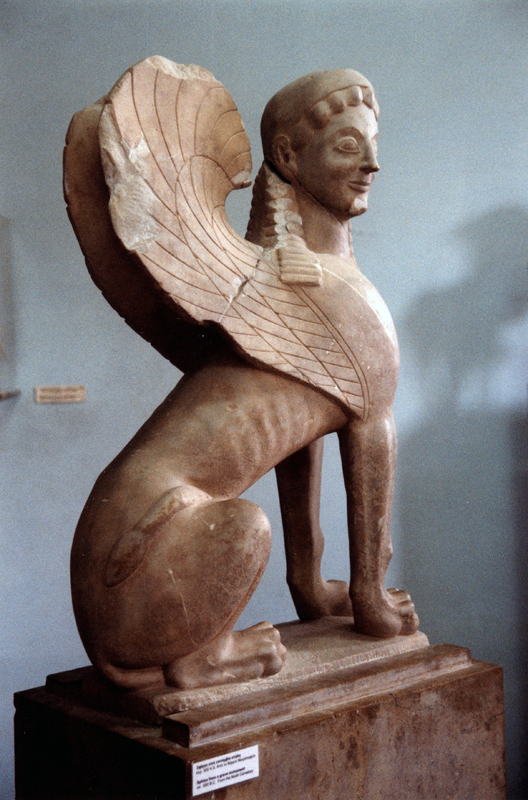
befell Thebes: the Sphinx appeared in Boeotia, laying waste the Theban fields and declaring that it would not depart unless someone interpreted the riddle that she proposed, and that, in the meantime, she would destroy whoever failed to give the correct answer. This beast—offspring of either Typhon or Orthus by Echidna—had the face of a woman, the breast, feet and tail of a lion, and the wings of a bird. She had learned her riddle from the MUSES, and sitting on
Mount Phicium, propounded it to any Theban willing
to solve it:
"What is that
which has one voice and yet becomes four-footed and
two-footed and three-footed?" (Apollodorus, Library 3.5.7).
Proclamation of the Government of Thebes
In order to face the threat, Creon 2 made a
proclamation throughout Hellas, promising that he
would give the kingdom of Thebes along with his
sister Jocasta in marriage to the person solving
the riddle of the Sphinx.
It was not difficult to find candidates; for when
it comes to acquiring power, property, and women,
there are always many disposed to go through no
matter which risks and atrocities. Accordingly,
many came and many were destroyed by the Sphinx,
who gobbled them up one after the other.
|
|
6616: Sphinx from a grave monument, ca. 550 BC. Archaeological Museum, Corinth.
|
|
Oedipus solves the riddle
After many men had perished, Oedipus heard the
proclamation and came to Thebes, declaring that he
had solved the riddle. So he went up, and meeting
the Sphinx, he asserted
that the riddle referred to man because as a little
child he is four-footed, going on his arms and
legs, as an adult he is two-footed, and as an old
man he gets a third limb in a staff. This Oedipus
knew only too well, who had his own feet mutilated,
and already used a staff; but on hearing the
solution, the Sphinx kept her promise and destroyed herself by throwing
herself down from the citadel.
Oedipus King
This is how, after having fulfilled the first part of the oracle by unwittingly killing his father, the way opened for him to fulfil the second part: Oedipus succeeded to the kingdom, and not knowing who she was, he married his own mother Jocasta, who in time gave him children: Polynices, Eteocles 1, Ismene 2, and Antigone 2, his own
offspring and yet his brothers and sisters.
Crisis persists Some think that Heaven dislikes this kind of
family configuration, and that because of it,
barrenness of crops and hunger fell on Thebes, along with a
plague that an oracle attributed to
blood-guiltiness related to the death of Laius 1.
The Seer's Panacea
The plague was worst, and in order to deliver
the city, the seer Tiresias was consulted. He then replied that if anyone died voluntarily for his country, the city would be free from the pestilence. It was then that brave Menoeceus 1—father of both Jocasta and Creon 2, and a firm
believer in seers and oracles indeed—having heard Tiresias's
pronouncement, threw himself from the walls of the
city, and died.
Oedipus "exposed" anew
Despite Menoeceus 1's self-sacrifice, the troubles continued. For when King Polybus 4 of Corinth, whom Oedipus believed to be his father, died, Queen Periboea 4 decided that the time had come to reveal the circumstances around Oedipus' adoption. And since when one talks then everybody else talks, and evidences appear where there before was but silence or denials, the man who had exposed the child Oedipus—Menoetes 4—came forth and recognized him by the scars on his feet and ankles as the son of Laius 1.
Also the seer Tiresias,
who recommended the sacrifice of Creon 2's father, and
who, on a later occasion advised the sacrifice of Creon 2's son, appears
now to have known the truth from the very
beginning:
"[Oedipus] will be discovered to be at once brother and father of the children … son and husband of the woman who bore him; heir to his father's bed, shedder of his father's blood." (Tiresias.
Sophocles, Oedipus
the King 455).
End of Oedipus' kingship
|
|
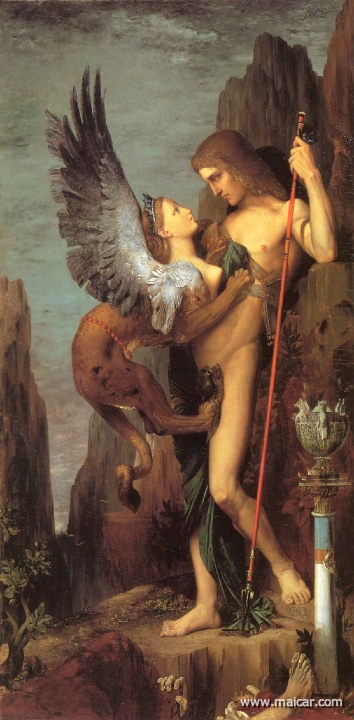
moreau003: Oedipus and the Sphinx. Painted by Gustave Moreau 1826-1898.
|
|
Having realized his plight, Oedipus tore the brooches from his mother's garment and blinded himself. He gave the kingdom for alternate years to his sons Polynices and Eteocles 1, but he also cursed them and was forced by them to go into exile, being then accompanied by his daughter Antigone 2. It has also been told that before Oedipus went
into exile, his sons hid him behind bars, hoping
that the disgrace might be forgotten, and that
while he still was living in the house, he made the
most unholy curses against his sons, praying that
they may divide their inheritance with a sharp
sword. Since the brothers were scared by these
curses, they agreed to alternate as kings, a deal
they did not respect. And it is told that when
Oedipus wished to leave Thebes he was not allowed
to do so, but when he grew accustomed to stay at
home, even as a prisoner, he was expelled. Jocasta,
his mother and wife, committed suicide; according
to some, she hanged herself in a noose, but others
say that she killed herself with a sword.
After abdication
Oedipus' abdication did not lead to peace and
prosperity in Thebes, but
to the destruction that comes from civil war and
foreign intervention. Oedipus' accursed sons did
not respect their deal concerning the kingdom, and
they indeed divided their inheritance by the sword.
The treasures of Thebes were taken out of the city, and soon the Argive
army of the SEVEN
AGAINST THEBES attacked the ill-fated town. The SEVEN were
defeated, and Creon 2 came to power again after the death of Oedipus'
sons. But ten years later, the sons of the SEVEN, known as the EPIGONI, captured Thebes.
Oedipus in exile
Oedipus took refuge at Colonus in Attica, where
he prayed in the precinct of the EUMENIDES
(ERINYES). There he was
hospitably received by King Theseus of Athens. It was while he
still was in Colonus that dissension grew between
his sons in Thebes. The younger brother Eteocles 1 banished Polynices, who being helped by King Adrastus 1 of Argos, raised the army of
the SEVEN. As war
approached, an oracle became known which stated
that victory would belong to those who had Oedipus
for ally. So first came Creon 2, on behalf of Eteocles 1, to persuade Oedipus to return to Thebes, or
if persuasion failed to take him back by force. Creon 2 attempted to
force Oedipus but was prevented by Theseus, who chose to
champion the rights of asylum. Later arrived
Polynices, promising his father to bring him back
to Thebes and
re-establish him if he would support his party. But
Polynices, who previously had expelled his father
from Thebes, received a
renewed curse from Oedipus:
"That city you will never storm, but first will fall, you and your brother, blood-imbrued. Such curse I lately launched against you both, such curse I now invoke to fight for me (…) This curse I leave you as my last bequest: Never to win by arms your native land, nor return to Argos, but by a kinman's hand to die and
slay." (Oedipus to Polynices. Sophocles, Oedipus
at Colonus 1385).
This curse came to be.
Death
Shortly after these encounters, Oedipus died at
Colonus, his grave becoming a protection for Athens. Some say that he
died of natural causes, others that he killed
himself, and still others believe that he died in Thebes. But the sight of this disgraced old man and
former king impressed the citizens of Colonus, who
reflected thus:
"Not to be born at all is best, far best that can befall. Next best, when born, with least delay to trace the backward way. For when youth passes with its giddy train, troubles on troubles follow, toils on toils … Last comes the worst and most abhorred stage of unregarded age, joyless, companionless and slow, of woes the crowning woe." (Citizens of Colonus. Sophocles, Oedipus
at Colonus 1225).
|