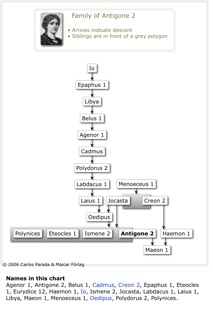
|
|
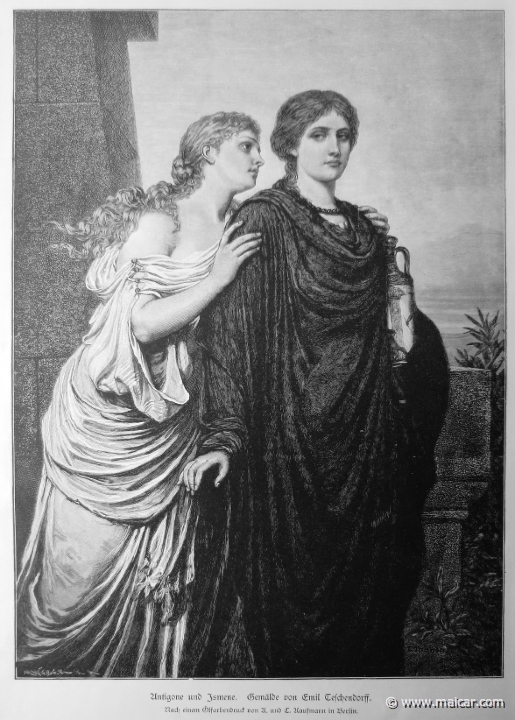
Antigone 2 (right), and her sister Ismene 2. print003: Emil Teschendorff (1823-?).
|
|
|
"If no one else will join me in burying him, then I will bury him, and chance what danger may result from burying my own brother. Nor am I ashamed to disobey thus and defy the State …" (Antigone 2. Aeschylus, Seven Against Thebes 1035).
Herald: Will you honour with burial a public enemy?
Antigone: The gods settled long since what honours are his right.
Herald: Not if since he plunged this land in mortal fear.
Antigone: He had been wronged. He was but answering wrong with wrong.
Herald: Because one man had wronged him, he attacked us all.
Antigone: Discord is the last of the gods to close an argument …
(Aeschylus, Seven Against Thebes 1052ff.).
|
|
Antigone 2 followed her blind father into exile, and only left him after his death at Colonus. When the SEVEN AGAINST
THEBES were defeated, the Theban regent
Creon 2 forbade the burial of the Argives and in particular that of Antigone 2's brother Polynices, who had been among those who attacked the city. Antigone 2, however, stole the body of Polynices and secretly buried him against the prohibition of Creon 2. And for that deed she was put to death.
Her father's fate
Oedipus suffered a cruel fate. Unwittingly, he killed his father and, having ascended the throne of Thebes, married his own mother and had children by her. And having learned that he had committed both murder and incest, he stabbed and drenched in blood his own eyes, as if believing they had been worthless. Yet Oedipus thought himself to be innocent, reasoning that his father was foredoomed by an oracle to die by his own son's hand and that therefore he, who chanced to meet his father and killed him believing him to be another man, was not to blame. Likewise, neither Oedipus nor Jocasta, whom he married, knew that they were mother and son. Therefore, he reasoned, they were not to blame, who had acted in ignorance.
Oedipus' curse
Nevertheless Oedipus, who was forced to abdicate when all this was known, met no sympathy. And his own sons Eteocles 1 and Polynices, either banished him or kept him hidden behind locked doors, hoping for oblivion to cover the dreadful story. But when Oedipus, on top of everything was forced to endure his sons' despise, he invoked upon them a wicked curse: that they should divide their inheritance by the sword.
Follows her father into exile
After uttering his terrible words, Oedipus went into exile guided in his blindness by her daughter Antigone 2, and arrived to Colonus, which is a small district in Attica under the jurisdiction of Athens. While they were there, dissension grew between his sons in Thebes. Eteocles 1 had seized power, and in violation of the covenant between the two princes, had banished his brother from the city. But exile did not mean misery for Polynices, who married an Argive princess, obtained foreign aid, and raised the army of the SEVEN AGAINST THEBES, with the help of which he hoped to regain the throne.
Creon 2 visits Oedipus
As the conflict hardened, Oedipus' daughter Ismene 2, riding on a colt and wearing a broad Thessalian hat, arrived with news from Thebes: An oracle, she informed, stated that victory would belong to him who had Oedipus on his side. And so, visitors came, in the eve of war, to see Oedipus at Colonus. First arrived, on behalf of Eteocles 1, Oedipus' brother-in-law Creon 2, hoping to persuade the former king to return to Thebes. And since scheming minds usually resort to sentimentality to achieve their goals, Creon 2, who uttered many solemn words about the fatherland, also declared:
"... I must be sorry for the sorrows of your Old Age, seeing you cast adrift like this, a vagabond, a beggar, with a sole companion at your side ..."
... adding as well what he believed to be moving words about the fate of Oedipus' daughter Antigone 2:
"Poor child! Could I ever have believed she would come to this, so young, condemned to endless tutelage of that sad ruined head, wasting her maidenhood in cheerless poverty; and so ill-protected against any rude assault." (Creon 2 to Oedipus. Sophocles, Oedipus at Colonus 744).
Oedipus curses his fatherland too
But neither patriotism nor considerations about the family who had betrayed him were in Oedipus agenda at the time:
"You shall not have your wish! This you shall have: My everlasting curse upon your country! As for my sons, their heritage in my land shall be no larger than the ground they die on." (Oedipus to Creon 2. Sophocles, Oedipus at Colonus 789).
Since there was no way to persuade the exiled king, Creon 2, going from words to deeds, arrested his daughters Antigone 2 and Ismene 2, believing that if he kept them as hostages, then Oedipus would follow. However, he was hindered by King Theseus of Athens, who, championing the rights of asylum, recovered the girls and ordered the intruder to leave the country.
Antigone 2 intercedes for her brother
Also Polynices came to Colonus, intending to promise Oedipus to bring him back to Thebes and restore him, if he would support his party. And when Oedipus refused to receive his son (for even his voice was hateful to the exiled king), Antigone 2 interceded, saying:
"It cannot hurt you to hear him: just the reverse: evil intentions betray themselves in speech. You are his father; and it cannot be right, even if he has done you the cruellest, wickedest wrong, for you to do him wrong again. Let him come." (Antigone 2 to Oedipus. Sophocles, Oedipus at Colonus 1187).
Oedipus agreed to meet his son, but Polynices received a renewed curse instead of support:
"May you never defeat your motherland; may you never return to Argos; may you, in dying, kill your banisher, and, killing, die by him who shares your blood." (Oedipus to Polynices. Sophocles, Oedipus at Colonus 1385).
These were Oedipus' pitiless curses; but no matter how heavy they lay on his heart, Polynices would not desist from attacking Thebes. Antigone 2 begged him to order his army back to Argos to save himself and the city from destruction, but to no avail. Oedipus died at Colonus, being buried in a place only known to King Theseus. And when Antigone 2 asked to see her father's grave, said the king:
"... It was your father's charge that no man should approach that place, nor any living voice he heard about the sacred tomb in which he sleeps ..." (Theseus to Antigone 2. Oedipus at Colonus 1760).
Curse fulfilled
After Antigone 2 and her sister Ismene 2 had returned to their motherland, the SEVEN AGAINST THEBES attacked the city and were utterly defeated. Only one of the seven leaders escaped with life. And the brothers' feud was settled according to Oedipus' curse, that is, Eteocles 1 and Polynices killed each other in the course of a single combat. This is why it is said:
"... A cruel and harsh divider of possessions is Ares ..." (Theban women. Aeschylus, Seven Against Thebes 941).
Creon 2 takes over
When now the princes who had refused to share their inheritance shared death instead, power reverted to the eternal regent Creon 2, who became once more the undisputed master of Thebes. This stern old man, brother of Oedipus' wife Jocasta, found it appropriate, as soon as his rule began, to conduct the postwar business with a hand of iron and a heart of stone. And so he ordered to give Eteocles 1, who had defended the city, all honourable rites of burial, but to leave Polynices, who had attacked it, unwept and unburied. This, he thought, would set an example of the iniquity of the invaders, showing their shame and ignominy. And he resolved that if anyone gave burial to Polynices, then the punishment for that disobedience should be death. This is what Creon 2 dictated, feeling that he is a true patriot who openly declares the dangers that threaten the people, putting his country above all other considerations. Polynices, he reasoned, came back from exile with an army, intending to burn and destroy his fatherland, and therefore:
"No man who is his country's enemy shall call himself my friend, because I know this, that our country is the ship that bears us safe, and that only when we sail her on a straight course can we make true friends ..." (Creon 2 to the Theban Elders. Sophocles, Antigone 189).
Creon 2 then denied Polynices a grave, resolving that he was to be left unburied to be eaten by dogs and vultures, who had raised his hand against the motherland. For Good, he thought, should pursue Evil beyond death, rewarding the faithful servant of his country, dead or alive, and punishing forever those who went against it.
Antigone 2 resists the law
However, some believe at times, as Antigone 2 did when she learned about the order, that such laws are unknown to Justice, who dwells with the gods. And even though government edicts are regarded as indispensable, they are sometimes resisted if they seem to overrule the unwritten and unalterable laws of Heaven. For these are everlasting, whereas those made by men come and go. This is why Antigone 2, who thought that she had a duty to the dead, decided to give his brother Polynices burial, contravening Creon 2, who refused to give equal honor to good and bad. Now, opposing the state is seldom recommended, and they are not few who, fearing the authorities' retaliation, prefer to yield. So when Ismene 2 learned that Antigone 2 planned to transgress the law and defy the king, she tried to dissuade her:
"... We are women; it is not for us to fight against men; our rulers are stronger than we, and we must obey in this, or in worse than this." (Ismene 2 to Antigone 2. Sophocles, Antigone 61).
But since fear had no place in Antigone 2's heart, she thought that to be convicted of reverence and die for it would rather be a great happiness, and that she should be content to lie beside the brother she loved. And as such a mood encourages contempt of life, she reproached her sister:
"Live, if you will; live, and defy the holiest laws of heaven" (Antigone 2 to Ismene 2. Sophocles, Antigone 76).
And once more Ismene 2 reminded her:
"I do not defy them; but I cannot act against the State. I am not strong enough." (Ismene 2 to Antigone 2. Sophocles, Antigone 79).
Antigone 2 went then by herself and covered with earth Polynices corpse, which lay in the plain where he had fallen dead, and made offerings to the dead. And while she was performing her rites, she was caught by sentries, who brought her in front of the king. When questioned, she, still lacking fear, did not deny the deed and openly declared that she was acquainted with the order forbidding such an act. And knowing that the penalty was death, she added that such a punishment would not cause her any pain since she had done what her heart and duty commanded her.
Defying authority
This is the kind of posture that a ruler finds most difficult to accept. For one thing are discrepancies of opinion, another a defiance of authority, and yet another to openly proclaim that authority is powerless when there is no fear of death:
"Would you do more than slay your prisoner?" (Antigone 2 to Creon 2. Sophocles, Antigone 497).
Tyrants, feeling that pride do not sit well upon subordinates, usually find this behavior both insulting and unbelievable, and they rely in the idea that this kind of over-obstinate spirit is soonest broken if met with enough determination. And as Creon 2 saw her gloating over her deed, seeming to believe that she could flout his orders with impunity, he decided to impose full punishment on her and on her sister Ismene 2, whom he suspected to be involved. Ismene 2 was then fetched and charged with the same crime as her sister. And although she, fearing the authorities, had opposed Antigone 2 and left her alone to perform the deed by herself, she now declared that she was as much to blame as her sister. Antigone 2 said that Ismene 2 had, in fact, not lend a hand, but Ismene 2 insisted in wishing to stand beside her in trial. And just as some wish for themselves alone the honour that comes with triumphs, Antigone 2 refused to share the honour of dying with the sister who had not helped her:
Antigone 2: ... I love no friend whose love is only words.
Ismene 2: O sister, sister, let me share your death. Share in the tribute of honour to him that is dead.
Antigone 2: You shall not die with me. Do not claim deeds to which you did not put your hand. One death is enough.
Ismene 2: Ah, misery! Will I fall short of sharing your fate?
Antigone 2: Your choice was to live, it was mine to die... (Sophocles, Antigone 544ff.).
On hearing this, Creon 2 believed both girls to have gone mad. Mortals do not usually claim their right to die. Instead they do whatever is needed to delay, no matter for how little time, the arrival of Death. Nevertheless Creon 2, disregarding the whole scene, still believed that the death penalty would restore authority, and so he condemned Antigone 2.
Father and son
Now, this girl was the bride of Creon 2's son Haemon 1. Some fathers might reflect upon the consequences of taking the girl from their own son's arms. But not Creon 2, who believed that a father's will should always take the first place within a son's heart, and that a son's duty is to be ready to strike down his father's foes and love his father's friends. So, adding up arguments and piling them on his creed, Creon 2 took upon himself the ungrateful task of persuading his son of the necessity to send his young bride to the next world. Having met Haemon 1, he spoke of treason to the State, committed by the girl, and explained how he could not make himself a traitor too by being tolerant. He also lectured about how those whom the State appoints must be obeyed, be they right or wrong, and described how States are devoured by disobedience, and how homes are laid in ruins and armies defeated by it. In a nutshell:
"... He that rules his household, without a doubt, will make the wisest king, or for that matter, the staunchest subject. He will be the man you can depend on in the storm of war, the faithfullest comrade in the day of battle." (Creon 2 to Haemon 1. Sophocles, Antigone 669).
and
"So let her call on Zeus who protects kindred blood. If I am to foster my own kin to spurn order, surely I will do the same for outsiders. For whoever shows his excellence in the case of his own household will be found righteous in his city as well." (Creon 2 to Haemon 1. Sophocles, Antigone 660).
Such principles did not persuade Haemon 1. On the contrary, he thought that his father was on the verge of committing an atrocity by dooming Antigone 2 to a cruel death for the action, rather honourable, of burying a brother. And as he deemed this act likely to dishonour his own father, Haemon 1 exhorted him to think twice, reminding him that it is no weakness for the wise man to learn when he is wrong, or know when to yield. Now, just as authority is reluctant to receive instructions from subordinates, senior citizens do not like to take lessons from young fellows. And so Creon 2, paying less heed to the matter of right and wrong than to the matter of age, found his son's opinions despicable, and proceeded forward:
"I'll have her taken to a desert place where no man ever walked, and there walled up inside a cave, alive ..." (Creon 2 to the Theban Elders. Sophocles, Antigone 774).
Antigone 2 meets death
So, though on still on earth, Antigone 2 had her life ended from the day she was closed up in her tomb. And before leaving, she explained why she would never have done such a sacrifice for a husband or son:
"For why? I could have had another husband and by him other sons, if one were lost; but, father and mother lost, where would I get another brother?" (Antigone 2. Sophocles, Antigone 909).
Consequences of Creon 2's enforcement of authority
This is how Creon 2 enforced law and authority and, as he saw it, his own position as head of the State. But soon he learned that his son Haemon 1 had killed himself, following his bride to death. And after him, his wife Eurydice 12 took her own life with a sword, when she learned that her son was dead. For, as they say, riches and rank are empty where there is no joy, being like unsubstantial shadows compared with happiness of heart. And the crown of happiness, they say, is wisdom, whereas arrogant men suffer, either in public or in private, heavy blows. For whatever folly, also that which cares for principles too much, leads to sorrow and confusion. That is why Creon 2 later complained:
"Lead me away, I beg you, a rash, useless man. I have murdered you, son, unwittingly, and you, too, my wife. I know not where I should turn, where look for help." (Creon 2 to the Theban Elders. Sophocles, Antigone 1339).
Others with identical name
Antigone 1, daughter of King Eurythion 2 of Phthia, married Peleus and had by him a daughter Polydora 1, mother of Menesthius 1 (see ACHAEANS).
Antigone 3, daughter of King Laomedon 1 of Troy, set herself against Hera, and the goddess turned her into a stork.
Additional notes about Maeon 1
(Motivated by a question posed by students from Edison High School, Nov. 2000)
- The mythographer Hyginus says in Fabula 72 that Oedipus' daughter Antigone 2 and her husband Haemon 1 had a child. Hyginus does not mention the child's name. This version is followed by Robert Graves in his book The Greek Myths (Penguin 1986 [1955]).
- The name Maeon, son of Haemon, is mentioned in Homer, The Iliad 4.394; Apollodorus 3.6.5; and Statius, Thebaid 2.693. The Theban Maeon is known for having ambushed Tydeus 2, father of Diomedes 2, at the time of the war of the SEVEN AGAINST THEBES. All of Maeon's comrades were killed but he escaped with life, and later buried Tydeus 2.
Now:
1) There are conflicting versions concerning Oedipus' daughter Antigone 2, who perhaps gave birth to a son, or perhaps not.
2) According to Apollodorus 3.5.8, Haemon 1, son of Creon 2, had been killed by the Sphinx, so he should not be alive at the time of the war of the SEVEN AGAINST THEBES which came afterwards; accordingly he could not have killed himself at Antigone 2's tomb (Sophocles, Antigone 1175), as a result of the Theban internal conflicts after that war. But see below Tripp's solution of Haemon's case.
3) There existed a Theban called Maeon, son of one Haemon, and contemporary of Antigone 2 and Haemon 1 (Homer, The Iliad 4.394; Apollodorus 3.6.5; Statius, Thebaid 2.693).
4) This Maeon was Maeon 1 and son of Haemon 1 and Antigone 2. Haemon 1 is the only Theban we know with that name, and he and Maeon 1 were contemporaries. Pierre Grimal says in his Dictionnaire de la Mythologie Grecque et Romaine (Presses Universitaires de France, 1986 [1951]), that Euripides, in his lost tragedy Antigone, affirmed that this Maeon was Maeon 1, son of Haemon 1 and Antigone 2, giving as source A. Nauck page 322 (Tragicorum Graecorum Fragmenta). I have not consulted this source, but Grimal claims to be supported by Euripides in TGF. Pierre Grimal presents Maeon 1 as son of Haemon 1 and Antigone 2 (entry Maeon), whereas Graves follows Hyginus Fabulae 72 in his account (The Greek Myths 106.m) and do not mention the name of the child.
If Maeon 1 was son of Haemon 1 and Antigone 2, then he was already grown up at the time of the war of the SEVEN AGAINST THEBES, which does not coincide with the account in Hyginus, Fabulae 72.
Edward Tripp in his Dictionary of Classical Mythology (Collins 1970) wishes to distinguish between the Haemon whom the Sphinx killed, and the Haemon who was betrothed to Antigone 2, saying that both had the same father (Creon 2) and adding: "One of the Haemons was said to be the father of Maeon."
"The legends of Greece generally have different forms, and this is particularly true of genealogy." (Pausanias, Description of Greece 8.53.5).