 |
|
|
|
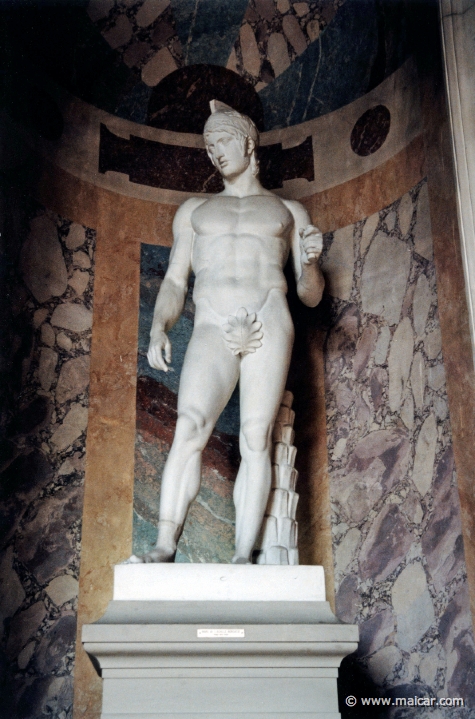
4232: Ares Borghese, 420 BC. Musée de Picardie, Amiens.
|
|
|
"Most hateful to me are
you of all gods on Olympus, for ever is strife dear
to you and wars and fightings." (Zeus to Ares. Homer,
Iliad 5.890).
|
|
Ares is the mighty but hated man-slaying god of war and warriors. This blood-stained homicide god is often followed in the fight by his sons Phobus 1 and Deimos (Terror and Fear, see below). But as standpoints are many, he has also been called "Saviour of Cities", "Defence of Olympus", "Father of Victory", "Ally of Themis", and "Leader of Righteous Men".
Ares to forget
As the Bronze Age of man approached, and men became oblivious, a new generation of gods was born: The MUSES and Apollo, to remind man of himself. Artemis, to remind him of the sacredness and purity of nature. Athena and the HORAE, to remind him of the virtues of order, industriousness and political sense. The gods honor Memory. But to assist the coming madness of man, his brutality, and his bloodthirst, came Ares, so that also wretches who delight in murder would not be altogether without consolation. For even coward deeds may seem feats of bravery thanks to this god. But he reminds men of nothing as he incites them to run riot, kill, burn, and rape, but submerges them in mud and blood, making them forget the beauties of heaven and earth. This misery is one of the many forms of oblivion.
Hated by gods, wounded by men
And since Ares "regards no law"—barely distinguishing between fighting camps, and caring nothing for any of them—he is hated, not only by men, but also by the gods. This is why Athena told Diomedes 2 in the battlefield:
"Drive up, and do not stop to think 'This is the redoubtable War-god', but let him have it at short range. Look at the maniac over there! Do you know that only the other day that pestilential, double-dealing villain gave Hera and myself his word to fight against the Trojans and help the Argives? And now he has forgotten all he said and is fighting on the Trojan side." (Athena to Diomedes 2. Homer, Iliad 5.830).
That day Athena, wearing in the battlefield the helmet of Hades which made her invisible, assisted Diomedes 2. And the latter wounded Ares, who cried as loud as ten thousand men. The blow made the god return to Olympus, where Paeeon, who knew the remedies for all things, healed his wound. Some say that Ares had been wounded in battle before, when the god helped the Pylians in their war against Heracles 1, who wounded him in the thigh. But Aphrodite did love Ares, and it is told that she, out of jealousy, caused Eos to be perpetually in love for having bedded with the god. Aphrodite was Ares' lover, but her husband Hephaestus, by means of a clever device of his own invention, trapped the two naked lovers in bed, exposing them to the laughter of the other gods. This invention was a chain of adamant which he put around the bed to catch the lovers.
The first to be tried for murder
It is told that Ares was the first to be tried for murder—for having killed Halirrhothius, son of Poseidon. The man had attempted to violate Alcippe 1, daughter of Ares, but was detected and killed by her father. Ares was then impeached by Poseidon and tried in the Areopagus (Hill of Ares) before the twelve gods, but was acquitted. In this same place, Orestes 2 was tried for killing his mother.
|
|
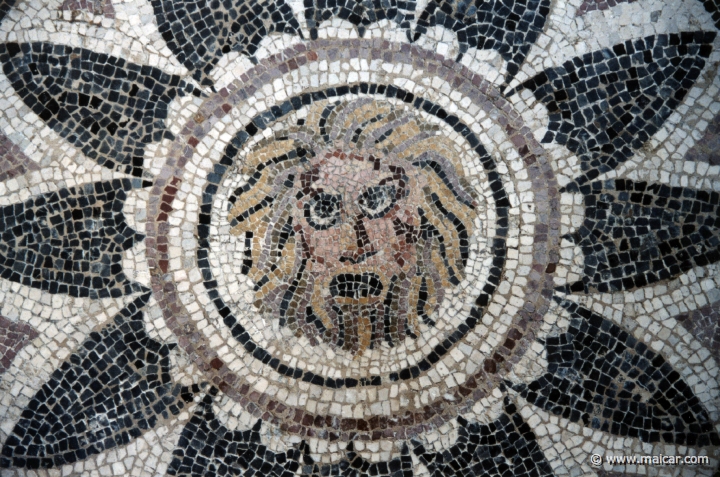
Phobus 1. 8205: Mask of Phobos (fear) within a radiating petal design. 4th century AD. From Halicarnassus. British Museum.
|
|
Ares in prison
It is also told that when the ALOADS (see Zeus) atacked heaven, they set Ossa on Olympus and Pelion on Ossa, threatening, by means of these mountains, to ascend up to heaven. In the course of this war, the ALOADS put Ares in bonds. He lay bound for thirteen months in a brazen jar, but was later rescued by Hermes as his bonds were about to overpower him.
Deimos and Phobus 1
Deimos and Phobus 1 (Fear and Terror) appear in battle following their father. They are usually regarded as personifications of these emotions, and have no myth of their own. Yet Theseus is said to have sacrificed to Phobus 1 before joining battle with the AMAZONS, daughters of Ares. They could also appear in company of Enyo 2 (Goddess of Warfare), sacker of cities, sister of War (when Troy was being taken Enyo 2, revelling in the drunkenness of unmixed blood, danced all night throughout the city, like a hurricane), or they could be seen together with Eris (Discord), or the ERINYES (Avenging Spirits).
|
| Family |
|
|
|
|
|
|
|
|
|
"a)", "b)" etc. stand for opposite versions; "---" means unknown.
Aerope 2 died while giving birth, but Ares made her dead body able to breast-feed the baby.
|
|
|
|
See text above.
|
|
|
|
A Thracian. He is one of the
CALYDONIAN
HUNTERS.
|
|
|
|
Harmonia 2 was a Nymph who was loved by Ares in the glens of the Acmonian wood in the country of the AMAZONS.
|
|
|
|
Ascalaphus 1 was one of the ARGONAUTS, one of the
SUITORS OF HELEN,
and one of the
ACHAEAN LEADERS.
|
|
|
|
Cycnus 2 challenged Heracles 1 to single
combat near the river Echedorus in Macedonia, but a
thunderbolt parted the combatants.
|
|
|
|
Cycnus 3 challenged Heracles 1 to single
combat, and was killed by him.
|
|
|
|
See main text above.
|
|
|
|
Cyrene was reared near
Mount Pelion and was of surpassing beauty.
Apollo found her without
spears wrestling alone with a lion, and carried her
off to that part of the land of Libya where in
later times he founded a city and named it
Cyrene, after her.
Diomedes 1 was King of the Bistonians in Thrace. He owned man-eating mares. One of the LABOURS of
Heracles 1 was to
bring these mares from Thrace to
Mycenae. Diomedes 1 was killed by Heracles 1.
|
|
|
|
This dragon guarded the spring of Ares near the
site of Thebes.
Cadmus killed it, and
sowed its teeth, and from them rose from the ground
the armed men called
SPARTI.
|
|
|
|
Dryas 2 fought together with other LAPITHS against the
CENTAURS. He is also
counted among the
CALYDONIAN
HUNTERS. Dryas 2 was killed, though innocent, by his brother Tereus 1, who suspected him of having the intention of killing his son Itys 1.
|
|
|
|
Evenus 2 was father of Marpessa 1. She was carried off by Idas 2, the Messenian who killed one of the DIOSCURI from a
winged chariot that he had received from
Poseidon. When Evenus 2 could not catch Idas 2, who had carried off Marpessa 1, he threw himself into the river Lycormas which is called Evenus after him.
|
|
|
|
See also Robe & Necklace of Harmonia 1.
|
|
|
|
Ialmenus 1 is one of the ARGONAUTS, one of the
SUITORS OF HELEN,
one of the ACHAEAN
LEADERS, and one of those who hid inside the
WOODEN HORSE.
|
|
|
|
Lycimnius, usually called the bastard son of King Electryon 1 of Mycenae, is the only one of the brothers who did not die at the hands of the sons of Pterelaus. He was killed by Tlepolemus 1, who was beating a servant when Licymnius ran in between.
|
|
|
|
Triteia was a priestess of
Athena, and Melanippus 6, founder of the city in Achaea, called it Triteia
after his mother.
|
|
|
|
When Meleager was
seven days old, the
MOERAE came and declared
that he should die when the brand burning on the
hearth was burnt out. On hearing that, his mother
snatched up the brand and deposited it in a chest.
But later, when
Meleager killed his
mother's brothers, Althaea kindled the brand out of
grief. Meleager was one
of the ARGONAUTS, and
one of the
CALYDONIAN
HUNTERS.
|
|
|
|
|
|
|
|
|
|
|
|
Nisus 1 was king of Megara when this city was
captured by the fleet of King
Minos 2 of
Crete. His life depended on a purple lock of hair that he had on his head, but his daughter Scylla 2, having fallen in love with Minos 2, pulled it out and Nisus 1 died.
|
|
|
|
Father of Orpheus.
|
|
|
|
Sterope 3 is one of the PLEIADES. Harpina is a
daughter of the river god Asopus.
Oenomaus 1 was the
king of Pisa who used to put to death his
daughter's suitors, and nail their heads to his
house, as an oracle had said that he would die
whenever his daughter should marry.
|
|
|
|
Protogenia 2 is daughter of Calydon, the eponym of the city in Aetolia.
|
|
|
|
Parthenopaeus is one of the
SEVEN AGAINST
THEBES, assailant of the Borraean (Electran)
Gate at Thebes.
|
|
|
|
Phlegyas 1 was king of the Phlegyans in Boeotia.
|
|
|

Phobus 1
|
See main text above.
|
|
|
|
A Calydonian, father of Oeneus 2.
|
|
|
|
|
|
|
|
See Romulus.
|
|
|
|
Romulus was suckled
by a she-wolf, founded Rome and gave his name to
the entire nation. As he saw twelve birds flying in
the sky and his brother only six,
Romulus was accorded the
government of the city.
|
|
|
|
A Thracian, who helped Pandion 2 in his war against Labdacus, and having received one of his daughters seduced the other, pretending the first was dead. Both became victims of his cruelty.
|
|
|
|
When Thestius 1 claimed the skin of the Calydonian Boar on the ground that Iphiclus 2 had been the first to hit it, war broke out between the Curetes (including the sons of Thestius 1) and the Calydonians (including Meleager). When
Tyndareus and Icarius 1 were expelled from Lacedaemon, they were received by Thestius 1, and allied themselves with him in the war which he waged with his neighbors.
|
|
|
|
|
|
|
|
Eos is Dawn. Because she
had lain with Ares,
Aphrodite caused her
to be perpetually in love.
|
|
|
|
|
|
|
Genealogical Charts
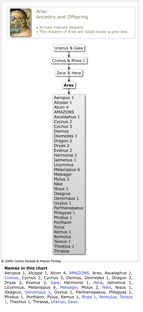
Names in this chart: Aeropus 1, Alcippe 1, Alcon 4, AMAZONS, Ares, Ascalaphus 1, Cronos, Cycnus 2, Cycnus 3, Deimos, Diomedes 1, Dragon 2, Dryas 2, Evenus 2, Gaia, Harmonia 1, Hera, Ialmenus 1, Licymnius, Melanippus 6, Meleager, Molus 2, Nike, Nisus 1, Oeagrus, Oenomaus 1, Oxylus 1, Parthenopaeus, Phlegyas 1, Phobus 1, Porthaon, Pylus, Remus 1, Rhea 1,
Romulus,
Tereus 1, Thestius 1, Thrassa, Uranus,
Zeus.
|
|
|
| Related sections |
METAMORPHOSES, ZEUS' OFFSPRING, OLYMPIANS |
|
|
Sources
Abbreviations |
Apd.1.3.1, 1.4.4, 1.7.7-8, 1.8.1-3, 1.9.16, 2.4.5-6, 2.5.8, 2.5.11, 2.7.7, 3.4.1, 3.5.4-5, 3.9.2, 3.10.8, 3.14.2, 3.14.8.; Apd.Ep.2.7; Arg.2.990; DH.2.2.3; Dio.4.21.1, 4.73.6, 5 5.48.2, Eur.Bacc.1357; Hes.The.922, 933, 975; Hom.Ar.8.4; Hom.Il.2.660, 2.494ff., 2.512, 5.761, 5.900; Hyg.Ast.2.21; Hyg.Fab.14, 45, 71, 84, 173, 198, 242, 252; Cal.Ze.76; Lib.Met.2, 21; Nonn.2.415, 4.358ff., 4.61, 5.101, 5.130, 13.428; Ov.Fast.1.199; Ov.Met.8.145; Pau.5.22.6, 6.22.4, 7.22.8, 8.44.7-8, 9.36.1-4; Plu.PS.40; Plu.Rom.2.3-6; Vir.Aen.1.273, 6.777; Stat.Theb.3.229, 4.309; Strab.5.3.2.
|
|
|


