Greek Mythology Link - by Carlos Parada, author of Genealogical Guide to Greek Mythology

| Biographies | GROUPS | Places & Peoples | Dictionary | Images | Albums | Topics | Search | Downloads |

SPARTI

ESPARTOI


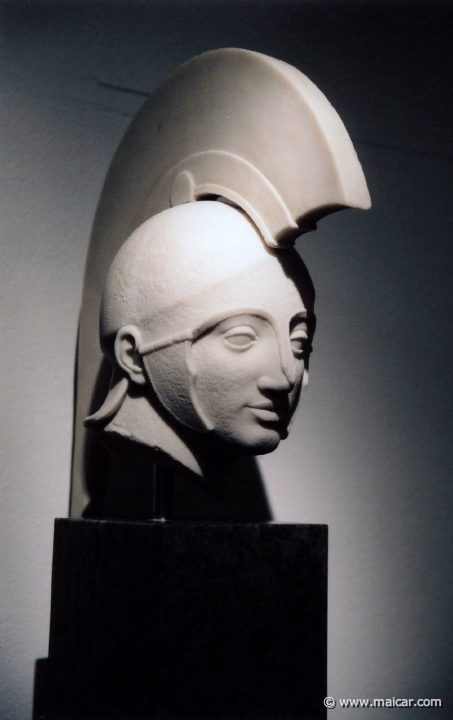
Head of warrior | Cabeza de un guerrero

Relevant links

Enlaces relacionados

"And Agenor's son Cadmus, sowed the teeth on the Aonian plains and founded an earthborn people ..." [Apollonius Rhodius, Argonautica 3.1185]

«Y Cadmo, el hijo de Agenor, sembró las semillas en las llanuras de Aonia, y dio origen a los nacidos del suelo...» [Apolonio de Rodas, Argonáutica 3.1185]


The SPARTI are the armed men who rose from the teeth of the dragon of Ares that had been sown by Cadmus. Most of them slew each other, but some survived. A new phalanx of SPARTI came to life when, much later, half of the teeth that had been given by Athena to King Aeetes of Colchis, were sown by Jason, captain of the ARGONAUTS. Of these, who also staged a massacre destroying themselves, no one survived, but of the Theban SPARTI five are said to have survived [see below]. Descendants of the SPARTI were Menoeceus 1, Creon 2, and the latter's sons.


Los ESPARTOI son los hombres armados que nacieron de los dientes del dragón de Ares, sembrados por Cadmo. Una nueva falange de ESPARTOI vio la luz tiempo después, cuando la mitad de los dientes, que Atenea le había dado al rey Eetes de Cólquide, fueron sembrados por Jasón, el capitán de los ARGONAUTAS. De estos últimos, ninguno sobrevivió la mutua masacre a la que ellos mismos se entregaron. Pero de los ESPARTOI tebanos, se dice que sobrevivieron cinco [ver más abajo]. Eran descendientes de los ESPARTOI, Meneceo 1, Creonte 2, y los hijos de éste.


Cadmus' men killed by the dragon

When still at the dawn of the short Heroic Age (for these events took place aproximately 200 years before the Trojan War) Cadmus was about to found the city of Thebes in Boeotia in mainland Greece, some of his men were taken by surprised, and killed by a dragon sacred to Ares (or perhaps the god's own offspring) when they came to a spring, Dirce or Castalia, to draw water.

El dragón mata a los hombres de Cadmo

Al comienzo de la breve Edad Heroica (pues estos acontecimientos tuvieron lugar unos doscientos años antes de la Guerra de Troya), cuando Cadmo se aprestaba a fundar la ciudad de Tebas, en Beocia (Grecia continental), algunos de sus compañeros fueron sorprendidos y muertos por un dragón que le era sagrado a Ares (o que acaso fuera descendencia suya), al ir a buscar agua a una vertiente—Dirce, o tal vez Castalia.

Cadmus kills the dragon

Cadmus then, having gone in search of his comrades, discovered the dragon of Ares and killed it, a deed that costed him dear, for he was forced to serve Ares during an eternal year, which is eight years of our reckoning, and in addition he and his wife were transformed into serpents at the end of their lives, many years later.

Cadmo mata al dragón

Al salir a buscar a sus camaradas, descubrió Cadmo al dragón de Ares, y lo mató. Esta muerte le costó cara, porque se vio obligado a servir al dios durante un año eterno, que corresponde a ocho de los nuestros, y además Cadmo y su mujer fueron convertidos en serpientes, al final de sus vidas, muchos años después.

The dragon's teeth

Cadmus was adviced by Athena to sow the teeth of the dragon of Ares, and when he did so, men in full armour rose from the earth. These SPARTI, sown-men, came up from the earth brawling for nothing, and fighting each other to death. Others have said that Cadmus provoked them to fight each other by casting stones, the SPARTI supposing, in their ignorance, that they were being pelted by each other.

Los dientes del dragón

Atenea le aconsejó a Cadmo que sembrara los dientes del dragón de Ares, y, al hacer lo que le decía, vio como hombres armados surgían del suelo. Estos ESPARTOI—hombres sembrados—, no bien salían del suelo se ponían a reñir sin motivo alguno, y luchaban a muerte entre sí. Según algunos, Cadmo provocaba reyertas entre ellos, arrojando piedras, y los ESPARTOI suponían, en su ignorancia, que alguno de ellos lo hacía.

They wish to fight in peace

It is also told that the SPARTI themselves exhorted Cadmus, who was preparing to take his arms, not to intervene:

"Take not your arms ... and take no part in our fratricidal strife." [One of the SPARTI to Cadmus. Ovid, Metamorphoses 3.126]

Deseaban pelearse en paz

Se cuenta también que los propios ESPARTOI exhortaron a Cadmo, que ya iba por sus armas, que se abstuviera de intervenir:

«No cojas tus armas...y no intervengas en nuestra lucha fratricida.» [Uno de los ESPARTOI a Cadmo. Ovidio, Metamorfosis 3.126]

Historical descendant of the SPARTI

The Theban commander Epaminondas, who in historical times crushed the invading Spartan army at Leuctra, dying of wounds several years later at Mantinea (362 BC), and whose innovative strategic ideas put an end to the military supremacy of Sparta, was believed to belong to the race of the SPARTI, which was shown on his tomb; for there, they say, stood a pillar, and on it a shield with a dragon in relief, the emblem of the SPARTI.

Descendiente histórico de los ESPARTOI

El estratego tebano Epaminondas—que en tiempos históricos aplastó al invasor espartano en Leuctras, que murió como consecuencia de sus heridas varios años después en Mantinea (362 a.C.), y cuyas innovaciones tácticas pusieron fin a la hegemonía militar de Esparta—, habría pertenecido, según se dice, a la raza de los ESPARTOI, como podía verse en su tumba. Pues había en ella una columna con un escudo, y en él, el relieve de un dragón—emblema de los ESPARTOI.


The surviving SPARTI

The survivors of the massacre of the SPARTI enjoyed in the times of Cadmus the greatest power next to his, which is shown below

Los ESPARTOI que sobrevivieron

Los sobrevivientes de la masacre de los ESPARTOI disfrutaron de un poder, sólo superado por el del propio Cadmo, como puede verse a continuación:

Chthonius 2. The sons of Chthonius 2 replaced the descendants of Cadmus in the throne of Thebes for many years. Chthonius 2 was father of Nycteus 2, to whom the government of Thebes at the death of Polydorus 2, son of Cadmus, was entrusted. Polydorus 2 had married Nycteis, daughter of Nycteus 2, and their son Labdacus 1 was still a child when his father died. Chthonius 2's other son Lycus 5 usurped the government in Thebes and reigned for 20 years. During his time the Thebans marched against Sicyon and subdued it. Lycus 5 killed, some say, their king Epopeus 1 and emprisoned his wife Antiope 3, who being the daughter of Nycteus 2, was his own niece. Antiope 3 was tormented by Lycus 5's wife Dirce, but was later avenged by her sons Amphion 1 and Zethus, who took power in Thebes after killing the usurper and his wife [Apd.3.4.1-2, 3.5.5].

Echion 2 married Agave 2, daughter of Cadmus. They had a son Pentheus 1 who took power in Thebes and is best known for having opposed the introduction of the rites of Dionysus 2. However, his mother was a supporter of the god, and she induced the Theban women to leave their houses and abandon themselves to what is called Bacchic frenzy. In the conflict that ensued Agave 2 torn her son limb from limb, or else Pentheus 1 was killed by the MAENADS, attendants of Dionysus 2, when he was spying on them. Echion 2 and Agave 2 had a daughter Epirus [Apd.3.4.1-2, 3.5.2; Pau.9.5.4; Parth.32.4].

Hyperenor 2 [Apd.3.4.1-2].

Pelorus [Apd.3.4.1-2].

Udaeus. Ancestor of the seer Tiresias [Apd.3.4.1-2].

Ctonio 2. Los hijos de Ctonio 2 substituyeron a los descendientes de Cadmo en el trono de Tebas, durante muchos años. Ctonio 2 era padre de Nicteo 2, a quien se confió el gobierno de la ciudad, al morir Polidoro 2, hijo de Cadmo. Polidoro 2 se había casado con Nicteis, hija de Nicteo 2, y su hijo, Lábdaco 1, era todavía un niño cuando falleció su padre. El otro hijo de Ctonio 2, Lico 5, usurpó el gobierno de Tebas, y reinó durante veinte años. En su época, los tebanos marcharon contra Sición, y la vencieron. Según algunos, Lico 5 dio muerte a Epopeo 1, y se llevó cautiva a Antíope 3, que, al ser hija de Nicteo 2, era su propia sobrina. Antíope 3 fue atormentada por Dirce, la esposa de Lico 5, pero sus hijos—Anfión 1 y Zeto—la vengaron, al adueñarse del poder en Tebas, en cuya ocasión mataron al usurpador y a su mujer [Apolodoro.3.4.1-2, 3.5.5].

Equión 2 se casó con Ágave 2, hija de Cadmo, y tuvo con ella un hijo, Penteo 1, el rey de Tebas que se hizo famoso por haber combatido los ritos de Dioniso 2. Sin embargo, al ser su madre una adepta del dios, indujo a las mujeres de Tebas a abandonar sus hogares y entregarse a lo que se conoce como frenesí báquico. Al final de ese conflicto, Ágave 2 descuartizó a Penteo 1, o, como también se describe, las MÉNADES (seguidoras de Dioniso 2) lo mataron, cuando él se aprestaba a espiarlas. Equión 2 y Ágave 2 tenían una hija, Epiro [Apolodoro 3.4.1-2, 3.5.2; Pausanias 9.5.4; Partenio 32.4].

Hiperenor 2 [Apolodoro 3.4.1-2].

Peloro [Apolodoro 3.4.1-2].

Udeo. Antepasado del adivino Tiresias [Apolodoro 3.4.1-2].


Family

Linaje

Parentage

Dragon's Teeth

The SPARTI were born from the teeth of the dragon of Ares which were sown by Cadmus.

Progenitores

Dientes de Dragón

Los ESPARTOI nacieron de los dientes del dragón de Ares, que Cadmo sembrara.

Sources
Abbreviations

Apd.1.9.23, 3.4.1; Nonn.4.421ff.; Val.7.610ff.

Web

GML

| Biographies | GROUPS | Places & Peoples | Dictionary | Images | Albums | Topics | Search | Downloads |

This page belongs to the Greek Mythology Link, a web site created and maintained by Carlos Parada. Except stated otherwise, the material in this site is copyright © Carlos Parada & Maicar Förlag 1997. About, Additions, Backups, Yahoo Group, Addresses, Contact.