 |
|
|
|
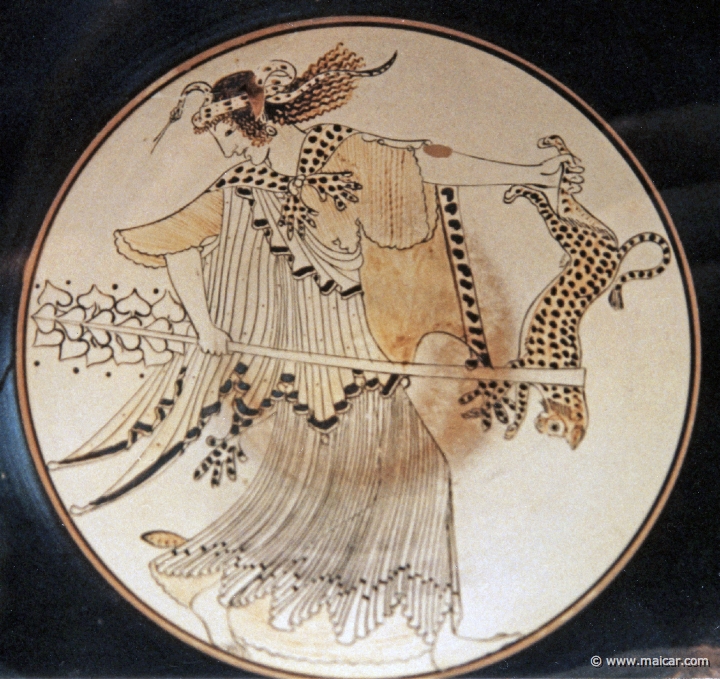
Maenad holding the thyrsos and wearing a panther skin. 0303: Staatliches Antikensammlungen, München.
|
|
|
"Dionysus holds this office, to join in dances, to laugh with the flute, and to bring an end to cares, whenever the delight of the grape comes at the feasts of the gods, and in ivy-bearing banquets the goblet sheds sleep over men." [Euripides, Bacchanals 380]
"The god, the son of Zeus, delights in banquets, and loves Peace, giver of riches, goddess who nourishes youths. To the blessed and to the less fortunate, he gives an equal pleasure from wine that banishes grief." [Euripides, Bacchanals 420]
|
|
The MAENADS or Bacchants are women sacred to Dionysus 2, maddened by his inspiring power.
Outfit
The MAENADS are followers of the god of the vine. They bore the thyrsos, a staff that is crowned with ivy, and wore the skin of a panther, a beast loved by Dionysus 2 for being
among the most excitable of animals. The MAENADS
also put a snake over their locks, for Zeus crowned his son with
snakes when he let him come out of his thigh.
Soldiers of Dionysus 2
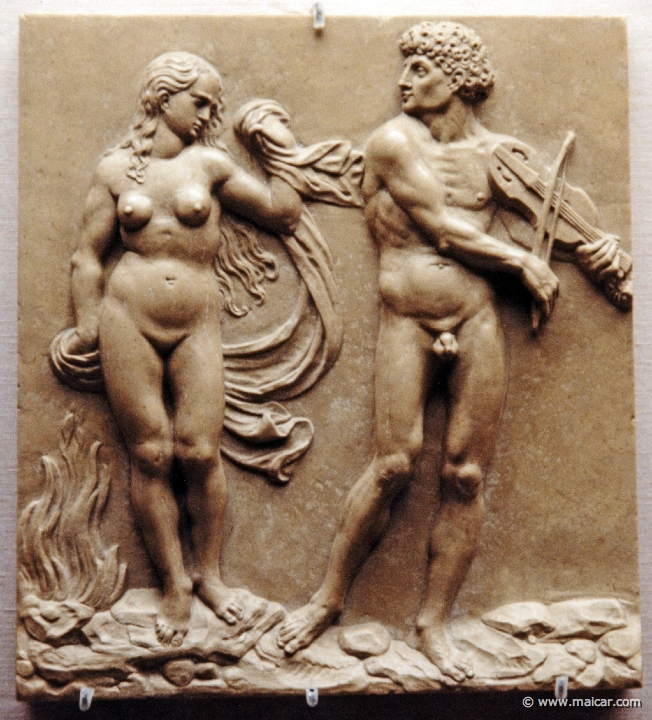
Since Dionysus 2 discovered the precious nectar of the vine, he was resisted by several who opposed the introduction of his rites. The MAENADS then, acting like soldiers, favored the god and his rites, and fought against his impious enemies, such as Pentheus 1 and Lycurgus 1; but also Orpheus was killed by
them for disputed reasons.
Their inspiration
The MAENADS have been reported to be able to
perform miracles, for it has been said that where
one of them stroke the ground with her thyrsos,
there came forth a stream of wine, and when they scratched the earth with their fingers they obtained streams of milk. And it has also been told that from the thyrsos dripped honey. The MAENADS could do such things, they say, because they were possessed and not in their senses. Their playing and dancing, it is said, should not be quelled, for the MUSES love the flute,
and they would be angered by those attempting to
pacify and put down these god-inspired women.
Their fury
But they were also known for being most cruel
against the enemies of the god they worshipped. For
being possessed by the unusual strength that came
from bacchic frenzy, they could tear apart whoever
came in their way, as it happened to King Pentheus 1 of Thebes, who was torn limb by limb by them. And they could rout armies, for they could not be wounded when touched by enemy weapons, but they inflicted casualties on their opponents by hurling the thyrsoi at them. It is also said that they could carry heavy objects on their shoulders without holding them with bounds, and that they carried fire on their locks without being burned. So, possessing such amazing qualities, they could fall upon towns, turning everything upside down, for no one could resist them. And yet it is told that the MAENADS were imprisoned by King Lycurgus 1 (known for being fond of cutting people to pieces, and for decorating his gates with their extremities), the first to oppose Dionysus 2, some say
in Thrace.
Young god
Dionysus 2 traveled through Lydia and Phrygia in Asia Minor, coming also to India. Assisted by the MAENADS and the SATYRS, he set to dance all those nations, establishing his mysteries, so that all would acknowledge him as a deity. This was no easy task because Dionysus 2 was a late comer (he was the grandson of Cadmus, the founder of Thebes) and also because mortals are easily scared. But the MAENADS, with their many wonders, proved that they were possessed and inspired by a god. And those who were unwilling to accept Dionysus 2, the general of the MAENADS, were ruined, to let them understand what it meant no to be initiated in the Bacchic rites.
Many from abroad
Since Dionysus 2 conquered the East before he came to Hellas, many forming his sacred band were recruited among those called barbarians, who came with the Phrygian drums which Dionysus 2 invented, along with Rhea 1, the mother of
the gods. The MAENADS celebrated this god of
delight with hymns, and knowing his rites and
having their souls initiated in the Bacchic revels,
kept their lives pure, danced in inspired frenzy,
and performed holy purifications, accompanying
themselves with the heavy beat of drums.
|
|
|
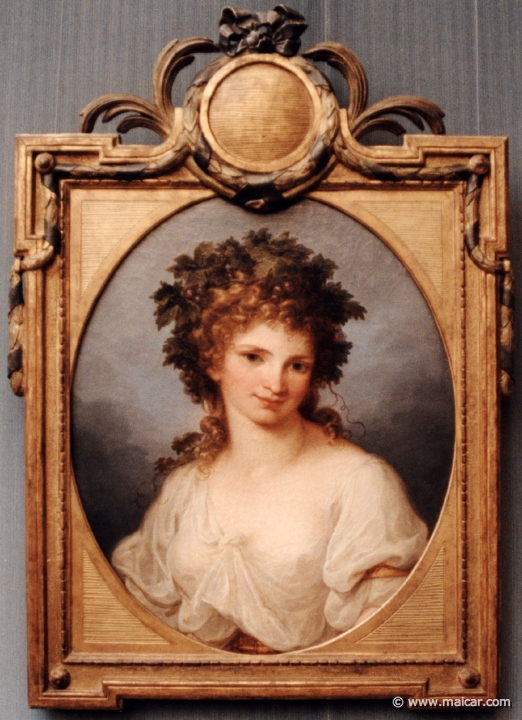
Gentle Maenad. 2237: Bacchant. Painting by Maria Angelica Kauffmann 1741-1807. Gemälde Galerie Kulturforum, Berlin.
|
|
Alcimacheia.
A Maenad from Lemnos who followed Dionysus 2 in his Indian campaign. She was daughter of Harpalion 2, a man from Lemnos famous for his wines, and was killed during the Indian war by Morrheus 1, an Indian general son of Didnasos.
Nonn.27.330, 30.192-194
Bromie.
One of the MAENADS who tried to kill Lycurgus 1.
Nonn.21.88.
Calybe 3.
Another follower of Dionysus 2 in the
Indian War.
Nonn.29.270.
Chalcomede.
When Chalcomede followed Dionysus 2 in his Indian campaign, the Indian general Morrheus 1, hit by one of Eros' arrows,
fell in love with her, and when he was about to
seize her a serpent darted out of her bosom to
protect her.
Nonn.33.17, 33.190ff., 35.204ff.
Charopeia 1.
Leader of the Bacchic dance. She followed Dionysus 2 in his
Indian campaign.
Nonn.36.256.
Chorea.
Chorea is said to have followed Dionysus 2 in his
expedition against Argos. Perseus 1 is said to
have put all the women to the sword, including
Chorea, but since she had a higher rank she was not
buried in a common grave, but had a tomb apart,
which some consider a great honor, although nothing
tangible or of any benefit for the dead man or
woman appears to come from it. And the memory is
kept of many who do not have a tomb.
Pau.2.20.4.
Cisseis.
One of the MAENADS who tried to kill Lycurgus 1.
Nonn.21.89.
Clite 3.
Same as above.
Nonn.21.77.
Codone 1.
A follower of Dionysus 2 in the Indian war. She was killed by Morrheus 1.
Nonn.30.213.
Coronis 3
A Thessalian who was raped by Butes 6, a Thracian. Butes 6 had plotted against his brother, Lycurgus 8, and had to go in exile. Having traveled through the Cyclades, he and his companions came to Thessaly. There they met the MAENADS who fled in fright as the men rushed upon them. However Butes 6 seized Coronis 3 and raped her, and she, angry at the seizure and the treatement she received, called upon Dionysus 2, who, hearing her prayer, drove him mad. Butes 6 then threw himself into a well and died.
Dio.4.70.3, 5.50.2, 5.50.5.
Eriphe.
One of the MAENADS who tried to kill Lycurgus 1.
Nonn.21.81.
|
|
Orpheus and his wife. He was killed by the MAENADS. 3321: Orpheus and Eurydice. Copy of bronze plaquette by Peter Vischer. 17C AD. Museum für Kunst und Gewerbe, Hamburg.
|
|
Eurypyle 2.
A follower of Dionysus 2 in the Indian war. She was killed by Morrheus 1.
Nonn.30.222.
Gigarto.
One of the MAENADS who tried to kill Lycurgus 1. She was killed by Morrheus 1.
Nonn.21.77, 30.223, 33.15.
Gorge 3.
One of the followers of Dionysus 2 in the
Indian War.
Nonn.29.266.
Melictaina.
Same as above.
Nonn.30.225.
Myrto.
One of the followers of Dionysus 2 in the
Indian War.
Nonn.29.270.
Nyse.
Same as above.
Nonn.29.272.
Oenone 2.
One of the followers of Dionysus 2 in the
Indian War.
Nonn.29.253.
Phasyleia.
A maid in the train of Methe 2. Leader of the Bacchanal dance. After Methe 2 the surfeit of wine (drunkenness) was called. Methe 2 was married to King Staphylus 2 of Assyria, who entertained Dionysus 2 in his
palace; after him the carryberry bunch of grapes
was called.
Nonn.20.125, 21.84.
Phlio.
One of the MAENADS who tried to kill Lycurgus 1.
Nonn.21.80.
Polyxo 2.
One of the MAENADS who tried to kill Lycurgus 1. See also HYADES 1, and
NYMPHS DODONIDES at NYMPHS.
Hyg.Ast.2.21; Hyg.Fab.182, 192 Nonn.21.69.
Soe.
One of the MAENADS who joined Dionysus 2 in his Indian campaign. She was killed by the Indian general Morrheus 1.
Nonn.30.222.
Staphyle.
One of the followers of Dionysus 2 in the Indian War. Killed by Morrheus 1.
Nonn.29.257, 30.223.
Sterope 7.
Same as above.
Nonn.29.237.
Terpsichore 2.
A dancing MAENAD who followed Dionysus 2 in the
Indian War and drove away the Indian army with her
dance.
Nonn.29.237.
Theope.
One of the MAENADS who tried to kill Lycurgus 1.
Nonn.21.86.
|
|
| Related sections |
Dionysus 2, Pentheus 1, SATYRS, Silenus, Wine |
|
|
Sources
Abbreviations |
Apd.3.5.2; Eur.Bacc. passim;
Hyg.Fab.76, 184, 239; Nonn.5.555, 18.5, 18.125, 19.55,
21.77, 21.88, 27.330, 29.237, 29. 257, 29.270, 30.192,
30.213, 30.225, 33.17, 33.190ff., 35.204ff., 36.256, 44.74,
46.258; Ov.Fast.4.458, 6.507; Ov.Met.3.712ff., 11.3ff.;
Pau.2.2.7, 2.20.4; Pla.Ion 534a;
Prop.3.17.24.
|
|
|