|
|
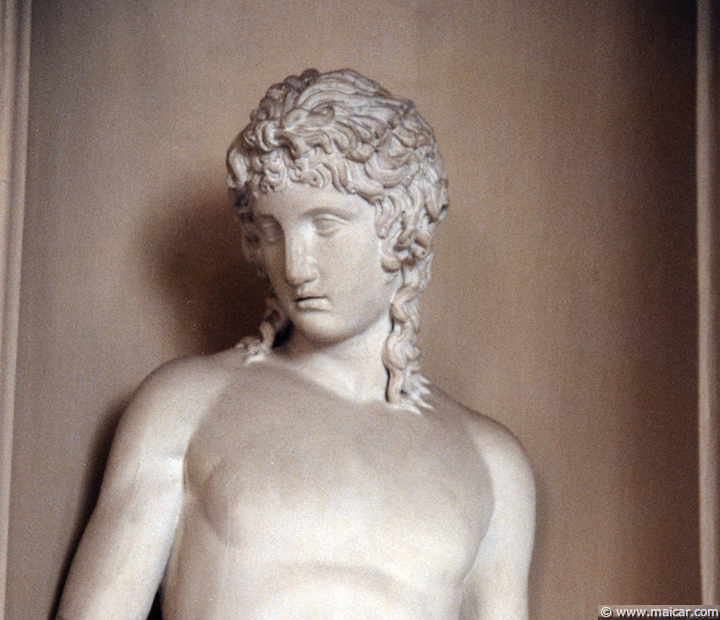
Eros. 3626: Eros von Centocelle um 350 v. Chr. Praxiteles aus Athen, tätig von 370-320 v. Chr. Landesmuseum Oldenburg, Das Schloß.
|
|
"Love resistless in fight, all yield at a glance of thine eye,
Love who pillowed all night on a maiden's cheek dost lie…
Over the upland folds thou roam'st, and the trackless sea
Love the gods captive holds. Shall mortals not yield to thee?" (Sophocles, Antigone 781).
"Ruthless Eros, great bane, great curse to mankind, from you come deadly strifes and lamentations and groans, and countless pains as well have their stormy birth from you." (Apollonius Rhodius, Argonautica 4.445).
|
Yo soy el Dios poderoso
En el aire y en la tierra
Y en el ancho mar undoso
Y en cuanto el abismo encierra
En su báratro espantoso.
Nunca conocí qué es miedo;
Todo cuanto quiero puedo,
Aunque quiera lo imposible,
Y en todo lo que es posible
Mando, quito, pongo y vedo.
(Miguel de Cervantes, Don Quijote de la Mancha, Segunda Parte, Capítulo XX).
|
|
My name is Love, supreme my sway.
The greatest god and greatest pain,
Air, earth, and seas, my power obey,
And gods themselves must drag my chain.
In every heart my throne I keep,
Fear ne'er could daunt my daring soul;
I fire the bosom of the deep,
And the profoundest hell control.
(Miguel de Cervantes, Don Quixote, Part II, Chapter XX).
|
"Whoever judges not Eros to be a mighty god is either stupid or, having no experience of good things, knows not of the god who is the mightiest power to men." (Euripides, quoted by Athenaeus, Deipnosophistae 13.600).
|
|
Eros is Love, who overpowers the mind, and tames
the spirit in the breasts of both gods and men.
Love is more powerful than Necessity
Eros (Love) has been regarded as more powerful a
god than Ananke (Necessity). For Love has no concern with ugliness,
or with the violent dealings deriving from the
compelling power of Necessity. And since Love
came to be, the delighting in beautiful things
surpassed the dominion of Necessity, bringing all
kinds of benefits both to gods and mankind.
The Courage of Love revered by the gods
The gods are said to give special honour to
Love, and particularly to the courage that comes
with him. Consequently, they allowed Alcestis, who died for
love of her husband, to return from the Underworld. But they
did not give Orpheus his
wife back, considering his attempt to raise her
from the Underworld,
the quest of a coward. For he, unwilling to die for
her, entered the Underworld alive, and
alive he left, both that gloomy place and his dead
wife.
On the other hand, Achilles was honoured
and sent to the Islands
of the Blest because he, putting his love for Patroclus 1 above
everything else, avenged him, and fearless sought
to slay Hector 1, although he knew that he was fated to die soon after killing him. That is why it is said that there is no sort of
courage more respected by the gods than the one
coming from Love.
Body & Soul
Some affirm that just as there are two Aphrodites (see "Urania" and "Pandemos" at Aphrodite)., there are also two Loves: one of a meaner kind, being concerned more with the body than with the soul, and another one, worth of celebration, that impels to love in a noble manner, that is, loving also the mind. It is on this ground that they who love the bodies of children are called mean; for they just deceive them, and take advantage of their green thoughtlessness, since children have not yet acquired enough mind. And because these manipulations are mean, they must always be done in secret. Yet it is known that it is more honourable to love openly; specially when the beloved not only excels for the beauty of the body, but also for the qualities of both mind and heart. For the same gestures of love may be judged admirable when they attend both to body and soul, and disgraceful when they only care for the body. Craving only the body while forgetting the soul
has been considered wicked because there is no
permanence in the body, and promises and speeches
made in its favor are fated to be dishonoured as
the bloom of the body fades away. Therefore, those
who love only the beauty of the body and know no
other reason for loving are believed to be lovers
of their own pleasure, prone to wrong both their
friends and the god.
|
|
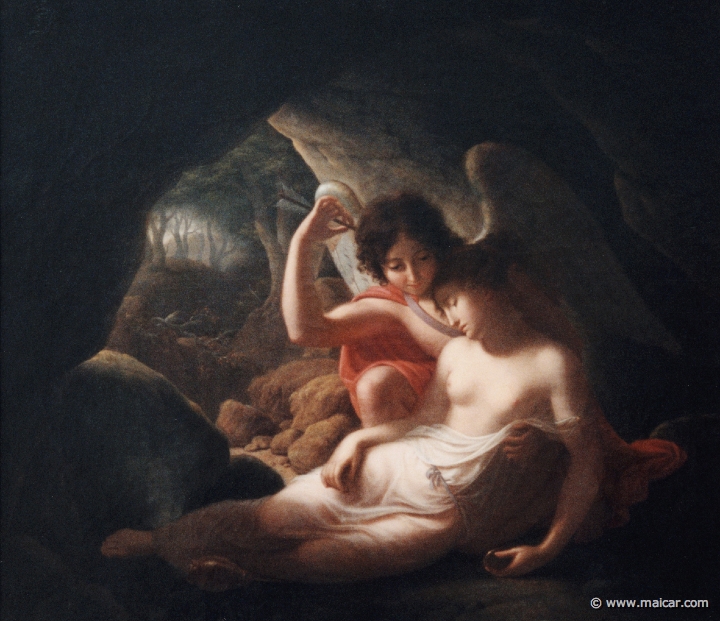
5126: Eros and Psyche. Painting by C. G. Kratzenstein-Stub, 1793-1860. Ny Carlsberg Glyptotek, Copenhagen.
|
|
Generals of Love
But since mortals have a body and this is never altogether disregarded (as eloquently shown by those who give themselves to excessive remodellation), they have been called hypocritical, who assert that one sould not love bodies but soul; and even more so when these are caught doing the very opposite of what they preach. Nevertheless, true lovers are said to look
mainly into each other's eyes, giving less
attention to the rest of the body; for they feel
that it is in the eyes that the charm of Love is
best perceived, as if they were the generals of the
god:
"… a kind of lightning-flash that Pelops has in his eyes; with it he is warmed himself, but scorches me with the flame …" (Hippodamia 1 on her husband. Athenaeus, Deipnosophistae 13.564).
Similarly, it is told that not Selene but Hypnos (Sleep) was in
love with Endymion, and
that the god put him to rest with lids wide open,
so that he could gaze upon Endymion's eyes continually. This is why praises of countenance, of curls, or
even of voice, have been regarded as inferior to
those addressed to the eyes, which bear the light
of love.
Love for Sale
There are also those who, resembling the lovers
of bodies, involve themselves in acts of love with
a view to gaining money, position, office, or Fame. They performi a vulgar charade or farce, leading to shame, reproach, and even scandal; for they will renounce Love when the money is gone, or the position lost. But the same gestures performed by true lovers for the sake of Love himself never lead to such disgraces, and such lovers never have to regret their conduct. And here again: while the merchants of Love have
to act secretly as if they were thieves, the others
find the general approval when showing their
affection openly, for there is never shame in true
love.
Cosmic Force
Love has been believed to be identical with the
combining force pervading the universe, which
causes the attraction of all creatures to a great
variety of things, and works in everything
existing. For example, he who is a physician is
seen as concerning himself with the love-matters of
the body in regard to its functions. He
distinguishes (as in the case of Love between
humans) in the functions of the body nobler and
baser loves. Therefore he is considered a good
physician, who is able to produce love where it
ought to flourish and remove it from where it
should not be. And fostering love among the most
contrary qualities inside the body, such as cold
and heat, bitter and sweet, and dry and moist, was
the skill which Asclepius developed to such a high pitch. Similarly, bringing that kind of consonance and agreement among the sounds grave and acute creates the harmony of music, just like the fast and the slow, appropriately combined, produce its rhythm. All these agreements, in both medicine and music, are the works of Love, who introduces mutual affection in opposites. Accordingly, the musician is said to be concerned with the love-matters of harmony and rhythm. And the same principle has been applied to the
seasons of the year, in which Love introduces
harmony or disharmony by bringing together, in an
orderly or disorderly way, such qualities as heat
and cold, and drought and moisture, thus bestowing
fertility and health on animals and men, or through
disturbances in the love-connexions, causing
pestilence and disease.
Love brings Pleasure and Happiness
In this way, and through what is just, temperate and have good purposes, Love, who is the only power capable of bringing happiness to the world, exerts his wide influence, providing peace and friendship among men and women, and agreement between mankind and the gods. And yet, it has been remarked, mortals fail to perceive the power of Love. For, some have asked, where are the many temples in honour of this sweet god, the most friendly to mankind? Only following the leadership of Love, some
believe, may mankind escape harm and attain
happiness; and they who oppose him incur the hate
of Heaven. For Love is the god who brings
fulfilment, healing men and women, temperating
pleasures and desires, and greatly blessing all who
revere him for his own sake, since there is no
greater pleasure than that which is found in Love
himself.
The Abode
Of the abode of Love this has been said: that
Love, possessing a natural delicacy, has not a hard
habitation but a soft one, and that he does not go
upon earth, which is hard, but of all places he
chose the softest to live in. That is why the abode
of Love is the soul of both gods and mortals, which
is the most soft and delicate part ever to be
found.
His Goodness
The goodness of this god is such that it has
been said that no one has ever injured him, and no
one has ever been injured by him. For no violence
is present in his dealings, and whenever he is
revered, right and just agreement is reached, and
friendship, and concord. This is why it has been
pointed out that Ares may
be caught by Love, but Love could never be caught
by Ares.
Power to Create
|
|
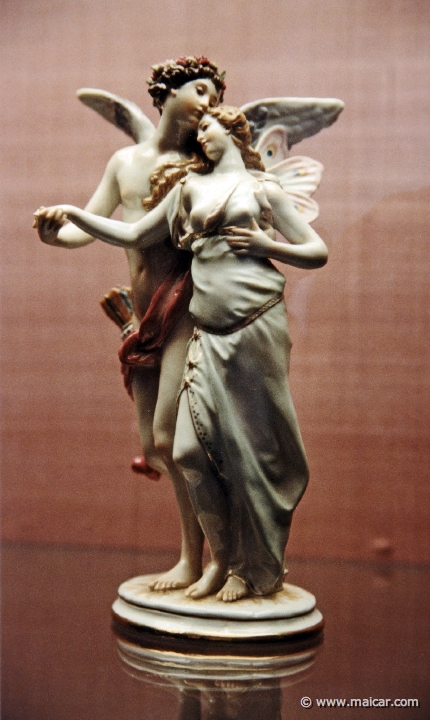
Eros and Psyche. 3409: Die ideale Liebe. Gustave Deloy, Porzellan ca. 1890-95. Museum für Kunst und Gewerbe, Hamburg.
|
|
Eros & Psyche
How Love came to the Soul
Short outline of the story (complete at Psyche)
Psyche was the daughter of an unknown king. Her beauty was so extraordinary that men would worship her instead of courting her. Aphrodite then, out of jealousy for her beauty, sent Eros to make Psyche fall in love with some unworthy man while an oracle said that Psyche must wed a horrible monster on the top of a mountain. Psyche then was first exposed, and then carried by the wind to a castle. But Eros, instead of obeying Aphrodite, fell in love with Psyche and visited her every night, although never allowing Psyche to see him. However, following the advices dictated by jealousy that her two sisters gave her, Psyche managed to know who her lover was. Eros then deserted her, and when their love was discovered, Psyche suffered the wrath of Aphrodite, who mistreated her in many ways. However, having surpassed several difficulties, the lovers could reunite, and Psyche was reconciled with Aphrodite, and made immortal.
|
|
|
|
Love has also been described as an accomplished poet and composer, for when the god gets hold of anybody, he or she becomes instantly a poet or a composer, taking part in the creative power that is again present when all creatures are produced. Accordingly, when Apollo invented archery,
and medicine and divination, or when the MUSES created music, or
when Hephaestus worked on his metals, or when Athena was weaving, or
when Zeus was guiding gods
and men, they did all these things in such a way
that they could be judged to be the disciples of
Love, attaching themselves to beauty, and having no
concern with ugliness, which is the dominion not of
Love but of Ananke.
Some blessings of the sweetest god
Because of Love, mortals have intimacy and may escape alienation, enjoy friendship, and avoid enmity. Those who are with him, they treasure him; and those who are not with him they covet him, because he is a marvel and a delight, and all tenderness, elegance and grace come from him, who is the ornament of all creatures. Similarly, they who know the labors of his mystic rites, wish no part with those who ignore them; for they, having found inspiration, wisdom, virtue and delight in Love, consider him to be the sweetest of all divinities, and do not desire any other thing than to yield to Love
Dual nature
Despite all representations, in which Love is depicted as a young man or a boy, Eros is believed to have a dual nature, being neither female nor male. He (or she) is regarded as composed of many elements and able to bear different qualities within a single frame. Therefore he may appear audacious or timid, seem wise or stupid, give himself to impetuosity, or choose persistance. Consequently, his influence on lovers has been
compared to that of wine on
drinkers. For when Eros comes in moderation, he is
gracious; but when he comes with great intensity,
he seems cruel and many are thrown into perplexity.
This is why it has been written:
"… the Love-god, golden-haired, stretches his charmed bow with twin arrows, and one is aimed at happiness, the other at life's confusion." (Euripides, Iphigenia
in Aulis 549).
As many opinions about Love, as forms he might have
In addition to these opinions, many others (for opinions about Love are innumerable) have been uttered. And some say roundly that Eros is not a god, preferring to call him "abstraction," or "emotion," or "a property inherent in ourselves," or "an object of our desire." Accordingly, they find themselves serving and revering these qualities, as if they were deities, while still imagining they avoid deification and adoration. But, whatever his title, Eros, being inevitable, is always worshipped.
|
|
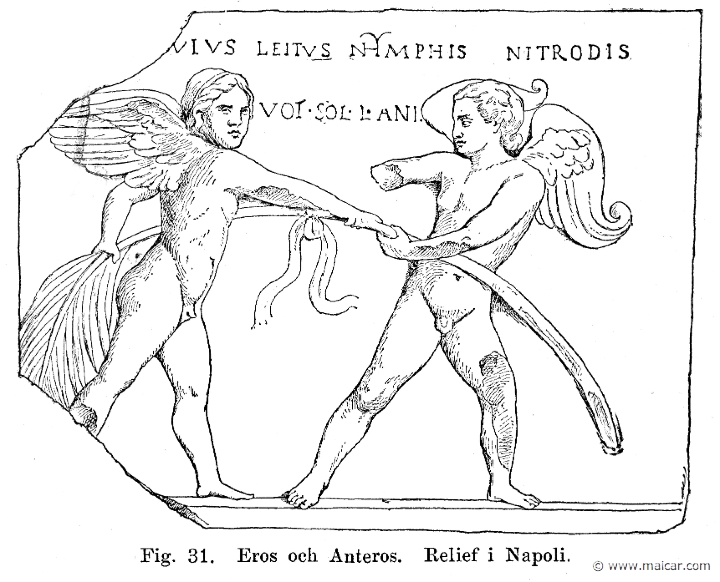
cen110: Eros and Anteros. Relief in Naples. J. Centerwall, 1897.
|
|
Anteros
Twin brother of Eros
Anteros is love avenged or returned,
"mutual love" or "reciprocal love". Aphrodite is
called the mother of the "Twin Loves" (Eros and Anteros) (Ov.Fast.4.1). The story of Timagoras and Meles illustrates the nature of Anteros:
The Athenian Meles, spurning the love
of Timagoras, bade him ascend to the
highest point of a rock and cast himself
down. Timagoras, who was ready to gratify
his beloved friend in any of his requests,
went and cast himself down. When Meles saw
that Timagoras was dead, he suffered such
remorse that he threw himself from the
same rock and died. For this reason some
people in Athens worshipped Anteros as the avenging spirit of Timagoras (Pau.1.30.1).
According to Cicero, Anteros was the
son of Mars (Ares)
and "the third
Venus" (Cic.ND.3.60). For Cicero's confusing genealogies and duplications of the gods, see Graphic
Guide to Cicero's De Natura
Deorum.
|
|


