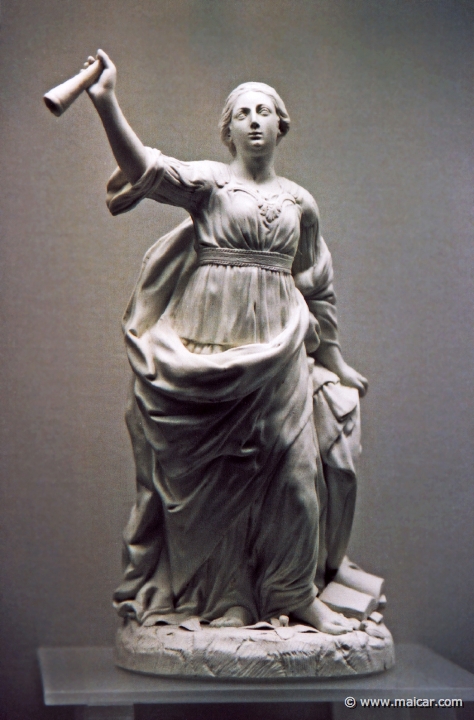
| Pheme is Fame, the irrepressible voice or rumour
that spreads reports among men and women.
Basics about Fame
The sayings and reports, that coming and going
among mortals become rumours, are spread by Pheme,
regarded by some as a messenger of Zeus. This Pheme, whose
eyes are never overcome by Sleep, is a swift
creature with countless tongues and ears. Pheme
does not care about the nature of the rumours
spread by her, whether they sound good or evil. And
it could be for this reason that Pheme is not
allowed to come into the peaceful world of heaven.
Instead she, being a spirit neither of hell nor of
heaven, dwells beneath the clouds, often spreading
panic and troubling the earth.
Provides ID cards
Despite her being infamous in heaven, and
despite the fact that it is on her account that
entire cities on earth are disturbed, many mortals
love Pheme. For it is because of her that things
become known, and mortals become well known.
Therefore Pheme's gifts are revered, and she
herself invoked as a kind of guarantee or identity
card by those whom Fame has enhanced. Otherwise had
not Aeneas said:
"I am Aeneas, the good, who carry with me in my
fleet my household gods, snatched from the foe; my
fame is known in the heavens above." (Aeneas to the disguised
Aphrodite. Virgil, Aeneid 1.378).
Fame may help in distress
And if stones could talk like men, they would
say similar things. For he who has been raised by
Fame sees himself as gifted, and rejoices when his
name is pronounced by the tongues of other mortals,
or written down by their hands. The same Aeneas, although being in
distress after the fall of Troy, feasted his soul on
the Carthaginian wall-paintings that depicted the Trojan War; for in them he could see the battles in which he had taken part, and a sign that the people of Carthage could be emotionally engaged in his fate and disposed to help him, now that he had become a stranded exile. This is why he says to his companion Achates 1 in a comforting manner:
"Dismiss your
fears; this fame will bring you some salvation." (Aeneas to Achates 1. Virgil, Aeneid 1.463).
Salvation and Perdition
However, since Fame does not care for good or
evil, what is salvation for some, is perdition for
others. For it was Fame, under the form of false
evidence and wicked witnessing, who ended the days
of Palamedes at Troy. And when the rumour
spread through the malice of Odysseus reached the
ears of the Achaean chiefs and soldiers, they,
believing the intriguer and caring nothing for the
truth of the charges, stoned Palamedes to death as
a traitor, although he was the innocent victim of a
conspiracy.
Adversity as price of Fame
Despite this kind of misadventures, humans love
Fame, whose gifts charm their hearts to such an
extent that they covet her and submit to her, even
when she appears in the company of Ruin and Death:
"… had not God overthrown us so, and whelmed beneath the earth, we had faded fameless, never had been hymned in lays, nor given song-themes to posterity." (Hecabe 1, Queen of Troy.
Euripides, Daughters
of Troy 1240).
Fame and Immortality
For many believe that precious immortality is
dependent on Fame; and whereas few wish
annihilation for themselves, the rest hope that
Fame will make them known in posterity when their
life is over, reasoning that to be remembered is
the same as to be immortal. Yet Fame, who is shut
out from Heaven, has never been reported to grant
immortality to anyone, even though some have
regarded her as if having some influence in this
matter, since they say:
"Fame of olden time, and you, dark Antiquity of the world, whose care it is to remember princes and to make immortal the story of their lives …" (Statius, Thebaid 4.32).
But if Fame granted immortality, as some seem to
believe, then it could be deduced that the more
famous would be more immortal, which cannot be
conceived without thinking that there are degrees
of immortality just as there are degrees of Fame.
But these would be degrees of mortality rather than
degrees of immortality, and they cannot be
immortals-by-degrees, who live in the absolute
realm of Heaven. On the other hand Fame, not being
allowed to dwell in Heaven and living just above
earth, cannot therefore deal with things but in
relative terms, that is, by degrees.
Fame and Victory
Others have thought that undying glory is
achieved through the fame that derives from Victory:
"… the blossoms of glory-bringing Victory nurture for men golden,
conspicuous Fame throughout their lives—for a
select few—and when the dark cloud of death
covers them, the undying glory of their fine deed
is left behind, secure in its destiny." (Bacchylides, Odes 13.58-66).
But Victory, it has been
pointed out, not necessarily produces the greatest
Fame. For the Fame accorded in defeat to those who
perished defending Thermopylae in historical times,
they argue, was greater than the Fame obtained by
many whom Victory favored,
since brave men are judged
"… not by the outcome of their actions, but by their purpose; in the one case Fortune is mistress, in the other it is
the purpose which wins approval." (Diodorus Siculus, Library
of History 11.10.4).
|
|
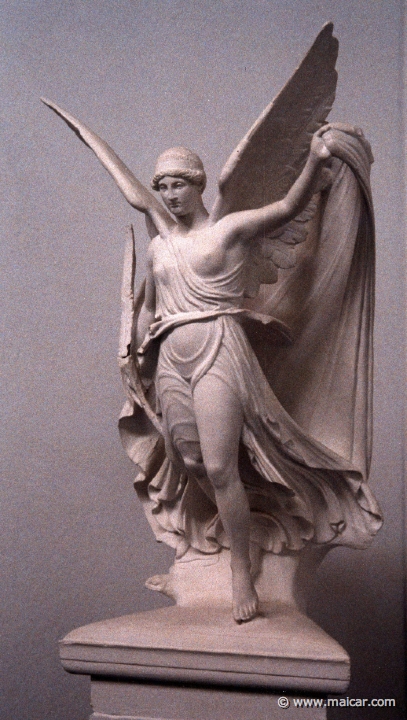
Nike: said to be behind Pheme. 6802: The Nike of Paeonios (reconstruction), 421 BC. Archaeological Museum, Olympia.
|
|
Immortality again
In any case, some reason, there is nothing that
humans desire more than preservation and
immortality, since many suffer seeing the body
first eroded by Old Age and then disintegrated by Death, while the soul
is affected in inexplicable ways. And this is why,
with a view to immortality, they devote themselves
to winning Fame:
"… consider how singularly they are affected with the love of winning a name, and laying up fame immortal for all time to come." (Socrates quoting Diotima. Plato, Symposium 208c).
And in order to reach Fame, it is added, not so
few humans may be ready to run all risks, to invest
money, perform any task, and even sacrifice their
lives. But others among them, it is remarked, being
bound to their bodies, care less about Fame, and
search immortality in the creation of children,
seeing in them their own eternal memorial. Yet even
these are not altogether deprived of ambition
regarding Fame:
"What, indeed,
is a nobler ornament for children than the fair
fame of a thriving father, or for a father than
that of his children?" (Haemon 1 to the Theban Elders. Sophocles, Antigone 704).
Impostor defined
At other times, however, Fame has been regarded,
not as a provider of immortality, but instead as an
infamous impostor herself, being shortly defined
thus:
"… of all evils, the most swift." (Virgil, Aeneid 4.174).
Speaks Truth and Falsehood Fame, they say, relies on speed from which she
derives her strength, winning vigour as she goes.
As Eris, she is small at
the beginning, but soon walks the ground with her
head in the clouds. Some have said that Gaia created this grotesque
monster, her last child, when she was angry against
the gods, and that she put a sleepless eye beneath
each of her many feathers. And for every eye Fame
has a tongue, a voice, and an ear. And being
sleepless, Fame flits between earth and sky and
terrorizes whole cities by day and by night,
speaking aloud every kind of truth and every kind
of falsehood.
Great Legislator
And although winged Fame cares nothing about her own words and rumours, many follow her tunes and, as if they were talking-birds, repeat them without thinking, wallowing in scandal and gossip, and thereby obliterating their own ability to distinguish between fact and fiction. Similarly many among mortals follow what Fame has proclaimed to be the latest clever invention, which could be a dress, a dance, a tune, a liquor, an opinion, or any other device of whatever sort, that she makes appear as something new, unique, and incredible. And so by means of Fame, who is carried from lip
to lip, many go dressed as she decrees, eat and
drink as she ordains, enjoy themselves as she
prescribes, think as she enjoins, and love or hate
as she dictates. And because of these
circumstances, Fame may be thought to be one of the
greatest legislators; for there is no aspect of
social life that is not ruled by her, who can make
whoever or whatever famous for being or for not
being, for having or for not having, for doing or
for not doing. And if someone happens to ignore her
messages, he is regarded as a barbarian, or as one
deprived of sound understanding, or as one unable
to grasp plain language.
Listened to with devotion
According to her nature, Fame not seldom causes
tumult and surprise; for she may start talking of
marriage or parties, and may end telling of murder
or war. And many do not care what is spoken of, as
far as it is Fame who speaks; and if she were
silent for a short while or two, they would urge
her to speak, be it truth or falsehood. Such is the
power of Fame, always shaking out her fluttering
plumes, and listened to with attention and
devotion.
Just outlines her tales
Yet at the beginning, they say, Fame is scorned
by men and women; but as they nevertheless cherish
her, she finally possess them all, governing their
tongues as she pleases, so that all kind of tales
are brought about: of ruin and riches, of peace and
war, or of whatever sort. And Fame does not need
more than to sketch a simple outline of a tale,
since others, like for example Envy, will easily fill it
out.
Fame and Wealth
Fame, they say, attends often on Wealth:
"… if a god were to give me luxurious wealth, I hope that I would find lofty fame in the future." (Pindar, Pythian Odes 3.110).
But just as Fame attends on Wealth, Wealth, power and honor
attend on Fame. And due to this, not few are eager
for Fame, knowing that no one is, in principle,
disregarded by this goddess, since she, to begin
with, cares neither about position nor about
profession.
Ignores purposes
|
|
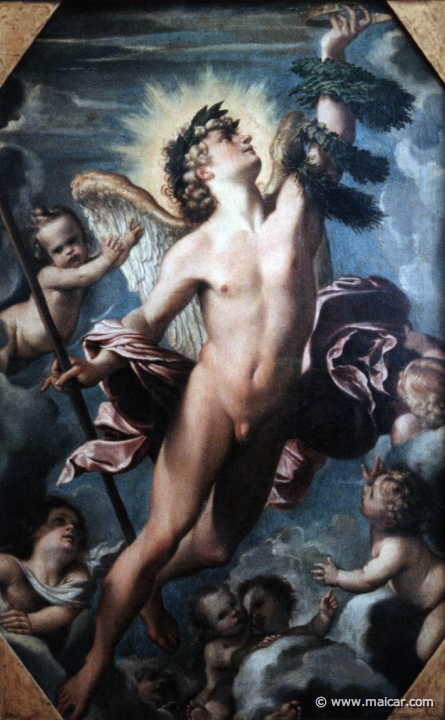
The genius of Fame. 4708: Annibale Carrachi 1560-1609: Der Genius des Ruhmes, um 1588/89. Gemäldegalerie Alte Meister, Dresden.
|
|
And since she does not care about purposes
either, some become famous for their abilities, or
for their inventions, or for being benefactors of
mankind, while others become famous on account of
their extraordinary frauds, or because of the
deadly devices their cleverness produced, or for
having achieved unprecedented milestones in the
field of criminality. And when Fame comes, neither
sort refuses her; for both the good and the evil
think they deserve Fame on account of the greatness
or originality of their deeds, regardless of
whether they have served the lives of humans, or
have destroyed them.
Brilliant like the morning-star
Not seldom some reason that what matters is to
make a great achievement, either good or bad, so
that Fame might ensure remembrance, which they
believe to be the same as immortality:
"There is
honor for those whose fame a god causes to grow
luxuriant when they are dead." (Pindar, Nemean Odes 7.30).
And seen in this way Fame is not a grotesque
monster, but a beautiful sight. And when she
awakens (for some believe that she may be caught by Sleep after all),
"… her body shines, marvellous to see, like the morning-star among other stars." (Pindar, Isthmian Odes 4.20).
Envying Fame
For these and yet other reasons Fame is the
object of the lust of many, who wish to be
possessed by her. And while they cannot be famous,
they may think that the cause of the popularity of
others is to be found neither in themselves nor in
their merits, but in random circumstances:
"… when a man from the little island of Seriphus grew abusive and told Themistocles that he owed his fame not to himself but to the city from which he came, he replied that neither would he himself ever have made a name if he had been born in Seriphus nor the other if he had been an Athenian." (Plato, Republic 329e).
This is how, through the words of a famous man,
Seriphus saw its own fame increased by some
degrees.
Insignificant places made great
For insignificant places may win Fame as well,
and through her receive legions of visitors
expecting to be somewhat touched by her wings.
Unknown and small places are thus raised to the
skies, being remembered for ages on account of the
events that took place in them:
"Caphareus in
Euboea is famous since the storm that here befell
the Greeks with Agamemnon on their voyage from Troy." (Pausanias, Description
of Greece 4.36.6).
Now, the bigger the catastrophe the more famous
it will tend to be. For Fame, preferring the bigger
and the biggest, cares more for thousands of dead
than for just a few, and more for those who already
are her favorites than for nobodies.
Powerful and hope-giving goddess
So Fame, having the power of making the small great and the great greater, can neither be disregarded nor underrated. Consequently, what she says is listened to carefully and repeated as a prayer. For she appears to change the very nature of things, turning into a shining star what before was neglected and opaque. And being regarded as opposed to oblivion, she is cherished by all those who value remembrance, and by those who think she carries under her wings the key to immortality, which separates gods and men. Such is the nature of this goddess; and her
power among men and women is practically limitless,
except in the realm of true intimacy and
confidence.
|