Greek Mythology Link - by Carlos Parada, author of Genealogical Guide to Greek Mythology

| Biographies | GROUPS | Places & Peoples | Dictionary | Images | Albums | Topics | Search | Downloads |

Aeneas

Eneas

Aeneas | Eneas

Relevant links

Enlaces relacionados

Aeneas in GROUPS


 "Learn courage from me, and true toil; from others the meaning of fortune." [Aeneas to his son Ascanius 2. Virgil, Aeneid 12.435]

 «Aprende de mí, muchacho, el valor y el esfuerzo verdadero, y de otros la fortuna.» [Eneas a su hijo Ascanio 2. Virgilio, Eneida 12.435]

At the fall of Troy, Aeneas, who had been Leader of the Dardanians, left the city in flames, and after wandering in the Mediterranean sea, came to Italy and founded the state that later became Rome.


Al caer Troya, Eneas, que había sido Jefe de las tropas de Dardania, abandonó la ciudad en llamas, y luego de varias vueltas por el Mediterráneo, llegó a Italia, en donde fundó el reino que más tarde sería Roma.

Birth and Childhood

Aeneas was born from the union of a mortal, Anchises 1, and a goddess, Aphrodite. Some say that it was Zeus himself who aroused in Aphrodite the desire to be joined with a mortal man, so to prevent her to say mockingly that she had joined all the gods with mortals. Aphrodite came to Anchises 1 in the form of a beautiful maiden, saying she was a mortal woman and the daughter of one Otreus. She explained to the incredulous Anchises 1 that she talked his language because she had been brought up by a Trojan nurse. Anchises 1 was taken by desire, but after they had made love, Aphrodite revealed her true identity and Anchises 1 feared the gods would destroy him for having slept with a goddess. But Aphrodite, who herself grieved for having laid in the bed of a mortal man, assured him that he was dear to the gods and nothing would happen to him, provided he would say their child was the offspring of a nymph, for Aphrodite disposed that the NYMPHS would rear Aeneas and that, as soon as he was a boy, he would be restored to his father.

According to some, Anchises 1, having drunk much wine, told his friends that he was the lover of the goddess, and for this reason he was struck by Zeus' thunderbolt. Others say, however, that he killed himself, and till others assert that the thunderbolt just crippled him.

Nacimiento e infancia

Eneas nació de la unión de un mortal, Anquises 1, y una diosa, Afrodita. Según algunos, el propio Zeus le inspiró a Afrodita el deseo de unirse a un mortal, para que ya no se jactara en sus burlas de haber suscitado ella tantas otras uniones entre dioses y mortales. Afrodita se le apareció a Anquises 1 transfigurada en una hermosa doncella, y fingiendo ser una mujer mortal, hija de un tal Otreo. Le explicó al incrédulo Anquises 1 que ella hablaba su lengua por haber sido criada por una nodriza troyana. A Anquises 1 lo venció el deseo, pero cuando ya habían hecho el amor, le reveló ella su verdadera identidad. Anquises 1 se sintió asediado por el miedo, al pensar que los dioses lo destruirían por haberse acostado con una deidad. Pero Afrodita, que ya se afligía por haberse reclinado en la cama de un mortal, le aseguró que los dioses lo amaban y que nada le ocurriría si afirmase que había engendrado su hijo con una ninfa. Pues ya había Afrodita resuelto que las NINFAS criarían al pequeñuelo Eneas, para devolvérselo al padre apenas dejara la primera infancia.

Según algunos, Anquises 1 se emborrachó en cierta ocasión, y se jactó frente a sus amigos de haber sido el amante de una diosa, por lo que Zeus lo fulminó con un rayo. Según otros, se habría suicidado, y aún otros afirman que aquel rayo apenas lo dejó inválido.

Wounded in battle

During the Trojan War, Aeneas, who some time before had been driven from Mount Ida by Achilles, was wounded by Diomedes 2 and, having fainted, would have died if his mother had not come to his rescue. Aphrodite herself was wounded by Diomedes 2 on this occasion, but Apollo took over the protection of the wounded Aeneas, removing him from the battle to the citadel, where his temple stood. In the sanctuary, Leto and Artemis healed Aeneas and made him even stronger. But for those fighting, Apollo fashioned a phantom of Aeneas, so that Achaeans and Trojans killed each other round it, until the real Aeneas, having recovered, returned to the field.

Herido en la guerra

Durante la Guerra de Troya, Eneas, que previamente había sido expulsado del Monte Ida por Aquiles, fue herido por Diomedes 2. Desmayado por la pelea, habría muerto si su madre no hubiera venido a rescatarlo. En esta ocasión, Diomedes 2 hirió a la propia Afrodita, y Apolo debió encargarse de la protección del herido Eneas, alejándolo del combate y transportándolo a au templo, que se encontraba en la ciudadela. En el santuario de ésta, Leto y Artemisa curaron a Eneas, y le otorgaron mayor fortaleza. Pero para despistar a los que luchaban, fabricó Apolo un fantasma de Eneas, de modo que aqueos y troyanos se mataran en su alrededor, hasta que el verdadero Eneas se recuperara y volviera al campo de batalla.

Poseidon's Prophecy

In another occasion, at a time when the gods had become more involved in the fighting, Apollo urged Aeneas to challenge Achilles and to fight with him in single combat. Aeneas was very close to die, but Poseidon rescued him, explaining to the other gods:

"Even Zeus might be angry if Achilles killed Aeneas, who after all is destined to survive and to save the House of Dardanus from extinction ... Priam's line has fallen out of favour with Zeus, and now Aeneas shall be King of Troy and shall be followed by his children's children in the time to come." [Poseidon to the gods. Homer, Iliad 20.300]

This way of speaking would have pleased Aeneas himself, as he had a grudge against King Priam 1 for not giving him his due. Aeneas and Priam 1 represent two royal lines with different interests, as Achilles reminded Aeneas when the latter was eager to fight against him:

"Do you propose to fight me in the hope of stepping into Priam's shoes and becoming King of the Trojans? Your killing me will not make Priam abdicate for you. He has sons of his own ..." [Achilles to Aeneas. Homer, Iliad 20.180]

El vaticinio de Poseidón

En otra ocasión, cuando los dioses interferían más activamente en las batallas, Apolo instó a Eneas a que desafiara a Aquiles. Por poco muere Eneas en ese duelo, pero quiso Poseidón salvarlo, y así se justificó ante los otros dioses:

«Ea, librémosle de la muerte, no sea que Zeus se enoje si Aquiles lo mata, pues el destino quiere que se salve a fin de que no perezca ni se extinga el linaje de Dárdano...Ya Zeus aborrece a los descendientes de Príamo; pero el fuerte Eneas reinará sobre los troyanos, y luego los hijos de sus hijos que sucesivamente nazcan.» [Poseidón a los dioses. Homero, Ilíada 20.300]

Esta manera de hablar le habría agradado al propio Eneas, que abrigaba rencores contra el rey Príamo 1, que acaso no le otorgaba lo que era suyo. Eneas y Príamo 1 representaban dos linajes distintos, como señaló Aquiles cuando iba a enfrentarse con Eneas:

«¡Eneas! ¿Por qué te adelantas tanto a la turba y me aguardas? ¿Acaso el ánimo te incita a combatir conmigo por la esperanza de reinar sobre los troyanos ...? Si me matases, no pondría Príamo en tu mano tal recompensa; porque tiene hijos...» [Aquiles a Eneas. Homero, Ilíada 20.180]

At the end of the war

Some say that when the Trojan War was over, Aeneas was given as a prize to Neoptolemus, who had also received Andromache, wife of Hector 1. Others tell that when the Trojans debated what they ought to do with the WOODEN HORSE, there were three opinions: some wanted to hurl the WOODEN HORSE down from the rocks, others wished to burn it, and still others were for dedicating it to Athena. This third opinion prevailed, and the Trojans, believing the war was over, turned to feasting. It was then that the two serpents appeared, which destroyed the seer Laocoon 2 and his sons after he had warned his fellow citizens:

"Is it thus you know Odysseus? Either enclosed in this frame there lurk Achaeans, or this has been built as an engine of war against our walls, to spy into our homes and come down upon the city from above; or some trickery lurk therein. Trojans, trust not the horse. Whatever it be, I fear the Greeks, even when bringing gifts." [Laocoon 2 to the Trojans. Virgil, Aeneid 2.48]

What happened to Laocoon 2 alarmed Aeneas and his followers in such a way that they withdrew to Mount Ida and were not at Troy when the city was sacked.

Al terminar la guerra

Según algunos, al terminar la Guerra de Troya, formó Eneas parte del botín que correspondió a Neoptólemo, y que también incluía a Andrómaca, esposa de Héctor 1. Otros afirman que al discutir los troyanos lo que harían con el CABALLO DE MADERA, se enfrentaron tres puntos de vista: los que querían despeñar al CABALLO desde un acantilado, los que querían quemarlo, y los que deseaban ofrendarlo a Atenea. Esta tercera opinión prevaleció, y como los troyanos creyeron que la guerra había terminado, empezaron a festejar. En ese momento, aparecieron dos serpientes que mataron al adivino Laocoonte 2 y a sus hijos, después de que él le hiciera advertencias a sus conciudadanos:

«¿Así conocemos a Ulises? O encerrados en esta madera ocultos están los aqueos, o contra nuestras murallas se ha levantado esta máquina para espiar nuestras casas y caer sobre la ciudad desde lo alto, o algún otro engaño se esconde: teucros, no os fiéis del caballo. Sea lo que sea, temo a los dánaos incluso ofreciendo presentes.» [Laocoonte 2 a los troyanos. Virgilio, Eneida 2.48]

Lo acontecido a Laocoonte 2 habría impresionado tanto a Eneas y sus seguidores que se retiraron al Monte Ida, en donde se encontraban cuando la ciudad fue saqueada.

Aeneas' piety

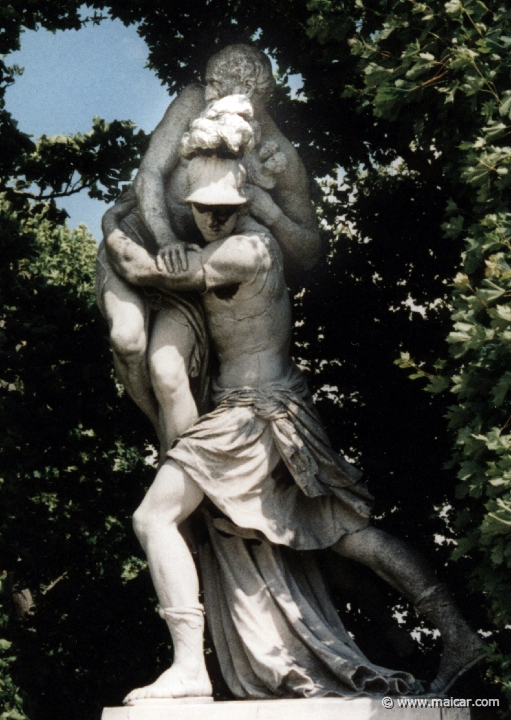
However, others say that Aeneas was indeed at Troy when the city was burned down and that he, carrying his aged father on his back, was allowed by the Achaeans, on account of his piety, to leave the town. Aeneas took also his son Ascanius 2 (later called Iulus 1), and his household gods, the PENATES [see Other Deities], but his wife Creusa 2 became separated from him. Some affirm that Aeneas also took the Palladium with him, bringing it to Italy; but others say otherwise.


La piedad de Eneas

Otros afirman, sin embargo, que sin duda se encontraba Eneas en Troya cuando se le pegó fuego a la ciudad. Dicen que cargó a su anciano padre sobre sus hombros y obtuvo permiso de los aqueos para abandonar la ciudad, en virtud de su piedad. Eneas también llevaba consigo a su hijo Ascanio 2 (llamado después Julo 1) y las divinidades de su hogar, los PENATES [véase también Otras Deidades], pero quedó separado de su esposa Creúsa 2. Algunos dicen que Eneas también se llevó el Paladio a Italia, pero otros testimonios no concuerdan.

Aeneas, in a remembered gesture of piety, carries his father out of Troy | Eeneas, en recordado y piadoso gesto, cargando a su padre al abandonar Troya

Aeneas and the fall of Troy

Still others affirm that when the Achaeans came into the city, Aeneas occupied the citadel of Troy, which was fortified with its own wall, and there resisted the enemy who attacked the acropolis. This resistance, they say, allowed many Trojans to save their lives or escape slavery. Having in this way prevented the enemy from taking the whole city by storm, the flower of the army was saved, many lives rescued, and many of the city treasures preserved. The city was anyway lost, but Aeneas had the time to send out from Troy the women, the aged, and the children, putting them in the roads to Mount Ida, together with an escort instructed to take possession of the strongest parts of the mountain. In the meantime, the Achaeans, being busy trying to capture the citadel, gave no thought to the multitude who was leaving the city. Aeneas himself, with the other part of the army, defended the citadel until Neoptolemus gained a foothold in part of the acropolis. Then Aeneas opened the gates and retired, as they say, in good order, carrying with him his family, his household gods, and whatever he considered a treasure, either person or thing.

Some have said that Aeneas betrayed the city of Troy, and that because of this service the Achaeans allowed him and his family to safely leave the city. Aeneas, they say, had been excluded from his prerrogatives by King Priam 1 and his son Paris, who could be thought to succeed his father after the death of Hector 1. So he overthrew the king, and negotiated with the enemy.

Eneas y la caída de Troya

Aún otros afirman que, al tomar los aqueos la ciudad, Eneas resistía en la ciudadela de Troya, una fortificación de intramuros, al enemigo que atacaba el acrópolis. Dicha resistencia habría permitido que muchos troyanos salvaran sus vidas o escaparan a la esclavitud. Al impedirle al enemigo que tomara toda la ciudad en un solo asalto, la flor del ejército troyano quedó intacta, muchas vidas se salvaron, y no se perdieron los tesoros de la ciudad. Troya estaba perdida, pero Eneas ganó tiempo para evacuar a mujeres, niños y ancianos, que se pusieron en camino del Monte Ida, protegidos por una escolta, cuyo objetivo era defender los puntos más estratégicos de la montaña. Los aqueos no prestaron atención a la multitud que abandonaba la ciudad, por estar ocupados en tomar la ciudadela. El propio Eneas la defendió, con parte del ejército, hasta que Neoptólemo logró afianzarse en un costado del acrópolis. En ese momento, abrió Eneas las puertas y se retiró, según dicen, en buen orden. Llevaba consigo su familia, las deidades de su hogar, y todo lo que le pareció de valor, ya fuera persona o cosa.

Dicen algunos que Eneas traicionó a Troya, y para pagar su servicio, los aqueos le dieron un salvoconducto a él y a su familia. Dicen que las prerrogativas de Eneas habían sido revocadas por el rey Príamo 1 y su hijo Paris, que se suponía habría de heredar el trono, luego de la muerte de Héctor 1. Ante esos hechos, Eneas habría desconocido o derrocado al rey, entablando negociaciones con el enemigo

Exile

After leaving Troy, Aeneas came to Mount Ida, where he was joined by inhabitants and troops who had left Dardanus and other cities, after seeing at the distance the great fire rising from Troy. All these hoped to return home when the enemy had sailed away. But the Achaeans, having taken the city and demolished all surrounding forts, were determined to subdue all refugees in the neighbouring territories. Perceiving the danger that threatened them, the Trojans in Mount Ida sent heralds to the Achaeans and an agreement was reached, which allowed Aeneas, as well as his people and valuables, to leave the Troad, after fisrt delivering up all fortifications to the Achaeans. So at the foot of the mountain, Aeneas and his followers built a fleet of twenty ships with which they sailed in the first days of summer.

But his son Ascanius 2, they say, came to Dascylium on the Propontis, in Phrygia, since he was invited by its citizens to rule over them. It is also told that Ascanius 2 remained there only until Astyanax 2, the son of Hector 1, was permitted by Neoptolemus to return home from Hellas and rule his country. For, according to this account, little Astyanax 2 was not murdered by the Achaeans during the sack of Troy, but taken prisoner by Neoptolemus.

Exilio

Luego de abandonar Troya, llegó Eneas al Monte Ida, en donde se le unieron los habitantes y tropas que habían evacuado Dárdano y otras ciudades, después de haber visto, desde la distancia, el incendio de Troya. Abrigaban todos estos la esperanza de regresar a sus hogares, cuando el enemigo zarpara. Pero los aqueos, además de saquear la ciudad y demoler las fortificaciones vecinas, se habían resuelto a subyugar a los refugiados de los territorios aledaños. Al darse cuenta del peligro que los amenazaba, los troyanos del Monte Ida enviaron heraldos a los aqueos, y se llegó a un acuerdo que autorizó a Eneas y su gente a abandonar la Tróade con sus bienes, una vez que hubiesen entregado todos los fuertes a los aqueos. De este modo, Eneas y su gente construyeron, al pie de la montaña, una flota de veinte naves con las que zarparon en los primeros días del verano.

De su hijo Ascanio 2, dicen algunos que se fue a Dascilio, en Propóntide—hoy Mármara—(Frigia), cuando los habitantes le ofrecieron el trono. Cuentan también que Ascanio 2 reinó ahí hasta que Astianacte 2, hijo de Héctor 1, recibió autorización de Neoptólemo para regresar. Pues de acuerdo con esta versión, el pequeñuelo Astianacte 2 no habría sido asesinado por los aqueos al caer Troya, sino que Neoptólemo lo habría tomado prisionero.

End of Anchises 1

As for Anchises 1, some say that when Aeneas was in his way to Sicily, he came first to Laconia, founding the cities Aphrodisias and Etis, and that his father died there, being buried by Aeneas at the foot of the mountain called Anchisia after Anchises. However, others say that old Anchises 1 died when they sailed past Lilybaeum, Sicily's western promontory.

"Yet if you could live on such as now you are in look and in form, and be called my husband, sorrow would no then enfold my heart. But as it is, harsh old age will soon enshroud you, ruthless, wearying and deadly age which stands some day at the side of every man." [Aphrodite to Anchises 1 when they first met at Mount Ida. Homeric Hymn to Aphrodite 245]

Fin de Anquises 1

De Anquises 1 afirman algunos que murió en Laconia, a donde había llegado Eneas y en donde fundó las ciudades de Afrodisia y Etis. Eneas enterró a su padre al pie de la montaña Anquisia, que se llamó así por Anquises 1. Otros dicen que el viejo Anquises 1 murió cuando navegaban frente a Lilibeo, el promontorio en el oeste de Sicilia.

«Pero si pudieras seguir viviendo tal como ahora, con el mismo aspecto y forma, y que pudieras ser llamado marido mío, entonces no se llenaría de pena mi corazón. Pero al no ser así, pronto la áspera y despiadada vejez te amortajará; la agotadora y mortal vejez que un día aparece al lado de cada hombre.» [Afrodita a Anquises 1, en su primer encuentro en el Monte Ida. Himno Homérico a Afrodita 245]

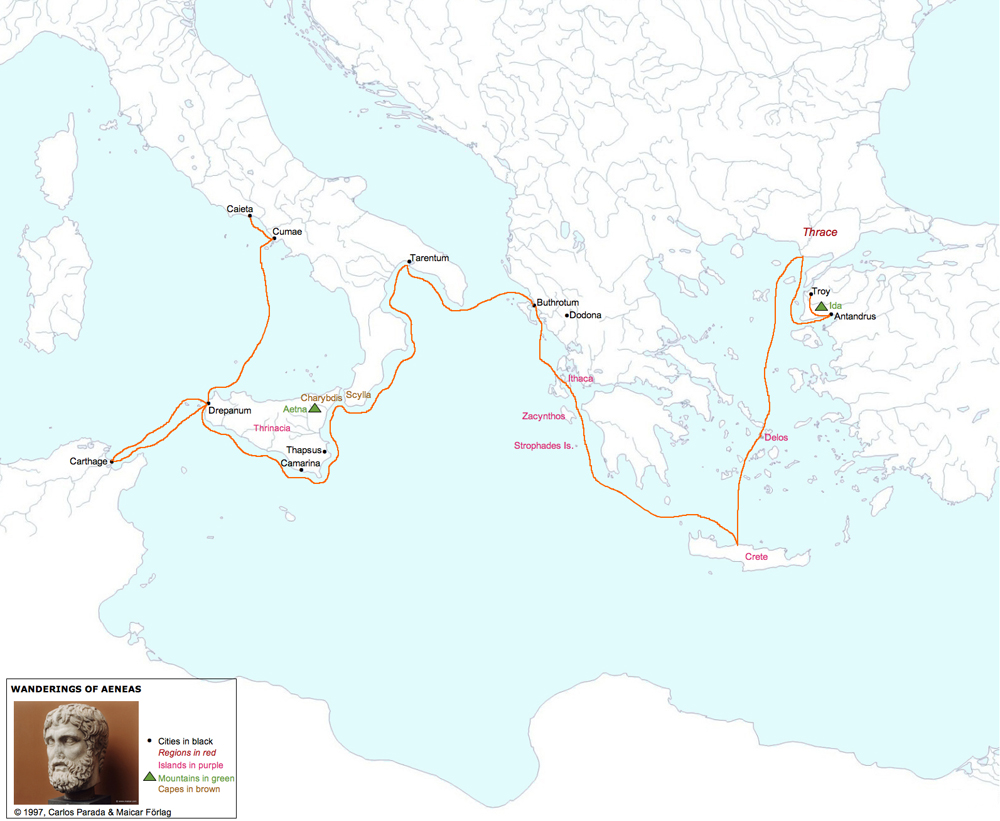
Synopsis of Aeneas' wanderings: Aeneas built his fleet in Antandrus. He sailed first to Thrace where he met Polydorus 3's ghost. Then, after having been received in Delos by King Anius, he attempted to settle in Crete but failed. Later, after having stopped in the Strophades Islands and Zacynthos and having sailed past Ithaca, Aeneas came to Buthrotum in Epirus. Thence he crossed to Italy skirting the waters of Tarentum, Lacinium and the Sicilian coast. On his first arrival to Drepanum, Aeneas lost his father. Thence he sailed to Carthage where he met Queen Dido. After having been amorously involved with the queen, Aeneas returned to Drepanum, and thence he crossed to Italy. In Cumae he descended to the Underworld, ending soon after his trip in the harbour of Caieta.

Resumen de los viajes de Eneas: Eneas construyó su flota en Antandro. Llegó primero a Tracia, en donde se encontró con el espíritu de Polidoro 3. Después que lo recibiera el rey Anio en la isla de Delos, realizó un fallido intento de afincarse en Creta. Luego hizo escalas en las islas Estrófades y Zacinto, pasando Ítaca de largo, antes de llegar a Butrotis, en Epiro. Luego cruzó hacia Italia, bordeando las aguas de Tarento, del cabo Lacinio, y de la costa siciliana. En su primera llegada al cabo Drépano, Eneas perdió a su padre. De ahí zarpó para Cartago, en donde conoció a la reina Dido. Después de su aventura amorosa con la reina, Eneas volvió a Drépano, y de ahí cruzó a Italia. En Cumas, descendió al Mundo Subterráneo, y luego culminó su viaje en el puerto de Cayeta (hoy Gaeta).

First part of Aeneas' wanderings

In Thrace, where he came first, he received a warning from the ghost of Polydorus 3 (Priam 1's son), whom King Polymestor 1 of the Bistonians had treacherously murdered [see also Priam 1 and Hecabe 1]:

"Get away from this cruel land, from these hard-fisted shores." [Ghost of Polydorus 3 to Aeneas. Virgil, Aeneid 3.44]

Next, they were received by Anius, king of Delos, where at the temple of Apollo he received instructions which he believed to mean that he ought to sail to Crete. However, famine and sickness waited for them in Crete, and when they left the island, the home-gods of Aeneas appeared to him and told him to sail to Italy, but having reached the Strophades Islands, they were plundered by the HARPIES.

In the island of Zacynthus, they were received in a friendly manner. The island is called after Zacynthus, son of Dardanus 1 and Batia 1, and brother of Erichthonius 1, an ancestor of Aeneas.

Later they arrived to Buthrotum in Epirus, where Priam 1's son Helenus 1, having married Andromache (wife of Hector 1 and, after the Trojan War, concubine of Neoptolemus until the latter's death) reigned. Helenus 1 gave Aeneas further directions who allowed him to reach Drepanum in Sicily. Some say, however, that Aeneas marched two days from Buthrotum to Dodona, in order to consult the oracle, and that it was in Dodona that he met Helenus 1.

Thence they intended to sail to Italy, but a storm sent by Hera, who had not forgotten the outrage she suffered at Mount Ida on the occasion of the Judgement of Paris, carried them to Libya, where there was a city Carthage, ruled by Queen Dido.

Primera parte de los viajes de Eneas

En Tracia, su primera escala, Eneas recibió una advertencia del fantasma de Polidoro 3 (hijo de Príamo 1), a quien alevosamente dio muerte Polimestor 1, rey de los Bistones [véanse también Príamo 1 y Hécuba 1]:

«Huye, ¡ay!, de esta tierra despiadada, huye de una costa tan avara.» [El fantasma de Polidoro 3 a Eneas. Virgilio, Eneida 3.44]

Después, fue hospedado por Anio, rey de Delos, en cuyo templo de Apolo recibió instrucciones que le parecieron indicar que debía ir rumbo a Creta. Sin embargo, no lo esperaban ahí sino hambre y enfermedades. Al zarpar de Creta, se le aparecieron a Eneas las divinidades de su hogar, indicándole que fuera a Italia, pero al llegar a las islas Estrófades, las HARPÍAS los despojaron.

En la isla de Zacinto, Eneas y sus compañeros fueron recibidos de manera amigable. La isla lleva ese nombre por Zacinto, hijo de Dárdano 1 y Batía 1, y hermano de Erictonio 1, antepasado de Eneas.

Luego llegaron a Butrotis, en Epiro, donde reinaba Héleno 1, hijo de Príamo 1, habiéndose casado con Andrómaca (esposa de Héctor 1, y, luego de la Guerra de Troya, concubina de Neoptólemo, hasta la muerte de éste). Gracias a las instrucciones de Héleno 1, pudo Eneas llegar al cabo Drépano, en Sicilia. Otros cuentan, sin embargo, que Eneas marchó dos días de Butrotis hasta Dodona para consultar el oráculo, y que fue ahí que se encontró con Héleno 1.

Su intención era navegar directamente a Italia, pero Hera, con rencor por la ofensa que había sufrido en el Monte Ida cuando Paris ofició de juez, envió una tormenta que lo arrastró hasta Cartago, la ciudad de Libia en donde reinaba Dido.

Queen Dido's story before Aeneas

Dido, daughter of Belus 2, an Assyrian, was a Phoenician who had left Tyre and founded Carthage. In Tyre she had been married to Sychaeus, a man of great status among the Phoenicians. Sychaeus, however, was murdered by Dido's brother Pygmalion 2, who was a great lover of gold and a man of power. Dido learned about what had happened when her husband's ghost appeared to her, disclosed the crime, and urged her to flee the country. She then organised her friends for escape, and having come to Libya, she purchased land, a site that was called "Bull's Hide" after the bargain by which she should get as much territory as she could enclose with a bull's hide. And in that site she founded Carthage.

Others say, however, that a Moor king called Iarbas, son of Zeus-Ammon, wished to marry Dido, who, being in love with Aenas, rejected him. Iarbas is also said to have given her the country where she founded her kingdom (Carthage). So, after Dido's death, Iarbas invaded the country and Dido's sister Anna 1, who had hoped that Dido would marry Aeneas, went into exile, first in Malta and afterwards in Italy, where she met Aeneas.

Historia previa de Dido

Dido, hija de Belo 2, un asirio, es la princesa fenicia que abandonó Tiro y fundó Cartago. En Tiro, había estado casada con Siqueo, un hombre influyente en Fenicia. Siqueo, sin embargo, fue asesinado por el hermano de Dido, Pigmalión 2—un gran amante del oro y del poder. Dido se enteró de lo que le había ocurrido a su marido cuando se le apareció el fantasma de éste, revelándole el crimen de que había sido víctima y apremiándola para que abandonara el país. Organizó ella a sus amigos, y huyó. Al llegar a Libia, compró tierra en un sitio conocido como «El Cuero del Toro», por el trato que estipulaba que recibiría un territorio igual al que pudiera rodearse con un cuero de toro. Y en ese lugar, fundó Cartago.

Dicen otros que un rey moro, Yarbas, hijo de Zeus-Amón, deseaba casarse con ella, pero que Dido lo rechazó por estar enamorada de Eneas. Se afirma que fue Yarbas quien concedió a Dido el territorio en donde fundó su reino (Cartago). Así, al morir Dido, invadió Yarbas el país, y la hermana de aquella, Anna 1, que había propiciado el casamiento de Dido con Eneas, tuvo que exilarse, primero en la isla de Malta y luego en Italia, en donde volvió a encontrarse con Eneas.

Extraordinary paintings

After his father's death at Drepanum in Sicily, Aeneas arrived to the prospering Carthage, where he discovered a series of frescoes depicting the Trojan War. In them, Agamemnon and Menelaus, Priam 1 and Achilles could be seen. He also recognised in the paintings the tents of Rhesus 2, who came from Thrace to fight at Troy and died the day after his arrival, killed by Odysseus and Diomedes 2.

Pinturas extraordinarias

Luego de la muerte de su padre en Drépano, Sicilia, llegó Eneas a la próspera Cartago, donde descubrió una serie de frescos que representaban la Guerra de Troya. En ellos aparecían Agamenón, Menelao, Príamo 1 y Aquiles. Reconoció también en las pinturas el campamento de Reso 2, el capitán que había llegado de Tracia para luchar en Troya, y que mataran, el día de su llegada, Odiseo y Diomedes 2.

Dido and Aeneas

Queen Dido received the Trojans with hospitality, and fell in love with Aeneas. He, in turn, started to forget that he was meant to sail to Italy. But as he was superintending public works, Hermes, sent by Zeus, came to him, amd reproached him:

"So now you are laying foundations for Carthage, building a beautiful city to please a woman, lost to the interests of your own realm?" [Hermes to Aeneas. Aeneid 4.265]

Aeneas then, remembering his own destiny, decided to leave Dido and Carthage:

"In Italy lies my heart, my homeland. You, a Phoenician, are held by these Carthaginian towers, by the charm of your Libyan city." [Aeneas to Dido. Aeneid 4.345]

But as Dido would not accept the separation, Aeneas proclaimed:

"No more reproaches ... they only torture us both. God's will, not mine, says 'Italy'" [Aeneas to Dido. Aeneid 4.360]

Dido, who felt she had rescued Aeneas' lost fleet, saved his friends from death, taken a pauper and a castaway and shared her kingdom with him, could not see in Aeneas' decision more than betrayal and ingratitude. So on Aeneas' departure, Dido cast herself upon Aeneas' sword on a pyre, and that is why upon her tomb it was written:

"Aeneas caused her death and lent the blade, Dido by her own hand in dust was laid." [Ovid, Heroides 8]

Dido y Eneas

La reina Dido recibió a los troyanos con hospitalidad, y se enamoró de Eneas. Al principio, olvidaba él que su destino era Italia. Pero un día, mientras supervisaba ciertas obras públicas, se le apareció Hermes, que había sido enviado por Zeus, para reprocharle:

«¿Tú te dedicas ahora a plantar los cimientos de la alta Cartago y complaciente con tu esposa construyes una hermosa ciudad? ¡Olvidas, ay, tu reino y tus propios deberes!» [Hermes a Eneas. Virgilio, Eneida 4.265]

Recordó entonces Eneas su destino, y decidió dejar a Dido y Cartago:

«...a Italia las suertes licias me ordenaron marchar; ése es mi amor, ésa mi patria... a ti, fenicia, las murallas de Cartago te retienen y la vista de una ciudad libia.» [Eneas a Dido. Eneida 4.345]

Y como Dido no aceptaba la separación, declaró él:

«Deja ya de encenderme a mí y a ti con tus quejas; que no por mi voluntad voy a Italia [sino por la de los dioses][Eneas a Dido. Eneida 4.360]

Dido, que sentía que había rescatado la flota de Eneas, salvado a sus amigos de la muerte, tomado bajo su protección a un vagabundo despojado, y compartido con él su reino, no podía ver en la decisión de Eneas más que traición e ingratitud. Y el mismo día que él zarpó, se dejó caer ella sobre la espada de Eneas encima de la pira funeraria. Por eso su epitafio decía:

«Ocasionó Eneas su muerte, y prestó la espada;
Dido, por propia mano, en el polvo fue enterrada.»
[Ovidio, Heroidas 8]

Aeneas descends to Hades

After landing once more in Sicily, Aeneas' fleet came to Cumae where Aeneas, led by the Sibyl, descended to the Underworld. There he met his father, and also Dido, who reunited with her Tyrian husband, refused to talk to him. Some of those whom Aeneas met in the Underworld belong to the past, but others belong to the future, as those from the future lineage of Alba Longa [see also AENEAS IN HADES], and his own son Silvius, who had not yet been born.

Eneas desciende al Hades

Después de un segundo desembarco en Sicilia, llegó la flota de Eneas a Cumas. Ahí, guiado por una Sibila, descendió al Mundo Subterráneo, donde se encontró con su padre, y también con Dido, que, reunificada con su marido tirio, se negó a dirigirle la palabra. En el Mundo Subterráneo se encontró Eneas con personajes del pasado y también del futuro, como los pertenecientes al linaje de Alba [véase también ENEAS EN HADES], y su propio hijo Silvio, que aún no era nacido.

End of journey

Next Aeneas came to Latium, a land ruled by King Latinus 1 (son of Faunus 1, son of Picus, son of Cronos), whose daughter Lavinia 2, King Turnus of the Rutulians wished to marry. Turnus was son of King Daunus of Apulia, the same who gave his daughter and lands to Diomedes 2, when the latter landed in Italy after the Trojan War. Latinus 1, however, preferred to give his daughter to Aeneas, as he had learned from an oracle that she was supposed to marry a foreigner. But his wife Amata encouraged Turnus, and because of the intrigue that ensued, a significant war broke out with many allies on both sides.This war only ended when, in single combat, Aeneas killed Turnus. After the war, he married Lavinia 2, and their son Silvius became ruler of Alba Longa.

Fin de la jornada

Después llegó Eneas al Lacio, territorio que gobernaba el rey Latino 1 (hijo de Fauno 1, hijo de Pico, hijo de Crono), a cuya hija Lavinia 2, deseaba desposar el rey de los rútulos, Turno. Era éste hijo de Dauno de Apulia, el mismo que le dio su hija y parte de sus tierras a Diomedes 2, al desembarcar éste en Italia, luego de la Guerra de Troya. Latino 1, sin embargo, prefería como yerno a Eneas antes que a Turno, pues había sabido por un oráculo que su hija se casaría con un extranjero. Pero Amata, esposa de Latino 1, prefería a Turno, y en razón de la intriga que se derivó de las contrarias preferencias, estalló una importante guerra, en la que ambas partes fueron apoyadas por numerosos aliados. La guerra terminó cuando, en un duelo, Eneas dio muerte a Turno. Se casó después con Lavinia 2, y el hijo de ambos, Silvio, llegó a ser rey de Alba.

Death

The circumstances of Aeneas' death are uncertain. Some affirm that Aeneas disappeared during a battle against the army of Mezentius (an ally of his enemy Turnus), but others say that he died in Thrace without ever reaching Italy, or that he, after having settled his people in Italy, returned home and became king of Troy, leaving the kingdom, after his death, to his son Ascanius 2.

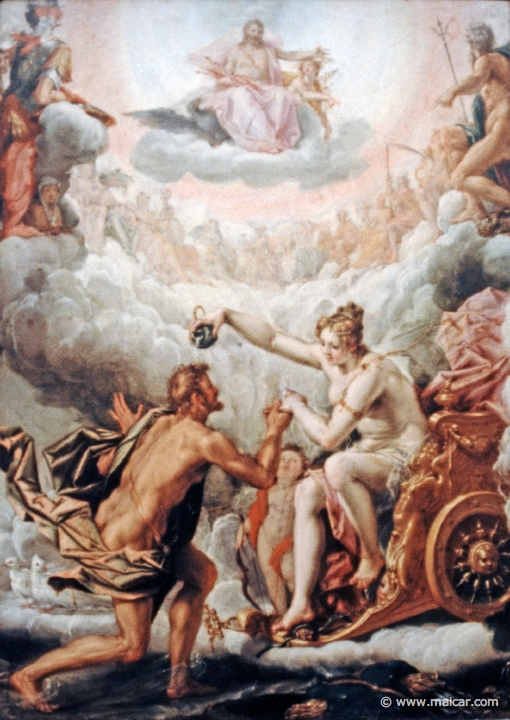
It is also told that Aphrodite asked Zeus to make Aeneas immortal, and as Zeus granted her request, the river god Numicius washed away all of Aeneas' mortal part, and Aphrodite anointed him with Nectar and Ambrosia, making him a god, whom the people later worshipped under the name of Indiges.

Family

Muerte

Las circunstancias de la muerte de Eneas son inciertas. Algunos afirman que Eneas desapareció mientras peleaba contra el ejército de Mecencio. Otros dicen que murió en Tracia sin llegar jamás a Italia, o que, luego de haber afincado a su gente en Italia, regresó a su país, donde fue coronado rey de Troya. Después de su muerte, lo habría sucedido en el trono su hijo Ascanio 2.

También se cuenta que Afrodita le pidió a Zeus que hiciera inmortal a Eneas. Zeus habría concedido el pedido, y el dios-río Numicio arrastró consigo las partes mortales de Eneas. Luego, lo ungió Afrodita con Néctar y Ambrosía, convirtiéndolo en una divinidad, que fue después adorada bajo el nombre de Indiges.

Linaje.

Aphrodite receives Aeneas in Olympus | Afrodita recibiendo a Eneas en el Olimpo


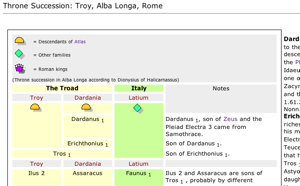
Throne succession in Alba Longa after Aeneas

Kings Album: 12 High Resolution Throne Succession Tables of 15 kingdoms with Dictionary Entries including sources of 266 Kings


Family

Linaje

Parentage

Mates

Offspring

Notes

Anchises 1 & Aphrodite


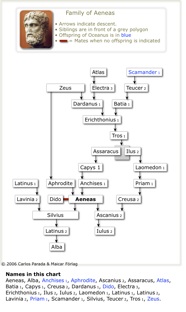
Anchises 1 was a member of the royal house of Dardania, which is a region neighbouring Troy. Anchises 1's father was King Capys 1 of Dardania, who recommended throwing the WOODEN HORSE into the sea. Capys 1 is son of Assaracus, son of Tros 1. This Tros 1 called the people of the land Trojans, after his own name. His father was Erichthonius 1, also king of the Dardanians; Erichthonius 1 became rich and powerful, as he inherited both the kingdom of his father and that of his maternal grandfather. This is so because his father was Dardanus 1 after whom the whole country was named, and his mother was Batia 1, daughter of Teucer 2, the eponym of the Teucrians who gave a share of his land to Dardanus 1. Teucer 2 was a son of the river god Scamander 1, and Dardanus 1 is son of Zeus and Electra 3, one of the PLEIADES, daughters of Atlas.

a) Creusa 2

b) Eurydice 10

Ascanius 2

Etias

["a)" and "b)" = different versions]

Creusa 2, daughter of Priam 1 and Hecabe 1, was left behind when Aeneas abandoned Troy.

Eurydice 10 is otherwise unknown.

For Ascanius 2, see Throne Succession above.

According to some, Aeneas named the city of Etis in Laconia after his daughter Etias.

Dido

---

See main text above.

Lavinia 2

Silvius

Aemilia

For Silvius, see Throne Succession above.

Aemilia is sometimes called mother of Romulus by Ares.

Roma 2

---

Roma 2 is said to have given her name to the city of Rome, but see also Roma 1, Roma 3, Romanus, Romus, and Romis.

Dexithea 2

Romulus

Dexithea 2 was daughter of Phorbas 9.

Codone 2

Aeneas' Daughter 1.

Aeneas' Daughter 1 is said to have been left by Aeneas in Nesos (Arcadia) after the Trojan War [see also Aeneas' Daughter 2 and Etias].

Anthemone

Aeneas' Daughter 2

Aeneas' Daughter 2 is said to have been left by Aeneas in Nesos (Arcadia) after the Trojan War [see also Aeneas' Daughter 1 and Etias].

unknown

Euryleon 2

Romus

Euryleon 2 is otherwise unknown.

Romus is said to have given her name to the city of Rome, but see also Roma 1, Roma 3, Romanus, Roma 2, and Romis.


Abolengo Album - High Resolution Genealogical Charts

Names in this chart

Aeneas, Alba, Anchises 1, Aphrodite, Ascanius 2, Assaracus, Atlas, Batia 1, Capys 1, Creusa 2, Dardanus 1, Dido, Electra 3, Erichthonius 1, Ilus 2, Iulus 2, Laomedon 1, Latinus 1, Latinus 2, Lavinia 2, Priam 1, Scamander 1, Silvius, Teucer 2, Tros 1, Zeus.


Family

Linaje

Progenitores

Parejas

Descendencia

Notas

Anquises 1 & Afrodita


Anquises 1 pertenecía a la casa real de Dardania, región vecina a Troya. Su padre era Capis 1, rey de Dardania, que recomendó arrojar el CABALLO DE MADERA en el mar. Capis 1 era hijo de Asáraco, hijo de Tros 1, epónimo de los troyanos. El padre de éste era Erictonio 1, también rey de Dardania. Erictonio 1 se hizo rico y poderoso al heredar al mismo tiempo el reino de su padre y el de su abuelo materno. Su padre era Dárdano 1, epónimo del país, y su madre era Batía 1, hija de Teucro 2, epónimo de los teucros, que le dio parte de su reino a Dárdano 1. Teucro 2 era hijo del dios-río Escamandro 1, y Dárdano 1 era hijo de Zeus y Electra 2, una de las PLÉYADES, hijas de Atlas.

a) Creúsa 2

b) Eurídice 10

Ascanio 2

Etias

[«a)» y «b)» = versiones distintas]

Creúsa 2, hija de Príamo 1 y Hécuba 1, se quedó atrás cuando Eneas abandonó Troya.

Aparte de esto, nada se sabe de Eurídice 10.

Sobre Ascanio 2, véase Sucesión al Trono.

Según algunos, Eneas le dio el nombre de Etis a la ciudad de Laconia, por su hija Etias.

Dido

---

Véase el texto más arriba.

Lavinia 2

Silvio

Emilia

Sobre Silvio, véase Sucesión al Trono.

A Emilia se la considera a veces madre de Rómulo (siendo Ares el padre).

Roma 2

---

Se dice que por Roma 2 recibió la ciudad de Roma su nombre. Pero véase también Roma 1, Roma 3, Romano, Romo y Romis.

Dexítea 2

Rómulo

Dexítea 2 era hija de Forbas 9.

Codone 2

Hija 1 de Eneas

La Hija 1 de Eneas habría sido abandonada por Eneas en Neso (Arcadia), con posterioridad a la Guerra de Troya [véase también Hija 2 de Eneas, y Etias].

Antémone

Hija 2 de Eneas

La Hija 2 de Eneas habría sido abandonada por Eneas en Neso (Arcadia), con posterioridad a la Guerra de Troya [véase también Hija 1 de Eneas, y Etias].

desconocida

Eurileonte 2

Romo

Aparte de esto, no se conoce a Eurileonte 2.

Se dice que la ciudad de Roma se llamó así por Romo. Pero véase también Roma 1, Roma 3, Romano, Roma 2 y Romis.

Sources
Abbreviations

Apd.3.12.2; Apd.Ep.3.34ff., 5.21; DH.1.49.1-2, 1.62.2, 1.64.4, 1.72.1; Eur.Rhe. passim; Hes.The.1008; Hom.Aph.5.198; Hom.Il. 20.300ff.; Ov.Her.7; Ov.Fast. 3.629, 4.37; Pau.3.22.10, 10.26.2; Plu.Rom.2.1-3; QS.13.300ff.; Strab.5.3.2; Vir.Aen. passim.