|
|
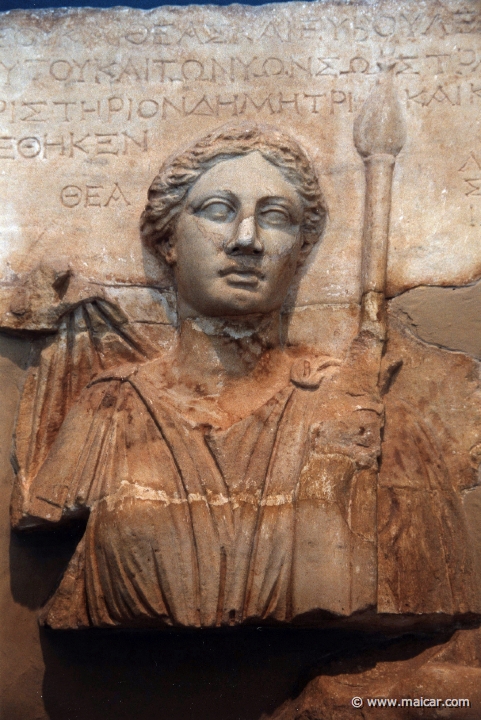
Underworld goddess (thea), whose name is not uttered. 6522: Relief dedicated by the priest Lakrateides and his family to the Eleusinian deities. Detail: nameless goddess (thea) 100-90 BC. Archaeological Museum of Eleusis.
|
|
|
"Who knows if to live is to be dead, and to be dead, to live? And we really, it may be, are dead; in fact I once heard sages say that we are now dead, and the body is our tomb …" (Socrates. Plato, Gorgias 492e).
" … it is not easy to believe that the gods possess any underground dwelling where the souls collect." (Pausanias, Description of Greece 3.25.5).
……..
There go the loves that wither,
The old loves with wearier wings;
And all dead years draw thither,
And all disastrous things;
Dead dreams of days forsaken,
Blind buds that snows have shaken,
Wild leaves that winds have taken,
Red strays of ruined springs.
…
From too much love of living,
From hope and fear set free,
We thank with brief thanksgiving
Whatever gods may be
That no life lives for ever;
That dead men rise up never;
That even the weariest river
Winds somewhere safe to sea.
(Algernon Charles Swinburne 1837-1909, The Garden of Proserpine).
"Any more for Lethe, Blazes, Perdition, or the Dogs? Come along now, any more for a nice restful trip to Eternity? No more worries, no more cares, makes a lovely break!" (Charon in Aristophanes, The Frogs 210).
|
|
After death there is no annihilation. The dead are dead because they lead a flavorless and unhappy existence in the Underworld. Those who for practical purposes are dead, but nevertheless exist and dwell in all happiness in the Islands of the Blest or Elysium, are called
Immortals. So life and death are qualities of
existence, not lack of it.
Oceanus and Styx
Between the world of the living and that of the
dead there are, it is said, great rivers and dread
streams. First, greatest and outermost is Oceanus, which winds
about the earth and the sea with nine rings, but is
also a subterranean river. The river Styx (river of
Hate), which is a primordial figure too (daughter
of Oceanus), is a branch
of Oceanus and a tenth
part of his water is allotted to her. So Styx,
which flows out from a rock, is the tenth ring,
though some say that Styx itself corrals the souls
in the Underworld with nine rings.
The Oath of the Gods
Styx, daughter of Oceanus, was the first
to come to Olympus and, together with her children,
supported the gods in their war against the TITANS. For this reason Zeus caused oaths to be
sworn by the water of Styx. If any of the gods
pours a libation of her water and is forsworn,
he/she lies breathless for a year, never tastes
Ambrosia and Nectar and lies down spiritless and
voiceless. After spending thus one year in sickness
he/she is cut off for nine years from the god's
councils and feasts and cannot return until the
tenth year. Such is the oath of Styx, which could
be expressed thus:
"Now let my
witness be Earth, and the wide Heaven above, and
the down-flowing waters of Styx, which is the
greatest and most dread oath for the blessed gods,
and your own sacred head, and our own bridal couch,
by which I would never dare to forswear
myself—that not by my will is Poseidon doing Hector and the Trojans harm and helping
their enemies." (Hera to Zeus. Homer, Iliad 15.36).
or thus:
"Now let Earth
be my witness, with the broad Heaven above, and the
down-flowing waters of Styx -the greatest and most
solemn oath the blessed gods can take- that I
harbour no secret plans to hurt you." (Calypso 3 to Odysseus. Homer, Odyssey 5.182).
or thus:
"Now hear
this, Earth and wide Heaven above, and dropping
water of Styx (this is the strongest and most awful
oath for the blessed gods), surely Apollo shall have here his fragrant altar
and precinct, and you he shall honor above all." (Leto to Delos, the
island. Homeric
Hymn to Delian Apollo 84).
or thus:
"… For -be witness the oath of the gods, the relentless water of Styx- I would have made your son deathless and unaging all his days…but now he can in no way escape death …" (Demeter to
Metanira. Homeric
Hymn to Demeter 259).
or thus:
"And may that
Stygian pool whereby gods swear, but which my eyes
have never seen, be witness of my promise." (Helius to Phaethon 3. Ovid, Metamorphoses 2.45).
|
|
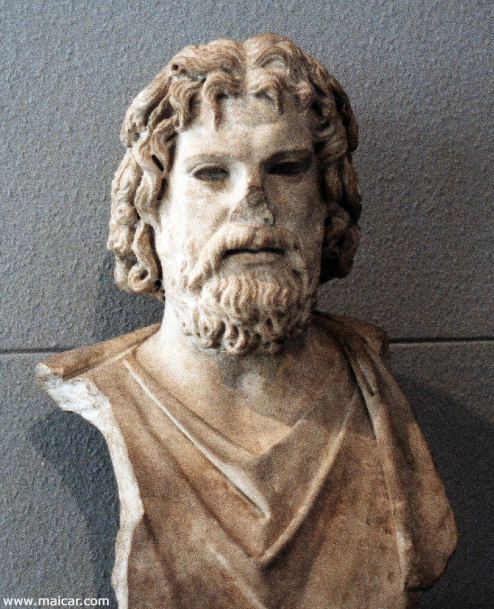
Hades, lord of the Underworld. 5616: Hades, dieu des Enfers. Vonitza, Grèce. Copie romaine d'une création grecque de 350-300 avant J.-C. Musée d'Art et d'Histoire, Genève.
|
|
Other Rivers
Styx is sometimes considered to be the river the souls must cross to enter the realm of the dead, though at other times it appears that the souls may cross the river Acheron (river of Woe), or embarking here in vessels and navigating its stream, come to the Acherusian Lake. Some say that it is in this lake that the ferryman Charon takes the two obols for the fare. According to some, into Acheron flow Pyriphlegethon (river of Fire), and Cocytus (river of Wailing), which is a branch of the Styx. But others say that the river Acheron, turbid with mud, pours all its sand into the stream of Cocytus, and the place where all these rivers meet is known as the Stygian marsh. Still others assert that these rivers have no
bottom or foundation and that they, coming in and
out from Tartarus, oscillate and wave up and down
from one side of the earth to the other. The river
Acheron, which flows through various desert places,
is said to come to the Acherusian Lake, where the
souls of most of the dead remain, some for a longer
time, some for a shorter, until they are reborn.
The river Pyriphlegethon, which is a stream of lava
rolling in its torrent clashing rocks, also builds
a large lake boiling with water and mud.
Pyriphlegethon comes to the edge of the Acherusian
lake, but does not mingle with its water and
neither does the Styx, which coming close to the
Acherusian Lake, passes round in a circle and falls
back into Tartarus under the name of Cocytus.
Tartarus, Cosmic Place
Tartarus is the lowest abyss beneath the earth
where all waters originate; all rivers flow into
the chasm of Tartarus and flow out of it again.
Tartarus is, they say, a gloomy place as far
distant from earth as earth is from the sky. For,
it is said, a brazen anvil falling down from heaven
nine nights and days would reach the earth upon the
tenth: and again, a brazen anvil falling from earth
nine nights and days would reach Tartarus upon the
tenth. Still others say that Tartarus yawns deep
under the shades, extending down twice as far as
the view upward to Heaven. Tartarus and the
Underworld are the realm of Erebus, which is pure
Darkness.
Tartarus, Place of Punishment
Tartarus is also a place of punishment. Round it runs a fence of bronze, and night spreads in triple line all about it. Some say that the gates are of iron and the threshold of bronze, and others that there is a threefold wall around it. Around this triple wall flows Pyriphlegethon with its flames and its clashing rocks. The entrance, in which there is an enormous portal has pillars of solid adamant that not even the gods could break. At the top of its tower of Iron sits the Erinye Tisiphone 1, with her bloody robe, and sleepless day and night, guards the entrance.
Tartarus, the Being
Tartarus is, at the same time, a being capable of intercourse. Tartarus is the father of such monsters as Echidna and Typhon (for the attack of Typhon against heaven see Zeus). Erebus, the Darkness of the Underworld, possibly existing from the beginning together with Chaos, Nyx (Night) and Tartarus,
gave birth, according to some, to the MOERAE, the HESPERIDES, Hypnos, Geras (Old Age), Thanatos (Death) and
Styx.
Arrival to Hades
|
|
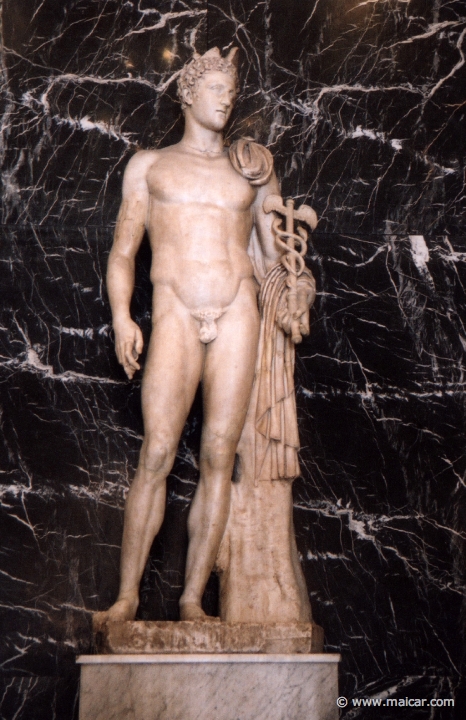
Hermes: leads the souls of the dead to the Underworld. 10013: Hermes, en el descanso de la escalera del Museo Arqueológico Nacional, Madrid.
|
|
As men and women die, Hermes leads their souls
to the Underworld, past the streams of Oceanus, past the White
Rock (Leucas), past the Gates of the Sun and the
Land of Dreams, until they reach the Asphodel
Fields, where the spirits dwell living the
flavourless existence of a shadow or phantom. This
is not a place of punishment, but there is no
pleasure and the mind is confused and oblivious
(with the exception of Tiresias).
The Entrance
Before the entrance to Hades live Grief and
Anxiety, along with Diseases and Old Age
(Geras). Also Fear,
Hunger, Death, Agony, and Hypnos (Sleep), brother
of Thanatos (Death),
dwell in this place together with Guilty Joys. On
an opposite threshold is War, the ERINYES, and Eris (Discord). Close to
the doors, many other beasts dwell: CENTAURS, GORGONS, the Hydra from Lerna, the Chimera, the
HARPIES, and others. In the midst of all this, an
Elm can be seen, and False Dreams cling under every
leaf.
Charon
The dead seem to know the location of Hades less
than the living, as several entrances to Hades were
known from all times (one of them is in Taenarum,
another in Cumae; Odysseus arrived to
Hades navigating the stream of Oceanus). The souls
descending to Hades carry a coin under the tongue
in order to pay Charon, the ferryman who ferries
them across the river. Charon may make exceptions
or allowances for those visitors carrying a certain
Golden Bough. Otherwise, this Charon is appallingly
filthy, with eyes like jets of fire, a bush of
unkempt beard upon his chin, and a dirty cloak
hanging from his shoulders. However, although
Charon embarks now one group now another, some
souls he keeps at distance. These are the unburied:
none may be taken across from bank to bank if he
had not received burial.
On the other bank
Across the river, or as some say, guarding the gates of Hades, is Cerberus 1, the bronze-voiced hound, who eats raw flesh and has fifty heads. Others say that this hound has three heads of dogs, the tail of a dragon, and on his back the heads of all sorts of snakes. Cerberus 1 was once caught by Heracles 1 (see this one). On another occasion, someone eluded his guarding instinct, throwing him a cake of honey and wheat infused with sedative drugs. Then several categories of souls appear in this neutral zone or Limbo, which could be the same as the Asphodel Fields. Children are by themselves, and so are those who have been condemned to death on a false charge, and those who killed themselves. Next comes the Vale of Mourning where those who were consumed by unhappy love dwell, and in the farthest fields, before the dividing road, are those who were famous in war.
The Dividing Road and the Judges of the Dead
Some say that the soul receives judgement in the
meadow (the Plain of Judgement) at the dividing of
the road, whence are the two ways leading, one to
the Isles of the
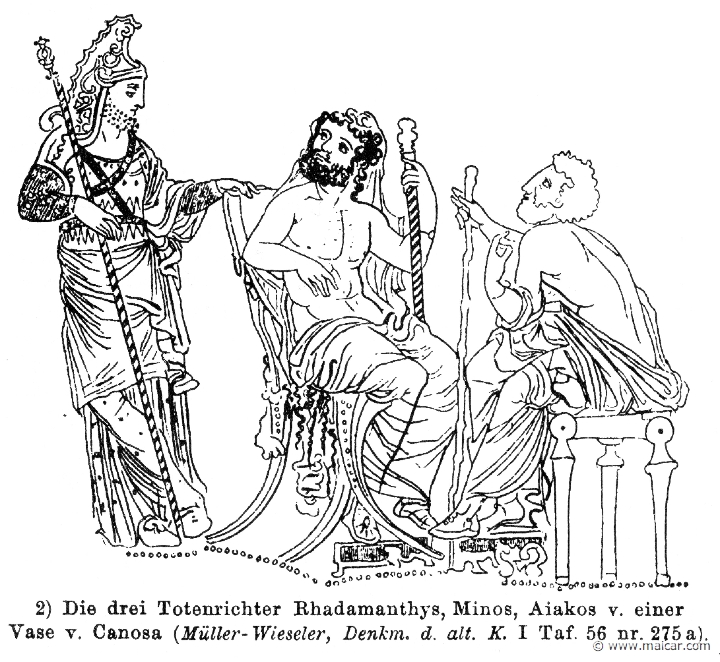
Blest (or Elysium), and the other to Tartarus. Those who pass judgement are Aeacus, former king of
Aegina, Minos 2, former
king of Crete, and
Rhadamanthys, brother of Minos 2. Aeacus, who keeps the
keys of Hades, judges those who come from Europe,
and Rhadamanthys the Asians, but Minos 2 has the privilege
of the final decision. However, those who suffer a
punishment in the Underworld have been condemned by
the gods.
|
|
The three JUDGES OF THE DEAD: Rhadamanthys, Minos 2, and Aeacus. RII.2-3003b: Die drei Totenrichter Rhadamanthys, Minos, Aiakos v. einer Vase v. Canosa (Müller-Wieseler, Denkm. d. alt. K. I Taf. 56 nr 275 a). Roscher, 1884.
|
|
Well known characters punished in Tartarus
Rhadamanthys, who rules in Tartarus, is sometimes said to be the one whose severe rule tries and chastises wrongdoers, and forces confessions; then Tisiphone 1, who guards the entrance wrapped in a bloodstained robe, pounces upon the guilty, and lashes and threatens them, holding angry snakes in her left hand. There receive punishment the TITANS, the ALOADS (see Zeus), Salmoneus who mimicked the thunder and lightning of Zeus, Tityus who tried to
rape Leto, Ixion who attacked Hera, and Pirithous who tried to
carry off Persephone.
Many of these are prevented by the ERINYES to stretch out
their hands for the food they see before them. The ERINYES (Alecto, Megaera, and Tisiphone 1) are detectors and avengers of crime and wickedness, avenging spirits, goddesses of vengeance, ready to stab fear into the hearts of mortals. The CYCLOPES and the HECATONCHEIRES were hurled down to Tartarus by both Uranus and Cronos. And when Zeus overcame the TITANS he shut them up
there. Campe was in Tartarus the jaileress of the CYCLOPES and the HECATONCHEIRES.
Double-shaped, she appeared a woman to the middle
of her body, with clusters of poisonous serpents
for hair. Her giant form, from the chest to the
parting-point of the thighs, was covered with
sea-monster's scales. The claws of her hands were
curved like a crook-talon sickle and over her
shoulders a scorpion coiled upon itself. Campe is
no longer in the Underworld because she was
destroyed by Zeus. But Eurynomus 3, a demon who eats off all the flesh of the corpses, leaving only the bones, is probably still there.
Crimes punished in Tartarus
Among those punished in Tartarus are also those
who in life hated their own brothers, those who
struck their parents, those who loving fraud
entangled their clients, those who kept their
wealth for themselves without ever sharing (these
are the majority), those who killed for adultery,
those engaged in treason, those who corrupted the
laws and became dictators, those who entered the
beds of their daughters, and others who committed
numerous crimes which would never cease to fill an
unending catalogue; but equally unending are the
punishments and retributions inflicted here:
rolling huge rocks, whirling round, or sitting in
the Chair of Oblivion are just a few examples.
Other punishments for the wicked
The most wicked and the worst criminals are cast
into Tartarus, whence they never emerge. Others,
who have committed great wrongs but who
nevertheless are curable, are thrown into Tartarus
where they remain for some time until the waves,
either of Cocytus or of Pyriphlegethon cast them
out again. They then are carried by the currents to
the Acherusian Lake, where they beg to those whom
they have wronged to be gracious and let them come
out into the lake. If they prevail and their
prayers are heard by those who had been outraged by
them, they may come out and their ills cease, but
if not they return to Tartarus starting all over
again until they prevail upon those whom they have
wronged. This penalty is imposed upon them by the
Judges.
Elysium (Elysian Fields)
|
|
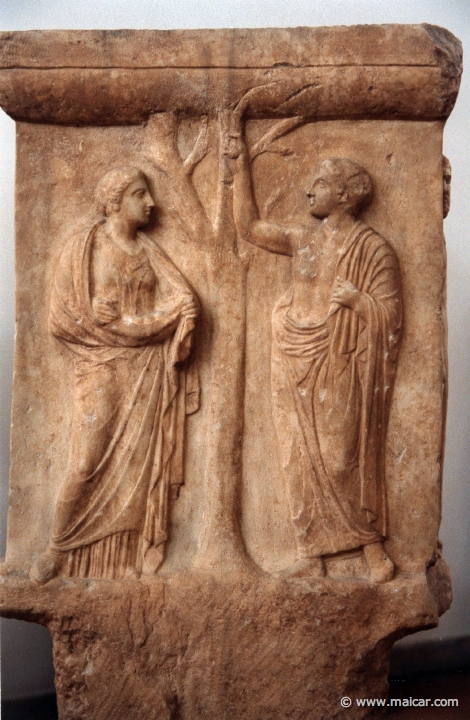
6322: Elysium? Relief decoration, base on which stood a lekythos. Hermes. Attic workshop near the end of the 5C BC. National Archaeological Museum, Athens.
|
|
There is then a spot where the way forks in two
directions, the right-hand leading, under the
Palace of Hades, to Elysium, and the left-hand
taking down to Tartarus. Elysium is a happy place
which has a sun and stars of its own. The souls in
Elysium cannot be grasped and are like phantoms and
in this they do not differ from those dwelling in
the Asphodel Fields. Those who dwell in Elysium
exercise upon grassy playing-fields or wrestle
friendly on yellow sands; some dance and others
sing or chant poems. Orpheus is here and Musaeus, who wrote songs and poems and uttered oracles. Some say several members of the Trojan Royal House dwell here. All these live in groves and make their beds on river-banks and may wander in luminous plains and green valleys (see also Islands of
the Blest).
Reincarnation
According to some in Elysium, which is
considered to be ruled by Cronos, live also those
who are not yet born. These souls swarm along the
banks of the river Lethe (Oblivion). Some say that:
"They were all
required to drink a measure of the water, and those
who were not saved by their good sense, drank more
than the measure, and each one as he drank forgot
all things." (Plato, Republic 10.618a).
The souls who are destined for reincarnation
drink from Lethe's stream and quench their troubles
in forgetfulness so that they may return to
corporeal existence on earth. This strange desire
(some say perverse) for earthly existence appears
to be a part of the laws governing the universe.
For, according to some, all that exists, heaven as
well as earth, the plains as the sea, the moon and
the sun and the stars are all sustained by a spirit
within, an immanent Mind. And this spirit flows
through the whole of the material world making it
work and producing all creatures including mankind.
Their life-force is celestial fire but they are
made out of clay, and thus encased in their dark
prison they fail to see the heavenly light and are
the victims of fear, depending on stupid desires
and grief as well as joy. They grow so accustomed
to their bodies and its evils that not even death
makes them relinquish those ills that the body is
heir to. That is why they are disciplined in the
Underworld paying the penalty of old evil, each one
finding his own level and suffering his own spirit.
Some of them however stay in Elysium, not needing
to reincarnate in order to regain original purity,
but the majority return to earth with their
memories deleted after having drunk from the waters
of Lethe.
The account of Er, Messenger from beyond
According to Er, the son of Armenius, who was
killed in battle but woke up when he was laying
upon the funeral pyre about to be cremated, he came
to the world beyond while he was dead and was
allowed to return so that he could be the messenger
to mankind to tell them of the Underworld. He
speaks about four mouths through which the souls
pass, some to damnation and some to salvation,
according to their deeds. For each wrong they have
done they pay the penalty tenfold for each,
measured by periods of a hundred years each, and
the same applies for those that are rewarded. And
before receiving judgement the souls wait in a
meadow, where acquaintances greet and tell their
stories to one another, some lamenting and others
relating their visions of beauty, depending on the
world they had just experienced. After several
days, when another cycle is about to begin, each
soul selects a new life. Says the Moerae Lachesis
(Alotter), attendant of Ananke (Necessity):
"Now is the beginning of another cycle of mortal generation where birth is the beacon of death. No divinity shall cast lots for you, but you shall choose your own deity [daemon, genius]. Let him to whom falls the first lot first select a life to which he shall cleave of necessity. But Virtue has no master over her, and each shall have more or less of her as he honors her or does her despite. The blame is his who chooses: God is blameless." (Plato, Republic 10.617d).
The patterns of lives put on the ground were far
more numerous than the assembly. There were lives
of all kinds of animals and all sorts of human
lives.
"There were lives of illustrious men, renowned for form and beauty or strength and physical achievement…In the same way there were lives of unknown men and women. But the disposition of the soul was not included, because with its choice of another life it too of necessity became different, but the other qualities were mixed with one another, wealth and poverty, sickness and health, and intermediate states." (Plato, Republic 10.618a ff.).
But to distinguish the better combination from
the worse was no simple thing. For how these
qualities—such as poverty and wealth, high or
low birth, private status and public office,
strength and weakness, intelligence and
stupidity—combine with the soul to produce
either good or evil, a better or a worse life, very
few know. Because most were dazzled by riches and
similar trumpery, and were not able to discriminate
or choose with sufficient examination, and because
they failed to observe what other things were
involved in the fate they had chosen, they were led
to all kind of iniquities. Because seeing the
riches they failed to see the sickness, or seeing
the power they failed to see the crimes they were
bound to commit. And so most of them disregarded
what makes life more just, and failed to follow the
mean in all circumstances, and to avoid excess in
either direction.
|
|
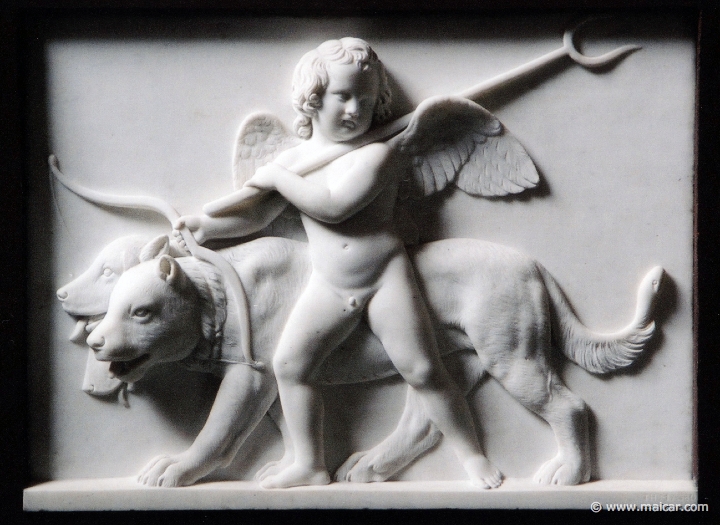
9130: Bertel Thorvaldsen 1770-1844: Cupid in the Underworld, as the Tamer of Cerberus, with Pluto’s Pitchfork, 1828. The Thorvaldsen Museum, Copenhagen.
|
|
Often the choice of a new life is determined by
the habits of former lives. So for example, Er saw Orpheus' soul select the
life of a swan, being unwilling to be born of a
woman, because women had been the cause of his
death. In the same way the soul of Ajax 1 was unwilling to
become a man and chose the life of a lion, not
being able to forget the adjudication of the arms
of Achilles. A similar
hatred of the human race made the soul of Agamemnon to choose
the life of an eagle. Odysseus, he says, drew
the last lot and went looking for the life of an
ordinary citizen who minds his own business, and at
last found it in a corner disregarded by the others
as they chose with higher ambitions in mind. When
all had chosen their new lives, the MOERAE confirmed their
fates and, having come to the Plain of Lethe and
its River of Oblivion, they were asked to drink a
measure, though some drank more than the measure,
and the more they drank the more they forgot. And
after they had fallen asleep a sound of thunder was
heard and the souls were wafted in different ways
to their birth like shooting stars.
Some who went there and returned
Besides the already mentioned Er, Odysseus, Aeneas, Heracles 1, Theseus, and Orpheus are among those
who descended to Hades while they still lived. None
of them was especially pleased with what they
witnessed. And Achilles, whom Odysseus met in Hades
(although some believe that he dwells in the Islands of the
Blest), said:
"Do not speak
soothingly to me of death, glorious Odysseus. I should choose to serve as the
hireling of another, rather than to be lord over
the dead that have perished." (Achilles' soul
to Odysseus. Homer, Odyssey 11.488).
|
