|
|
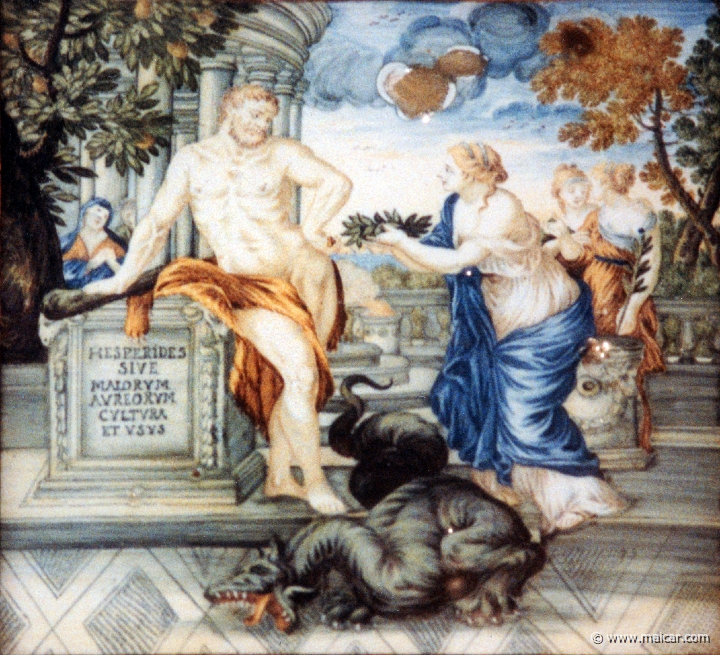
7702: Heracles and the Hesperides. Maioliche di Castelli d'Abruzzo del XVII e XVIII Secolo. Opere dei Grue, Gentili. Museo Correale di Terranova, Sorrento.
|
|
|
"And Atlas through hard constraint upholds the wide heaven with unwearying head and arms, standing at the borders of the earth before the clear-voiced Hesperides." (Hesiod, Theogony 319).
|
|
HESPERIDES are called the women who guarded the
Golden Apples that Heracles 1 had to
fetch.
The Golden Apples
When Zeus married Hera, Gaia gave them as a wedding
gift, the Golden Apples; and Hera, feeling great
admiration for these wonderful fruits, asked Gaia to plant them in the
garden that Hera kept near Mount Atlas, in the region we today may call northwestern Africa, but that was then called Libya. However, the HESPERIDES kept picking the Golden
Apples from the tree, and that is the reason why Hera decided to place a guardian dragon which was never overcome by sleep, although others say that the HESPERIDES and the dragon guarded the Golden Apples jointly, the monster guarding the tree, and the HESPERIDES singing their lovely songs around it. This dragon, called sometimes Ladon 4, was, according to some, the offspring of Typhon and Echidna, or according to others, of Phorcus and Ceto 1, and having one hundred heads, it was able to speak with many different voices. Yet some have represented it as a regular snake coiled round the apple-tree. Some affirm that Ladon 4 was immortal, but others tell that Heracles 1 killed him when he, following the orders of
his tormentor Eurystheus, came to
fetch the Golden Apples; and they add that the
flies which came to the wounds caused by the
poisoned arrows of Heracles 1 (for he had
dipped his arrows in the gall of the Hydra)
withered and died.
Heracles 1 finds
his way
In order to fetch the apples, some say, Heracles 1 visited
first the NYMPHS,
daughters of Zeus and Themis, who lived by the
river Eridanus. Having learned from them how to
find Nereus, Heracles 1 caught this old god asleep, and though he
proceeded as usual to turn himself into all kinds
of shapes in order to get away, Heracles 1 did not release him until Nereus told him where the HESPERIDES and their wonderful Golden Apples were to be found. Others say that Prometheus 1, out of
gratitude, pointed out the way to Heracles 1. For the
latter, ignorant of the way to the HESPERIDES, came
to Mount Caucasus—where Prometheus 1 was chained—and killing the eagle that tortured him, set him free. After traversing many countries, Heracles 1 came to Atlas' abode, which was not, as some say, in northwestern Africa, but in the land of the Hyperboreans in the far north. Heracles 1,
following the instructions he had received from Prometheus 1, asked Atlas to fetch the Golden Apples instead of fetching them
himself. And thus, for a short time, the pillars of
heaven and earth were supported not by Atlas,
but by Heracles 1, who
relieved the former while he went to fetch the
Apples.
|
|
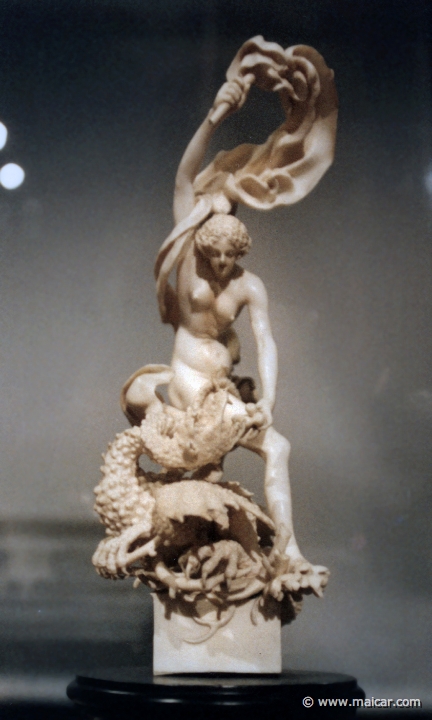
One of the HESPERIDES outwits the dragon. 0701: The Dragon outwitted. "Furienmeister", work from the 17C AD. Künsthistorische Museum, Wien.
|
|
Atlas reluctant to go back to work
Atlas returned carrying three Golden Apples, but was no
longer willing to support the world and the vault
of the sky, declaring that he himself could deliver
the fruits to Eurystheus. So,
seeing that Atlas could not be persuaded to take the burden again
upon his shoulders, Heracles 1 asked him
to hold the sky just for a moment while he placed a
pad on his head; and when Atlas held the sky again, Heracles 1 picked up the apples and left. Yet, there are those who affirm that Heracles 1 did not
follow Prometheus 1's advice, but plucked the Golden Apples
himself after killing the dragon. When Eurystheus received the Golden Apples, he gave them back to Heracles 1, who in
turn gave them to Athena,
who sent them back again to their original place,
since it was not lawful that they should be laid
down anywhere.
The HESPERIDES receive a horn
It is told that when the river god Achelous
turned himself into a bull in order to fight
against Heracles 1 for the hand of Deianira 1, Heracles 1 tore off
one horn, and that when he came for the Golden
Apples he presented it to the HESPERIDES, who
filled it with fruits and called it Cornucopia,
which is the horn of plenty. Yet others affirm that
the NYMPHS were the
recipients of that horn.
Clever interpretations
Now, some clever men have deemed the story of the Golden Apples of the HESPERIDES to be a childish tale. In order to put things aright, these men have
revealed that the Golden Apples were not apples but
sheep, reasoning that the same Greek word is used
for both the fruit and the animal. Accordingly, the
HESPERIDES were not goddesses guarding the Libyan
gardens, but ordinary women tending flocks of sheep
which had a peculiar golden colour. This is how
their cleverness explained the origin of this
embarrassing confusion. As for the dragon, they
added, there was no dragon at all; for dragons do
not exist. The dragon, they asserted, was just a
shepherd named Dracon, a very strong man who
guarded the sheep, and killed whoever dared to
steal the precious yellow beasts.
HESPERIDES kidnapped by pirates
Likewise, they have explained that Atlas was an extraordinary astrologer, this being the reason why gossip—which always distorts truth—made him into a fantastic figure that carried the entire firmament upon his shoulders. They also explained that Atlas married his brother's daughter Hesperis, and had by her the HESPERIDES. The whole family possessed beautiful flocks of sheep which—as already stated—were of a golden yellow colour. Now, cruel King Busiris 2 of Egypt desired to get the HESPERIDES, being as he was sensitive to beauty, but not being able to conceive a better procedure, he dispatched pirates by sea in order to kidnap the girls. However, while the pirates were on their way, Heracles 1 came to Egypt and, for other reasons, killed Busiris 2. In the meantime, the pirates—now performing the orders of a dead man—seized the girls while they were playing in a certain garden, and sailed away. Unfortunately for them, Heracles 1 came upon
them when they were taking a meal on the shore.
Having learned from the HESPERIDES what had
happened, he slew all the pirates and restored the
girls to their father Atlas,
who in gratitude, gave Heracles 1 the
assistance he needed to perform the orders of his
own tormentor, King Eurystheus of Mycenae.
|


