|
|
|
|
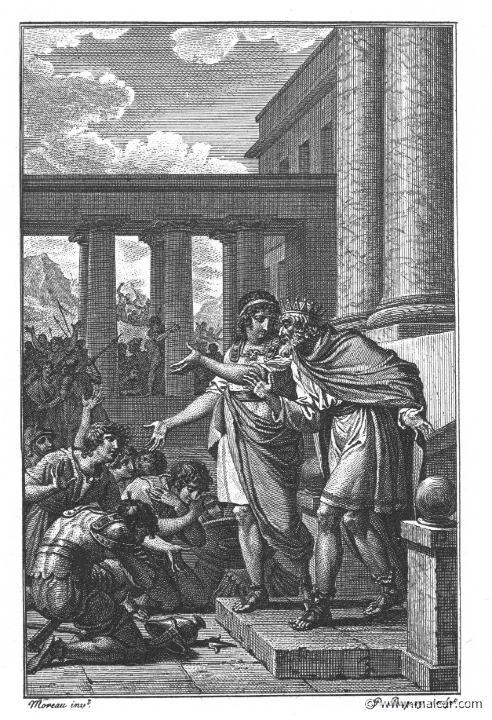
Telamon shows King Aeacus the men who came to greet him as king. Drawing by Jean-Michel Moreau "le Jeune", 1741-1814 (Les Métamorphoses d'Ovide, Paris 1806).
|
|
Aeacus was, in this world, king of the island of Aegina, which is in the Saronic Gulf, and is now one of those who judge the dead in the Underworld, keeping the keys of that subterranean place.
Birth of Aeacus
Zeus, assuming the shape of an eagle (or of fire, Ov.Met.6.113) approached Aegina, one of the daughters of the river god Asopus and Metope 1, herself daughter of the river god Ladon 1, and being in love with her, carried her off and took her to the island of Oenone—also called Oenopia but now called Aegina after her—where she gave birth to a son Aeacus. Sisyphus refused to reveal this love affair to Aegina's father Asopus until the latter agreed to give him a spring (Peirene) on the Acrocorinthus (Pau.2.5.1). But for having disclosed Zeus' secret, Sisyphus is still being punished in the Underworld. Having learned who the ravisher was, Asopus went after Zeus, but the god forced him back to his own streams by hurling thunderbolts. It is told that this is the reason why coals could be fetched from the streams of the river Asopus (Apd.3.12.6).
Ants turned into men
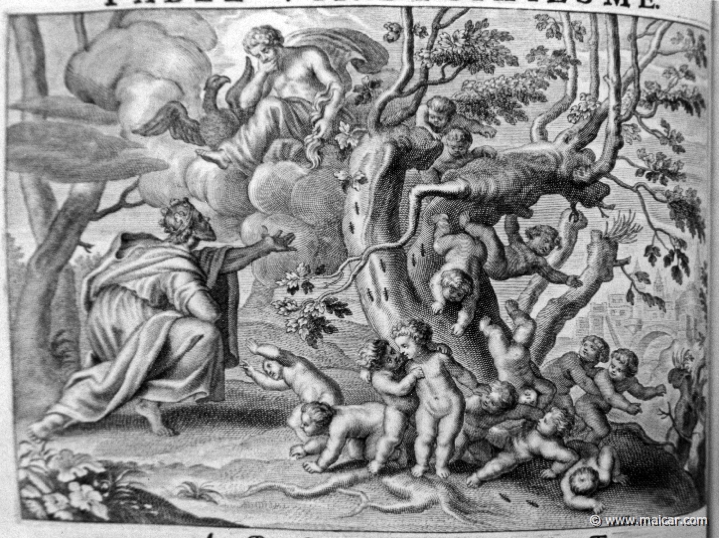
Aeacus was alone in the island, and since a territory without human beings is worthless for any man living in it, to put an end to that solitude Zeus turned the ants of the island into men. And when human beings were added to the land, Aeacus could become king. These men, some say, were called Myrmidons following the Greek word for "ants".
Famine and the ants
However, some have said that the Aeginetans were called Myrmidons, not because ants became human beings in answer to Aeacus' prayers, but because during a famine they excavated the earth in the way ants do and spread the soil over the rocks in order to have some ground to till, and also because they lived in the dug-outs, refraining from the use of soil for making bricks.
Pestilence and the ants
Others affirm that famine was not the trouble in Aegina but pestilence. For jealous Hera, they say, wished to punish the island that had been named after her husband's mistress. And so a plague fell upon Aegina, attacking first the animals and then the human beings. This epidemic had such proportions that almost no one was left alive, and the dead bodies were so many that no one cared to bury them. It is said that many drove away the fear of death by death and committed suicide, and so the country was left desolate.
Aeacus' prayer
It was then that Aeacus prayed to Zeus under an oak, and seeing ants marching in a long column he asked:
"O most excellent father, grant me just as many subjects, and fill my empty walls." (Aeacus to Zeus. Ovid, Metamorphoses 7.627).
Then the ants turned into men, first in Aeacus' dream that night, but later in reality, for on the following day he could see them with his waking eyes as they came greeting him as king. And because of his prayer and his dream he called them Myrmidons, deriving this name from the word "ant". Yet others have said that Zeus raised up the inhabitants of Aegina out of the earth.
Pious man
During his rule, Aeacus fortified Aegina, making the island difficult to approach, surrounding it by sunken rocks and reefs. King Aeacus, who was regarded as the most righteous among the Hellenes, had such a reputation as a pious man that Zeus would listen to him alone. Aeacus was known for settling disputes even for the gods. It is said that Hellas was delivered of a terrible dearth thanks to Aeacus' prayers. This calamity had been caused by the perfidious actions of the ambitious Pelops 1, who, not being able to defeat King Stymphalus 1 of Arcadia, made peace with him pretending friendship, but afterwards treacherously slew him. At that time no rain fell either to the north of the Isthmus of Corinth or in the Peloponnesus, and the Pythian priestess said that Zeus would listen to no one except Aeacus. So the people of Hellas sent envoys to Aeacus from each city and he, by praying and sacrificing to Zeus, caused rain to fall upon the earth again. According to some, Aeacus helped Apollo and Poseidon to build the walls of Troy, and a prophecy was uttered when the work had been done:
|
|
Zeus transforms ants into men to give Aeacus company. 2718: Zeus turns ants into men to help Aeacus. Drawing from the 17C AD.
|
|
"And three gray-green serpents, when the wall was newly built, tried to leap into it; two of them fell down, stunned, and gave up their lives, and the third leapt up with a cry. Pondering this adverse omen, Apollo said right away: 'Pergamos is taken, hero, through the works of your hands—so says a vision sent to me from the son of Cronos, loud-thundering Zeus—not without your sons: the city will be destroyed with the first generation, and with the third.'" (Pin.Oly.8.31).
Famous grandsons
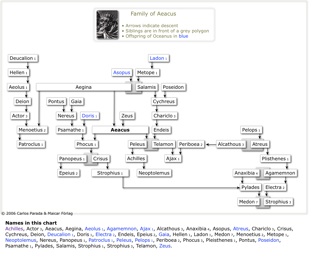
Aeacus married first Endeis, a woman of uncertain parentage, and had by her two sons: Peleus (father of Achilles) and Telamon (father of Ajax 1). Then Aeacus married the Nereid Psamathe 1, who turned herself into a seal in an attempt to avoid him, and had by her a son Phocus 3.
Death of Phocus 3
Phocus 3 excelled in athletic sports and this hability, they say, arose the jealousy of his half-brothers Peleus and Telamon, who plotted against him and killed him, hiding his body in the woods. Some say that Telamon during a match threw a quoit at his head, but others assert that Telamon killed Phocus 3 with a spear while hunting (see Psamathe 1 at NEREIDS). Having learned what his sons had done, Aeacus drove them into exile. Telamon came to Salamis, an island off the coast of Attica in the Saronic Gulf, and Peleus came to Phthia in southern Thessaly, and in time both became rulers of the countries that received them.
Descendants of Aeacus
As these sons left and the third was dead, posterity has failed to mention other kings of Aegina except Aeacus. For Panopeus 1 and Crisus, sons of Phocus 3, also left and settled in Phocis, a region bordering the Gulf of Corinth west of Boeotia, where their father Phocus 3, thinking to settle there, had made friends. The son of Panopeus 1 is the architect Epeius 2, constructor of the WOODEN HORSE. And Crisus had a son Strophius 1, who brought up the exiled Orestes 2, son of Agamemnon, together with his own son Pylades, who himself became Orestes 2's best friend.
Judge
Aeacus was buried in Aegina, but after his death he was appointed to be one of the JUDGES OF THE DEAD (or to be the keeper of the keys of the Underworld—Apd.3.12.6; Aristophanes, The Frogs 465) along with the former king of Crete, Minos 2, and with Rhadamanthys, both sons of Zeus and Europa (see also Underworld).
The discovery of silver has been attributed to Aeacus. Others have said that he founded the first temple of Zeus in Arcadia, and the city of Dia in Thessaly. Roscher, Lex. 1. 112. 30ff.
Some mention only Minos 2 and Rhadamanthys as Judges of the Dead, leaving to Aeacus the role of keeping watch in the Underworld, near the Tower of Hades. Roscher, Lex. 1. 112. 57.
|
| Family |
|
|
|
|
|
|
|
|
|
|
Aegina is daughter of the river god Asopus and Metope 1, daughter of the river god Ladon 1. She was twin sister of Thebe, after whom the city of Thebes was called, and was carried off by Zeus, who approached her in the shape of an eagle, to the island then named Oenone but now called Aegina after her.
Aegina had Aeacus by Zeus; but by Actor 3, son of Deion, son of Aeolus 1, she had a son Menoetius 2, who became father of Patroclus 1.
|
|
|

Peleus
|
Peleus is Achilles' father.
|
|
|
Telamon, who is counted among the ARGONAUTS and the CALYDONIAN HUNTERS, was the father of Ajax 1.
|
|
|
|
See NEREIDS.
|
|
|
|
|
|
|
Genealogical Charts
Names in this chart: Achilles, Actor 3, Aeacus, Aegina, Aeolus 1, Agamemnon, Ajax 1, Alcathous 3, Anaxibia 4, Asopus, Atreus, Chariclo 3, Crisus, Cychreus, Deion, Deucalion 1, Doris 1, Electra 2, Endeis, Epeius 2, Gaia, Hellen 1, Ladon 1, Medon 7, Menoetius 2, Metope 1, Neoptolemus, Nereus, Panopeus 1, Patroclus 1, Peleus, Pelops 1, Periboea 2, Phocus 3, Pleisthenes 1, Pontus, Poseidon, Psamathe 1, Pylades, Salamis, Strophius 1, Strophius 3, Telamon, Zeus.
|
|
|
| Related sections |
Aeacus in GROUPS: JUDGES OF THE DEAD, ZEUS' OFFSPRING. |
|
|
Sources
Abbreviations |
Apd.3.12.6; Dio.4.61.1, 4.72.6; Hes.The.1004; Hyg.Fab.52; Lib.Met.38; Nonn.13.203, 22.254ff.; Ovi.Met.7.517ff.; Pau.2.29.2; Prop.2.21.30.
|
|
|