| The War of the SEVEN AGAINST THEBES |
|
|
|
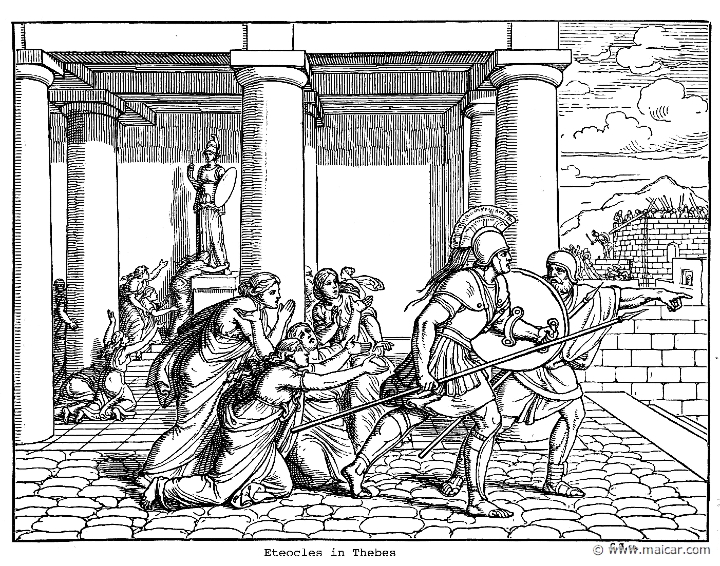
Eteocles 1 on his way to confront his brother Polynices. sch217: Engraving from G. Schwab's Die schönsten Sagen ... 1912.
|
|
|
"Many are the homes and cities once prosperous that Ambition has entered and left, to the ruin of her worshippers. It is better to honor Equality, who always joins friend to friend, city to city, allies to allies; for Equality is naturally lasting among men ... Lay aside your violence, my sons, lay it aside; two men's follies, once they meet, result in very deadly evil." (Jocasta. Euripides, Phoenician Women 532).
"Wealth is most valued by men, and of all things in the world it has the greatest power. This I have come to secure at the head of my great army; for a man well-born but poor is worth nothing ... The words of truth are naturally simple, and justice needs no subtle interpretations, for it has a fitness in itself; but the words of injustice, being sick in themselves, require clever treatment." (Polynices. Euripides, Phoenician Women 440, 470).
"If all were at one in their ideas of honor and wisdom, there would be no strife to make men disagree; but, as it is, fairness and equality have no existence in this world beyond the name ... I will not yield the blessing of kingship to another rather than keep it for myself; for it is cowardly to lose the greater and to win the less." (Eteocles 1. Euripides, Phoenician Women 500, 509).
|
|
The war of the SEVEN AGAINST THEBES was an
Argive intervention in a Theban conflict.
Oedipus' curse
When Oedipus was
found guilty of both murder and incest, he was
forced to abdicate. Thus the man who unwittingly
had killed his father and slept with his mother,
found himself, not only deprived of his throne and
reputation, but also despised by his sons, who kept
him isolated, afraid of showing this walking family
shame. Oedipus requited this outrage by cursing his sons Polynices and Eteocles 1 so that they never would come to terms as to who would become Oedipus' successor on
the throne of Thebes.
"When I was
thrust from hearth and home; when I was banned and
banished, they never raised a hand. Then may the
gods never quench their fatal feud. That neither he
who holds the sceptre now may keep his throne, nor
he who fled the realm return again." (Oedipus. Sophocles, Oedipus
at Colonus 425).
Brothers' compact
In order to avoid their father's curse, Polynices and Eteocles 1 made at first an agreement, deciding that each should rule alternately for one year at a time. But this deal did not last long, and Oedipus had not yet died when Polynices was already raising an army to march against his younger brother Eteocles 1, who having seized power and refusing to share the throne, had banished him.
Renewed curse
When Polynices met the exiled Oedipus at Colonus,
asking for his father's support (since an oracle
had said that he who counted Oedipus as an ally would
win), he received a renewed curse from his father,
who doomed them to kill each other and never rule:
This curse I
leave you as my last bequest: Never to win by arms
your native land, nor return to Argos, but by a kinman's hand to die and
slay." (Oedipus to Polynices. Sophocles, Oedipus
at Colonus 1385).
Help from abroad
Betrayed and banished by his brother, Polynices
took with him the Robe & Necklace of Harmonia 1, a Theban treasure, and
came to Argos. Arriving by
night to the palace of King Adrastus 1, he met
another exile, Tydeus 2,
who had fled from Calydon, and engaged in a fight with him, waking up the king, who came out and parted them. Some affirm that Adrastus 1 compared
them to wild beasts because they came to blows
about a bed. But others say that when he later
examined the boar and lion in their shields, he
remembered the words of a seer who had told him to
yoke his daughters in marriage to a boar and a
lion. And interpreting the seer's words as well as
he could, Adrastus 1 married these two exiles to his daughters,
promising that he would restore them both to their
native lands, Polynices first. This is how the
Theban conflict turned into an affair between
different kingdoms.
Different opinions about the Theban crisis
But just as there are always those who find high
reasons to intervene in what they feel is the
concern of all, there are also those who are always
reluctant to engage in what they feel should not
concern them. So, on the matter of intervention in Thebes, the opinions of
the Argives were almost as divided as Argos itself, for at that
time there were in Argos three kingdoms, the kings being Adrastus 1, Amphiaraus, and Iphis 1. And while Adrastus 1 had already promised the exiles to make war, Amphiaraus, who was a
seer and knew that the expedition against Thebes would fail,
refused to participate. But as he who has disorder
at home is weaker, Amphiaraus was at
last forced to join the coalition, betrayed by his
own wife Eriphyle, who let herself be bribed by the
party that advocated war. That Amphiaraus was not
taking counsel only from his own peaceful nature is
proved by the fact that, on leaving for Thebes, he instructed his
sons to slay their mother and march against Thebes once they were
grown up.
Right and Force
|
|
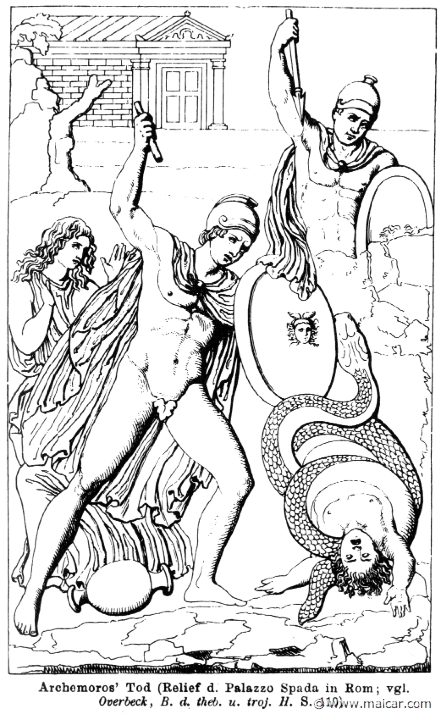
RI.1-0473: Death of Archemorus (Opheltes). Relief in Palazzo Spada. The snake was killed by the Seven Against Thebes. Wilhelm Heinrich Roscher (Göttingen, 1845- Dresden, 1923), Ausfürliches Lexikon der griechisches und römisches Mythologie, 1884.
|
|
In this way the coalition was formed that marched against the town of the seven gates. And while Eteocles 1 sat in his precarious throne at Thebes, and was suspected
of being a man who breaks his promises because of
his power ambitions, his brother Polynices, who
succeeded in raising an army to defend his own
rights, was now suspected of wishing to cause his
own native land's destruction.
Antigone 2: Turn back your host to Argos with all speed, and ruin not
yourself and Thebes as well.
Polynices: That cannot be. It
is a shame to live in exile, and shall I, the
elder, bear a younger brother's flouts?
Antigone 2: But brother, what profit from your
country's ruin comes? Will you then bring to pass
the prophecies of he who threatens mutual slaughter
to you both?
(Sophocles, Oedipus
at Colonus 1416).
The brothers' arguments
Polynices argued that
"After
consenting to our deal and calling the gods to
witness his oath, Eteocles has performed none of
his promises, but is still keeping the sovereignty
in his own hands together with my share of our
heritage. And now I am ready to take my own and
dismiss the army from this land, receiving my house
in turn to dwell in, and once more restore it to
him for an equal period, instead of ravaging our
country and bringing scaling-ladders against the
towers as I shall attempt to do if I do not get my
rights." (Polynices. Euripides, Phoenician
Women 480).
And Eteocles 1 replied:
"I am ashamed
to think that Polynices should gain his object by
coming with arms and ravaging the land; for this
would be a disgrace to Thebes, if I should yield my scepter up
to him for fear of Argive might. He ought not to
have attempted reconcilement by armed force. Still,
if on any other terms he cares to dwell here, he
may; but power I shall never willingly let go.
Shall I become his slave, when I can rule? I will
not give up government to him. For if we must do
wrong, to do so for government is the fairest
cause, but in all else piety should be our aim." (Eteocles 1. Euripides, Phoenician
Women 510).
Face to face
When war had already broken, the brothers met
during a short truce and harshly declared their
views to each other:
Polyneices: Once more I demand back my scepter
and share of the land.
Eteocles: I admit no demand;
I will live in my own house.
Polyneices: And keep more
than your share?
Eteocles: Yes. Leave the
country!
Polyneices: O altars of my
fathers' gods ...
Eteocles: Which you are here
to destroy.
Polyneices: ... Hear me
...
Eteocles: Who would hear you
after you have marched against your
fatherland?
Polyneices: I am being driven
from my country ...
Eteocles: Yes, for you came
to destroy it.
Polyneices: You have become
unholy ...
Eteocles: But I have not,
like you, become my country's enemy.
Polyneices: By driving me out
without my portion. (Euripides, Phoenician
Women 601ff.).
Meeting in Nemea
As the brothers could not be reconciled, the
Argive army, with Theban Polynices as one of its
seven commanders marched against Thebes. The army of the SEVEN came first to Nemea where they sought for water. King of Nemea was at the time Lycurgus 3, son of Pheres 1, son of Cretheus 1, son of Aeolus 1, son of Hellen 1, son of Deucalion 1, the man
who survived The Flood. Lycurgus 3, who some call Lycus 11, was father of the child Opheltes 1, and in charge of this child as his nurse was Hypsipyle. This Hypsipyle had been queen of the Lemnian women, but was afterwards sold into slavery by them, the reason being that when the Lemnian women decided to kill their husbands and all men in Lemnos because of their having taken Thracian wives,
Hypsipyle secretly spared her father. But this was
not yet public when the ARGONAUTS arrived to Lemnos, and their
capitain Jason fell in love with her, and had children by her. One of them, Euneus 1, became later king of Lemnos, and is remembered
for having sent ships from the island with cargoes
of wine for the Achaeans
during the Trojan War. But now, years after the expedition of the ARGONAUTS, and years
before the Trojan War, when the SEVEN came to Nemea looking for water, Hypsipyle showed them the way to a spring, and doing so she left behind the little prince Opheltes 1, who was killed by a serpent, or as some say, devoured by a dragon.
Embassy
After celebrating the Nemean games in honor of
the dead prince, the army came to Cithaeron (the
mountain between Boeotia and Attica) whence Tydeus 2 was sent as
ambassador to Thebes to tell Eteocles 1 to cede the kingdom to Polynices as they had previously agreed.
The Army ad portas
Since this embassy had no effect, the army
approached the walls of Thebes, and each commander was stationed facing each of the seven gates, with the whole host behind them. Now, when the sight becomes blurred in face of growing troubles, some think that resorting to divination might help them to see clearer, and so did Eteocles 1 and his government, who decided to listen to what the famous seer Tiresias had to say, and the seer was of the opinion that the Thebans should be victorious if Menoeceus 2, son of Creon 2, would sacrifice himself voluntarily. And that is why Menoeceus 2, a firm believer in SEERS,
slew himself before the gates.
Oedipus' curse
fulfilled
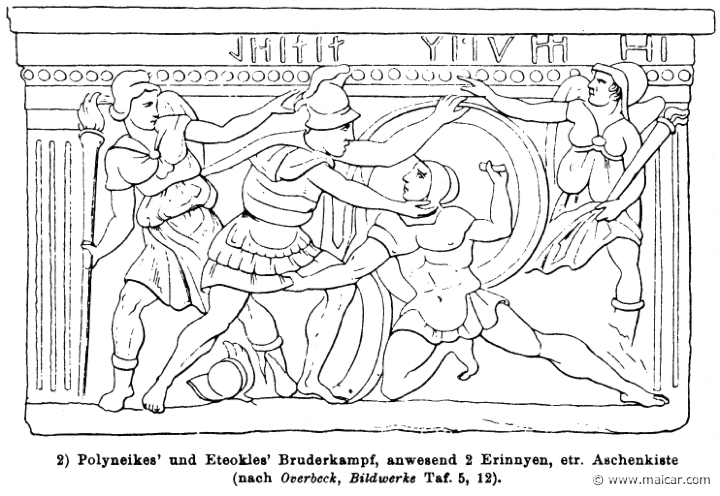
As the fight was taking many lives, Capaneus' one of the first, the armies decided that the brothers should fight in single combat, and in that fight Polynices and Eteocles 1 slew each other, thus fulfilling Oedipus'
curse.
Barbaric behavior does not lead to immortality
During the fight Tydeus 2 killed the Theban Melanippus 1, but was himself mortally wounded by him in the belly. As Tydeus 2 lay almost
dead, Athena approached
with a medicine she had received from Zeus, and by which she
intended to make him immortal. But then Amphiaraus cut off the head of Melanippus 1 and gave it to Tydeus 2, who opened it
and gulped up the brains. So when Athena saw this utterly
disgusting scene, she withheld the intended
privilege.
|
|
RIII.2-2675: Fight of Polynices and Eteocles. Wilhelm Heinrich Roscher (Göttingen, 1845- Dresden, 1923), Ausfürliches Lexikon der griechisches und römisches Mythologie, 1884..
|
|
Amphiaraus vanishes
Shortly after, when Amphiaraus was about
to be killed, Zeus cleft
the earth with a thunderbolt, and Amphiaraus vanished,
chariot and charioteer included.
Greatest war in Hellas
Some have noticed that the war of the SEVEN was the first war in Hellas that caused an army to make a long march; for wars had before taken place among neighboring states only. But the Argives marched from Peloponnesus to Boeotia, collecting allies out of Arcadia and Messenia, while the Thebans were assisted by mercenaries from Phocis and other places. It is said that after a first encounter in an
open field, the Thebans, having been worsted,
retired within their fortifications. And since the
Argives, though attacking fiercely, could not
assail the walls properly, many of them were killed
by the missiles hurled by the Thebans, who
afterwards sallied forth and defeated the weakened
army.
Thebes survives and so
do its troubles
All commanders died except Adrastus 1, but the
defeat of the SEVEN did not put an end to Thebes' troubles. Creon 2 came to power after the death of Eteocles 1, and because he forbade to bury the dead enemies, an Athenian intervention under the command of Theseus took place that
forced him to carry on the regular funeral
practices. But Antigone 2, Oedipus'
daughter, who resisted Creon 2's unholy edict, and in secret buried her
brother Polynices, was detected and interred alive.
Ten years after these events, the sons of the
SEVEN, called the EPIGONI, marched against Thebes and were
victorious.
|
| The SEVEN AGAINST THEBES: Commanders |
|
 |
Adrastus 1. King of Argos and son of Talaus. He married his daughters to the two exiles: Argia 1 to Theban Polynices and Deipyle to Calydonian Tydeus 2, and
having promised his sons-in-law to restore them
both to their native lands he raised an army in
order to march first against Thebes. Adrastus 1 lost the war and Thebes could not be taken but of all seven chiefs he was the only one who survived, saved by his horse Arion 1. Ten years after, his son Aegialeus 1, one of the so called EPIGONI, was
killed at Thebes by Laodamas 1, son of Eteocles 1 and king of Thebes. Adrastus 1 died because of Old Age and the fate of Aegialeus 1. Some say that he threw himself into the fire when he learned about his son's fate. |
 |
Amphiaraus. Being a seer and foreseeing that all who joined Adrastus 1 against Thebes would perish, Amphiaraus refused at
first to join the expedition but was finally forced
to go to war. He was the assailant of the
Homoloidian Gate at Thebes. When about to be killed by Periclymenus 3, Zeus saved him by splitting
the earth. Amphiaraus vanished for ever and Zeus made him immortal. Amphiaraus was the son of Hypermnestra 2, either by Oicles, who sometimes is said to be his son instead, or by Apollo. He married hateful Eriphyle and had children by her: Alcmaeon 1, Amphilochus 1, Eurydice 9, Demonassa 4, Alexida, and perhaps Oicles. Amphiaraus joined the
expedition of the ARGONAUTS and was
among the CALYDONIAN
HUNTERS (see also Robe & Necklace of Harmonia 1). Aes.Sev.569; Apd.1.8.2, 1.9.13, 1.9.16, 3.6.2-3,
3.6.6-8, 3.7.2; Cic.ND.2.7; Dio.4.32.3; Hyg.Fab.70,
73; Pau.5.17.7, 8.45.7, 9.5.15; Pin.Nem.9.24, 10.9;
Pin.Oly.6.13; Pin.Pyth.8.39ff.; Plu.GQ.23;
Stat.Theb.3.470, 7.818ff., 8.1. |
 |
Capaneus. Capaneus was the husband of Evadne 2, the daughter of the third king of Argos, Iphis 1. It is said that Zeus smote him with a
thunderbolt when he was climbing the walls of Thebes, and that his wife
threw herself on the funeral pyre and was burned
with him. Capaneus, so they say, was raised from
the dead by Asclepius. Capaneus, counted as the assailant of the
Electran (Ogygian) Gate at Thebes, was son of Hipponous 1 and Astynome 1, daughter of King Talaus of Argos. His son by Evadne 2, Sthenelus 2, is found among the EPIGONI, the SUITORS OF HELEN,
the ACHAEAN
LEADERS, and among those who hid inside the WOODEN HORSE. Aes.Sev.423ff.; Apd.3.6.3-7, 3.7.1-2, 3.10.3;
Eur.Phoe.1172ff.; Hyg.Fab.68, 70, 97; Pau.10.10.3;
Stat.Theb.10.927. |
|
Eteoclus. King Iphis 1 did not join the expedition himself, but sent his son Eteoclus, who was killed by Leades. Eteoclus was the assailant of the Neistan Gate at Thebes. Aes.Sev.458; Apd.3.6.3, 3.6.8; Pau.10.10.3. |
|
Hippomedon 1. Assailant of the Oncaidian Gate at Thebes. Hippomedon 1, who some call son of Aristomachus 1, others son of Talaus, and still others son of Mnesimachus, also perished in this war, killed by Ismarus 1, a brother of Leades (see above). Hippomedon 1 is father, either by Evanippe or by Nealce, of Polydorus 1, counted among the EPIGONI.
Parentage (three versions)
|
|
|
|
|
|
|
|
|
|
|
|
|
|
Aristomachus 1 is son of Talaus & Lysimache 1.
Talaus was king of Argos.
Lysimache 1 was daughter of Abas 3, son of Melampus 1, a king of Argos, also counted among the SEERS.
Metidice is daughter of Talaus.
|
|
Aes.Sev.488; Apd.1.9.13, 3.6.3, 3.6.6, 3.6.8;
Hyg.Fab.70, 71; Stat.Theb.9.519ff., 12.122.
|
|
|
|
 |
Parthenopaeus. Parthenopaeus was the Assailant of the Borraean
(Electran) Gate at Thebes. Some say that Parthenopaeus was son of Talaus & Lysimache 1, but others call him son of Atalanta (either by Meleager, Melanion or Ares). It is not clear who
killed him at Thebes: it could have been Amphidicus, Periclymenus 3 or Dryas 9. Dryas 9, who died mysteriously in battle, was a chieftain from Tanagra who came to defend Thebes with one thousand
archers. Parthenopaeus is one of those whom Aeneas
met in the Underworld (see Map of the
Underworld). Aes.Sev.547; Apd.1.9.13, 3.6.6, 3.6.8, 3.7.2,
3.9.2; Eur.Phoe.1157; Hyg.Fab.70, 71; Pau.9.18.6,
9.19.2; Stat.Theb.4.309, 9.885; Vir.Aen.6.480. |
 |
Polynices. Son of Oedipus in feud with his brother Eteocles 1. They killed each other in single combat. His son Thersander 1 became king of Thebes after the
war of the EPIGONI, but
was later killed by Telephus, son of Heracles 1 when the
Achaean fleet sailing against Troy arrived by
mistake in Mysia. Polynices' mother was Jocasta, but some, not
believing in the story of the incest of Oedipus, say that his mother was Eurygania, daughter of Hyperphas. Polynices married Argia 1, daughter of Adrastus 1 (see above), and had children by her: Thersander 1, Adrastus 4, and Timeas (see also main text above). Aes.Sev.641, 811; Apd.3.5.8-9, 3.6.1-6,3.7.2;
Eur.Phoe.288, 1360ff. and passim; Hyg.Fab.67, 70;
Pau.2.20.5; Soph.OC.passim; Stat.Theb.1.681,
11.552ff.; |
 |
Tydeus 2. The celebrated Tydeus 2 from Calydon was sent by the SEVEN to tell Eteocles 1 that he must cede the kingdom to Polynices, as they had agreed among themselves, and during his embassy, defending himself from an ambush, killed fifty men in single combat. Tydeus 2 is
father of Diomedes 2. Apd.3.6.3, 1.9.13, 1.9.16; Hdt.5.67;
Hom.Il.2.565; Pau.9.18.1. |
|
Mecisteus 1. To these commanders some have added Mecisteus 1, son of Talaus (either by Lysimache 1 or by Lysianassa 3), and father of Euryalus 1 (one of the ACHAEAN LEADERS). Mecisteus 1 was killed by Melanippus 1. Apd.3.6.3, 1.9.13, 1.9.16; Hdt.5.67; Hom.Il.2.565; Pau.9.18.1. |
|
Aes.Sev.375ff.;
Soph.OC.1313ff.:
|
Apd.3.6.3:
|
Eur.Phoe.1104ff.:
|
|
Assailant
|
Defender
|
Gate
|
Assailant
|
Gate
|
Assailant
|
Gate
|
Amphiaraus |
Lasthenes |
Homoloidian |
Adrastus 1 |
Homoloidian |
Adrastus 1 |
Seventh |
Capaneus |
Polyphontes 2 |
Electran |
Amphiaraus |
Proetidian |
Amphiaraus |
Proetidian |
Eteoclus |
Megareus 1 |
Neistan |
Capaneus |
Ogygian |
Capaneus |
Electran |
Hippomedon 1 |
Hyperbius 2 |
Oncaidian |
Hippomedon 1 |
Oncaidian |
Hippomedon 1 |
Ogygian |
Parthenopaeus |
Actor 5 |
Borraean |
Parthenopaeus |
Electran |
Parthenopaeus |
Neistan |
Polynices |
Eteocles 1 |
--- |
Polynices |
Hypsistan |
Polynices |
Fountain |
Tydeus 2 |
Melanippus 1 |
Proetidian |
Tydeus 2 |
Crenidian |
Tydeus 2 |
Homoloidian |
| |
|
Dio.4.65.2; Stat.Theb.4.62-247;
Hyg.Fab.70:
|
Eur.Supp.860ff.:
|
Stat.Theb.8.353:
|
|
Assailant
|
Assailant
|
Defender
|
Gate
|
Adrastus 1 |
Adrastus 1 |
Creon 2 |
Ogygian |
Amphiaraus |
Capaneus |
Dryas 9 |
Electran |
Capaneus |
Eteoclus |
Eteocles 1 |
Neistan |
Hippomedon 1 |
Hippomedon 1 |
Eurymedon 6 |
Hypsistan |
Parthenopaeus |
Parthenopaeus |
Haemon 1 |
Homoloidian |
Polynices |
Polynices |
Hypseus 3 |
Proetidian |
Tydeus 2 |
Tydeus 2 |
Menoeceus 2 |
Dircean |
|
