 |
|
|
|
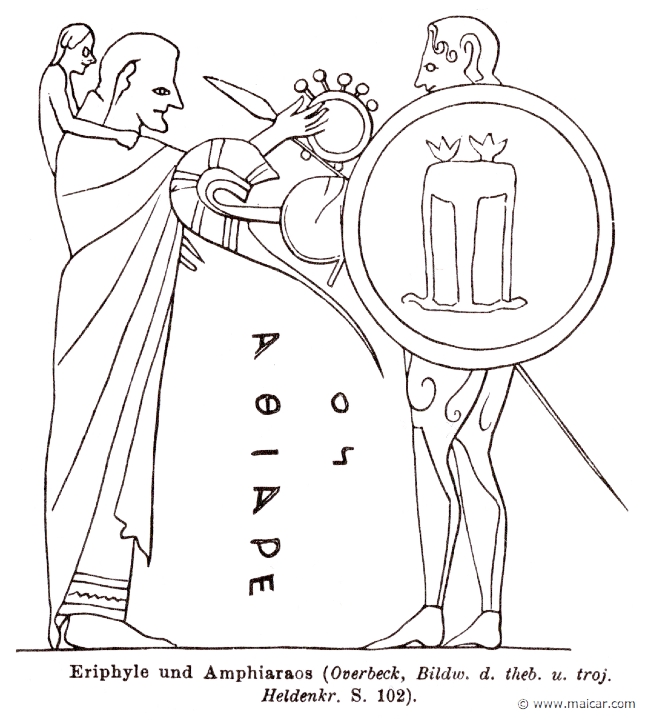
Eriphyle, with a child, is seen holding the fateful necklace. Behind the shield Amphiaraus holds his helmet. RI.1-0295: Eriphyle and Amphiaraus. Wilhelm Heinrich Roscher (Göttingen, 1845- Dresden, 1923), Ausfürliches Lexikon der griechisches und römisches Mythologie, 1884.
|
|
|
"Bearing prayers of supplication, father, in person to you, my own prayers and those of my allies, who now with seven armies behind their seven spears have set their blockade around the plain of Thebes. One such is swift-speared Amphiaraus, a matchless warrior, and a matchless diviner ... " (Polynices to Oedipus. Sophocles, Oedipus at Colonus 1310).
Antigone: Who is that, old man, on his chariot, driving white horses?
Old servant: That, lady, is the prophet Amphiaraus ... (Euripides, Phoenician Women 170).
"No symbol was fixed to his shield's circle. For he (Amphiaraus) does not wish to appear the bravest, but to be the bravest, as he harvests the fruit of his mind's deep furrow, where his careful resolutions grow. I advise you to send wise and brave opponents against him. He who reveres the gods is to be feared." (A scout to Eteocles 1. Aeschylus, Seven Against Thebes 595).
"... he [Amphiaraus] had no boastful sign, but weapons chastely plain." (A messenger. Euripides, Phoenician Women 1110).
"Just so the seer, Oecles' son [Amphiaraus], although a moderate, just, noble, reverent man and a great prophet, mixes with impious, rash-talking men against his own judgment, men stretching out in a procession that is long to retrace, and, if it is Zeus's will, he will be dragged down in ruin along with them." (Eteocles 1 to a scout. Aeschylus, Seven Against Thebes 610).
"... I know that the prince Amphiaraus was ensnared by a woman's chain of gold and swallowed up. And now beneath the earth ... he reigns supreme with the wits of the living." (Chorus of Mycenaean women. Sophocles, Electra 836).
|
|
The wise seer
Amphiaraus is one of the commanders remembered as the SEVEN AGAINST THEBES. Being a seer, he knew that defeat would follow that expedition. Consequently, he refused at first to join the coalition, but was finally forced to go to war. Amphiaraus is counted among the ARGONAUTS, and among the CALYDONIAN HUNTERS, being the second to shoot the boar (in the eye) after Atalanta, who shot it in the back with an arrow, but before Meleager, who slew the beast by a stab in the flank. These are the first occasions bringing up the name of Amphiaraus, and consequently nothing is known about his childhood. When many years later, the aged seer Amphiaraus disappeared from the world of mortals, he was deified and worshipped as a hero, partly because he—like Tiresias—kept his wits after death and could still give oracular responses, and partly because he was reputed to be just, noble, moderate, courageous, reverent, plain, modest, and a wise and matchless seer.
"Son of Apollo"
Some may think that it is on account of his reputation as "a great prophet", that some have called him "son of Apollo". And they might reason that it is natural to regard the great seers as "sons" of the god of prophecy, or if they were seeresses—like Cassandra—to regard them as mistresses of the god (or potential such). Yet, the title "son of Apollo" could be difficult to unveil, and others could ask, for example, why the excellent seer Melampus 1, who was able to understand the language of worms in addition to that of birds, being besides the first to devise a cure by means of drugs and purifications, was never called "son of Apollo". Nor was Aesacus 1, the interpreter of dreams who declared that Paris was to become the ruin of his country, called "son of Apollo". Nor were "sons of Apollo" such diviners as Calchas, or Laocoon 2, or Phineus 2, or Polyidus 1. But some of them—like Aristaeus, or Iamus, or Idmon 2, or Mopsus 2—were certainly regarded as such. On the other hand, prophetic faculties and excellency may also be found in Amphiaraus' human ancestry. His earthly father, Oicles, was son either of Antiphates 3 or of Mantius (both sons of Melampus 1, the "excellent seer"), and his mother Hypermnestra 2 was sister of both Leda (the woman who laid the egg from which Helen was born), and Althaea, mother of Meleager. According to Pausanias, Amphiaraus became a seer once he slept a night in Phliasia (near Sicyon):
"Behind the market-place is a building which the Phliasians name the House of Divination. Into it Amphiaraus entered, slept the night there, and then first, say the Phliasians, began to divine. According to their account Amphiaraus was for a time an ordinary person and no diviner." (Pau.2.13.7).
The three kingdoms of Argos
Now, the aforementioned Melampus 1 was an "excellent seer", also in the sense that his prophetic and healing faculties paved his own way to power. For after healing the daughters of King Proetus 1 (uncle of Danae) of their madness, he received the third part of the kingdom of Argos from the grateful king. At the same time, Melampus 1 proved to be an "excellent brother" indeed (a kind of person as rare as an "excellent seer"), for he shared the kingdom he had obtained with his brother Bias 1. This is how three kingdoms of Argos were created, the brothers Melampus 1 and Bias 1 reigning over two of them, and the third being ruled by King Alector 1, a man belonging to Proetus 1's family. Later the thrones were occupied by their descendants: Iphis 1 (son of Alector 1), Amphiaraus (descendant of Melampus 1), and Adrastus 1 (grandson of Bias 1). The kingdom of Argos was reunified after the Trojan War (that is, a couple of generations after Amphiaraus' time) under the rule of Cylarabes, son of Sthenelus 2 (one of the EPIGONI), son of Capaneus (one of the SEVEN).
Married to Eriphyle
After the expedition of the ARGONAUTS and the Calydonian Boar Hunt, Amphiaraus became conspicuous when his kingdom was requested to support the coalition that was to wage war on Thebes in order to restore Polynices on the throne. And what made him particularly conspicuous on the occasion was his stubborn refusal to join the coalition. Amphiaraus was married to Eriphyle, who later on became known as "hateful Eriphyle". Here some could ask: "If Amphiaraus was such a wise and just fellow as his reputation asserts, how come he married such a cruel and treacherous woman as Eriphyle?" For wisdom's counsel is (they could argue) that a marriage should be among equals, as the daughters of Oceanus said:
"When marriage is on equal terms … it is no cause for dread." (Aeschylus, Prometheus Bound 901).
And when they affirm that "to marry in one's own class is far the best" (890), they do not only advise to avoid differences in riches, but above all to avoid those differences that derive from the qualities of the soul. For when they add
"Never, oh never, immortal Fates, may you see me the partner of the bed of Zeus, and may I be wedded to no bridegroom who descends to me from heaven." (Aeschylus, Prometheus Bound 895).
... it becomes plain that they do not mainly refer to differences in riches (since the gods do not care a whit about possessions), but differences in the disposition of the souls.
Old debts
Now, those who happened to be near "bold-thinking" Amphiaraus could not have thought him to be all that noble and just. And particularly not Adrastus 1, who must flee the civil war in Argos expelled by Amphiaraus, when it became evident that none of them had inherited, along with the Argive thrones, the brotherly affection of their ancestors, Bias 1 and Melampus 1. Adrastus 1, however, was received by his maternal grandfather King Polybus 9 of Sicyon, inheriting the throne when the king died. And he later managed to patch his quarrel with Amphiaraus and return to Argos, by giving him in marriage his sister—"man-conquering" Eriphyle—thereby sealing the seer's fate. For the two men agreed to let Eriphyle (a veritable jewel) decide any future dispute they might have against each other. This is how the great seer, paying old debts of sedition and violence, came to marry perdition in the shape of his former rival's sister, a woman
"… who took precious gold as the price of the life of her own lord." (Homer, Odyssey 11.326).
Not few believe that a seer may save anyone except himself, finding what the Fates have spun difficult to tear apart. For hundreds of years after these events, it could still be seen in Argos—opposite the sanctuary of Amphiaraus—the tomb of Eriphyle. Yet Amphiaraus ended better than this.
Amphiaraus yields
The "future dispute" finally arose when the coalition of the SEVEN AGAINST THEBES was being formed in order to demand, under the threat of war, the throne of the city for Polynices, then exiled in Argos. Too well could Adrastus 1 understand Polynices' plight, who had himself been cast into exile in the past! But Amphiaraus, whose oracular mind revealed to him that the expedition would fail, could not be persuaded to join the coalition. As a result, there was a harsh division in Argos on the matter of intervention in the Theban affairs. But opinions may be adjusted by means of bribes. And being acquainted with these astounding depths of reality, the third king of Argos (Iphis 1) informed Polynices that Amphiaraus could be forced to yield if Eriphyle were accommodated with the Necklace of Harmonia 1, a Theban treasure that Polynices had brought with him. Accordingly, when war was advocated by Adrastus 1 and opposed by Amphiaraus, Eriphyle, having accepted the lovely gift, decided in favor of her brother, thus forcing her husband to honour his oath and join the coalition. This is how riches sacrificed judgment and opened the gates of war. Others have said that Amphiaraus, with the knowledge of his wife, hid himself to avoid going to war, and that it was Adrastus 1 himself who bribed Eriphyle with a necklace of gold and gems of his own making. But it amounts to the same. This is how most things became hateful for Amphiaraus: hateful war, hateful brothers-in-arms, and hateful wife. The first he confronted for as long as heaven allowed, the second he despised for as long as they lived, and the third he destroyed through vicarious hands. Concerning the hateful wife, Amphiaraus did not hesitate at disgracing his own offspring in order to avenge himself. For he, before leaving, instructed his sons to slay their own mother. And he also bade them to march against Thebes once they were grown up (since he knew that the efforts of the SEVEN would be fruitless), which shows that, when opposing the war, he was not taking counsel from his own peaceful nature only.
Polynices rebuked
Now, those who have the wealth to raise a powerful army can seldom resist the temptation to deploy it and put it into action, since it seems to them a waste to abstain from punishing general insolence and the ever growing bands of evil-doers. Was not Polynices' brother an usurper, and an act of justice to overthrow him? Not according to Amphiaraus, who, noticing that the usurper could be turned by the attack into the legitimate defender of his country, rebuked his Theban ally thus:
"Will such a deed as this be pleasing to the gods, fine to hear of and to relate to those in the future—that you sacked the city of your ancestors and your native gods and launched a foreign army against them? What justice is it to drain dry the font of your existence?
And since the seer knew that peace is far more difficult to win than war, he rhetorically asked Polynices:
And how shall your fatherland, captured by the spear for the sake of your ambition, be won over to your cause?" (Amphiaraus to Polynices. Aeschylus, Seven Against Thebes 585).
Tydeus 2 cursed
Adrastus 1 must have known that once a campaign has been launched, it is easier to launch a second one. For the Theban war was just the first of two wars conceived by his ambition: another exile, Tydeus 2, was waiting to be restored in Calydon with the help of Adrastus 1's army. To this exile said Amphiaraus:
"Murderer, maker of unrest in the city, principal teacher of evils to the Argives, summoner of vengeance's Curse, servant of Slaughter, counselor to Adrastus in these evil plans." (Amphiaraus to Tydeus 2. Aeschylus, Seven Against Thebes 572).
This is what Amphiaraus thought about his allies, and that is why this war was for him, not a just but a bitter war, devised by political intrigue and treason within his own household.
At Nemea
When Adrastus 1 had finally mustered the army, the SEVEN marched against Thebes, and on their way they came to Nemea looking for water. There they found Hypsipyle, who showed them the way to a spring. But as she did so, she left behind the little prince Opheltes 1—whom she nursed—and the child was killed by a serpent. Amphiaraus then said that the event foreboded the future, and they called the child "Archemorus", which scholars interpret as "beginner of doom", "ominous", or "foreboding". Opheltes 1 was son of Lycurgus 1, son of Pheres 1, son of Cretheus 1, son of Aeolus 1. Hypsipyle had been queen of the Lemnian women, but was afterwards sold into slavery by them, the reason being that when the Lemnian women decided to kill their husbands and all men in Lemnos because of their having taken Thracian wives, Hypsipyle secretly spared her father. But this was not yet public when the ARGONAUTS arrived to Lemnos, and their captain Jason fell in love with her. On this occasion, the Nemean games were celebrated for the first time by the Argive army, in honor of the dead prince, and in them Amphiaraus won the leaping and quoit-throwing match.
Killed by Amphiaraus
Having approached the walls, each leader was stationed at each of the seven gates of Thebes. Some have said that Amphiaraus was at the Proetidian, but others say at the Homoloidian. Whichever the gate Amphiaraus did what he was supposed to do, that is, he killed many enemies. Among them are counted Aetion, Alcathous 6, Antiphus 9, Chremetaon, Chromis 7, Clonis, Gyas 5, Iphinous 3, Lampus 7 (who once had attempted to rape Manto 1, daughter of Tiresias), Lycoreus 2, Melanippus 1 (son of Astacus), Menaleus, General Phlegyas 4, Phyleus 3, Polites 3 (of ill-renown for having murdered his brother), and Sages 2. The death of Melanippus 1 illustrates Amphiaraus' hate for his brother-in-arms Tydeus 2, whom he ensnared in his own savage nature: It is told that Tydeus 2 was mortally wounded by Melanippus 1 in the belly before he killed him. As he lay almost dead, Athena approached with a medicine she had received from Zeus, by which she intended to make him immortal. At that moment, Amphiaraus, perceiving the goddess' intention, cut off Melanippus 1's head, and gave it to him. Tydeus 2 then opened it and gulped up the brains. The goddess then, disgusted at his savagery, withheld the intended privilege. That is why Tydeus 2, although remembered, is not counted among the immortals, remembrance being one thing and immortality another. Others have said, however, that Melanippus 1 died at the hands of Amphiaraus. His tomb was still pointed out in the times of the traveler Pausanias (c. AD 150), on the road between Thebes and Chalcis.
|
|
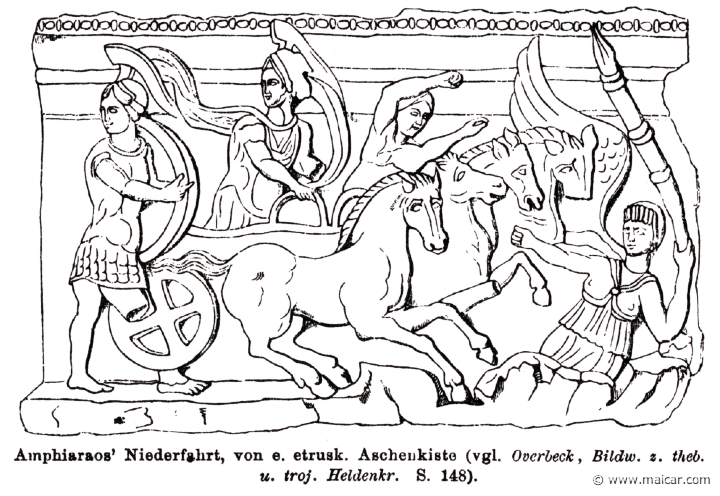
RI.1-0299: One of the ERINYES pulls Amphiaraus' chariot down the chasm. Wilhelm Heinrich Roscher (Göttingen, 1845- Dresden, 1923), Ausfürliches Lexikon der griechisches und römisches Mythologie, 1884.
|
|
Snatched by heaven
This war was not fated to be crowned by Victory, and as Amphiaraus fled beside the river Ismenus, Zeus cleft the earth with a thunderbolt and the seer vanished for ever along with his four-horse chariot and his charioteer (either Elato, or Baton, a member of his family). The extraordinary event prevented Periclymenus 3, the son of Poseidon and Astypalea, from wounding him in the back, and the god made Amphiaraus immortal. Others have said that Amphiaraus' chariot was later drawn empty to Harma in Boeotia, where a shrine to the hero was built.
Still a prophet
Concerning the place where Amphiaraus was swallowed by the earth, says the traveler Pausanias:
"On the way from Potniae to Thebes there is on the right of the road a small enclosure with pillars in it. Here they think the earth opened to receive Amphiaraus, and they add further that neither do birds sit upon these pillars, nor will a beast, tame or wild, graze on the grass that grows here." (Pausanias, Description of Greece 9.8.3).
The same traveler says that it was near the coastal city of Oropus (between Attica and Tanagra) that the divinity of Amphiaraus was first established, and that it was from the Oropians that the rest of Hellas received the cult (1.34.1). Herodotus, "the father of history", asserts that Croesus had found the oracle of Amphiaraus as reliable as that of Delphi, and that he himself had seen, in the Theban temple of Ismenian Apollo, the gifts that the Lydian king had dedicated: a shield and a spear of solid gold. According to this historian, the Thebans themselves were not allowed to inquire, since Amphiaraus had bade them through an oracle either to take him for their prophet or for their ally. And as they chose him as ally, none among the Thebans was allowed to seek prophecy by sleeping in the hero's shrine.
Missed
Such was the fate of this remarkable man, and even former rivals longed for his presence on earth when he was gone:
"I long for the eye of my army, a man who was good both as a prophet and at fighting with the spear." (Adrastus 1 on Amphiaraus. Pindar, Olympian Odes 6.15).
Pausanias (5.17.8) says that Asius, the epic poet from ca. 700 BC, affirmed that Alcmena was daughter of Amphiaraus and Eriphyle.
Roscher, Lex. 1.246.35, 1.293.44. Latin writers have regarded Catilus, Tiburtus and Coras (brothers in Aeneid 7.670; 11.640) as descendants of Amphiaraus. They are the founders of Tibur (today Tivoli):
"May Tibur, which the pioneers
From Argos built ..." (Horace, Odes 2.6.5).
Solinus (fl. ca. AD 200) says that Tiburtus and Coras were grandchildren of Amphiaraus; sons of Catillus.
Roscher, Lex. 1.293.51.
During a conflict between the three influential Argive families (descendants of Proetus 1, of Melampus 1, and of Bias 1), the Biantid Talaus, or perhaps his son Pronax (brother of Adrastus 1), was killed by Amphiaraus (descendant of Melampus 1). As a result, Adrastus 1 fled to Sicyon, where his grandfather Polybus 9 reigned (Polybus 9 was father of Lysianassa 3, wife of Talaus and mother of Adrastus 1), and married his daughter Amphithea 1 (who otherwise is called daughter of Pronax).
Roscher, Lex. 1.78.59
Adrastus 1 became powerful in Sicyon, and reconciliation with Amphiaraus followed as the latter married Adrastus 1's sister Eriphyle. Having made a pact with his former enemy that any future disagreement between them would be settled by Eriphyle, Adrastus 1 returned to Argos.
Roscher, Lex. 1.79.10.
Amphiaraus' wife Eriphyle has also been called daughter of Iphis 1. Stesichorus has said that Eriphyle's motive for sending her husband to war was the love of her country (rather than the Necklace).
Roscher, Lex. 1.294.56, 1.295.9.
|
| Family |
|
|
|
|
|
| |
|
|
|
|
|
|
Oicles is also reported to be Amphiaraus' son, which is doubtful. Otherwise, King Oicles of Argos is son either of Antiphates 3 (king of Argos before him) and Zeuxippe 4, or of Mantius. Both Antiphates 3 and Mantius are sons of Melampus 1 (son of Amythaon 1, son of Cretheus 1, son of Aeolus 1). Oicles helped Heracles 1, during the latter's expedition against Troy, where he was killed in battle by King Laomedon 1. Others say, however, that he met his end in Arcadia.
Hypermnestra 2 was daughter of Thestius 1, and therefore sister of Leda, Althaea and others.
|
|
|
- Alcmaeon 1
- Amphilochus 1
- Eurydice 9
- Demonassa 4
- (Oicles)
- Alexida
|
"Hateful Eriphyle" was daughter of King Talaus
of Argos and Lysimache 1, daughter of Abas 3 and Cyrene.
Alcmaeon 1 is counted among the EPIGONI, and among the
SUITORS OF HELEN.
He died as a result of the intrigues surrounding
the Robe & Necklace of Harmonia 1.
Amphilochus 1 committed matricide in conjunction with his brother Alcmaeon 1. He is not always well distinguished from Amphilochus 2, son of Alcmaeon 1. Amphilochus 1 fought in the Trojan War and is
counted among the
EPIGONI and among the
SUITORS OF HELEN.
He was killed by Apollo
at Soli (Cilicia).
Demonassa 4 married Thersander 1, who became king of Thebes after the
Argive victory in the war of the
EPIGONI.
Oicles appears as Amphiaraus' son in Diodorus
4.32.3, but the same author says otherwise in
4.68.3.
Persons who have the ability to turn away
attacks of epilepsy are called Averters, and these
are thought to be descendants of Alexida.
|
|
|
|
|
|
|
Genealogical Charts
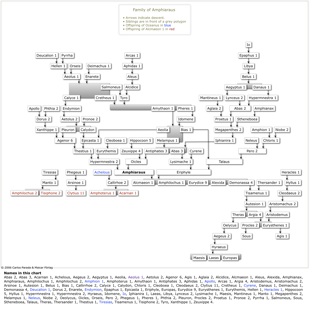
Names in this chart: Abas 2, Abas 3, Acarnan 1, Achelous, Aegeus 2, Aegyptus 1, Aeolia, Aeolus 1, Aetolus 2, Agenor 6, Agis 1, Aglaia 2, Alcidice, Alcmaeon 1, Aleus, Alexida, Amphianax, Amphiaraus, Amphilochus 1, Amphilochus 2, Amphion 1, Amphoterus 1, Amythaon 1, Antiphates 3, Aphidas 1, Apollo, Arcas 1, Argia 4, Aristodemus, Aristomachus 2, Arsinoe 1, Autesion 1, Belus 1, Bias 1, Callirrhoe 2, Calyce 1, Calydon, Chloris 1, Cleoboea 1, Cleodaeus 2, Clytius 11, Cretheus 1, Cyrene, Danaus 1, Deimachus 1, Demonassa 4, Deucalion 1, Dorus 2, Enarete, Endymion, Epaphus 1, Epicasta 1, Eriphyle, Europas, Eurydice 9, Eurysthenes 1, Eurythemis, Hellen 1, Heracles 1, Hippocoon 5, Hyllus 1, Hypermnestra 1, Hypermnestra 2, Hyraeus, Idomene, Io, Iphianira 1, Laeas, Libya, Lynceus 2, Lysimache 1, Maesis, Mantineus 1, Manto 1, Megapenthes 2, Melampus 1, Neleus, Niobe 2, Oeolycus, Oicles, Orseis, Pero 2, Phegeus 1, Pheres 1, Phthia 2, Pleuron, Procles 2, Proetus 1, Pronoe 2, Pyrrha 1, Salmoneus, Sous, Stheneboea, Talaus, Theras, Thersander 1, Thestius 1, Tiresias, Tisamenus 1, Tisiphone 2, Tyro, Xanthippe 1, Zeuxippe 4.
|
|
|
| Related sections |
|
|
|
Sources
Abbreviations |
Aes.Sev.569; Apd.1.8.2,
1.9.13, 1.9.16, 3.6.2-3, 3.6.6-8, 3.7.2; Cic.ND.2.7; Dio.4.32.3,
4.65.7, 4.68.3; Hdt.1.49.1, 1.52.1, 8.134.2;
Hyg.Fab.70, 73; Pau.2.6.6, 5.17.7, 8.45.7, 9.5.15,
2.23.2; Pin.Nem.9.14ff., 10.9; Pin.Oly.6.13;
Pin.Pyth.8.39ff.; Plu.GQ.23;
Stat.Theb.3.470, 7.818ff., 8.1; Strab.9.2.11.
|
|
|
