| Summaries of the Trojan Cycle |
|
| Introduction and Definition of terms |
|
|
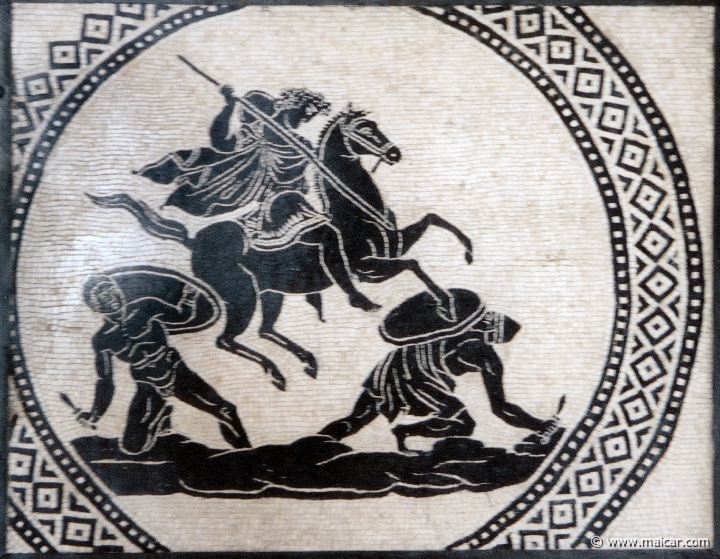
|
9216: Battle scene, mosaic (info n/a). The Thorvaldsen Museum, Copenhagen.
|
|
The so called Epic Cycle is sometimes
referred to with the term Epic Fragments since just fragments is all that remain of them.
Some of these fragments contain details about the
Theban wars (the war of the SEVEN and that of
the EPIGONI), others
about the prowesses of Heracles 1 and Theseus, others about
the origin of the gods, and still others about
events related to the Trojan War. The
latter, called Trojan Cycle, narrate
events that occurred before the war
(Cypria), during the
war (Aethiopis, Little Iliad, and Sack of Ilium ), and
after the war
(Returns, and Telegony).
The term epic (derived from Greek épos = word, song) is generally
applied to narrative poems which describe the deeds
of heroes in war, an astounding process of mutual destruction that periodically and frequently affects mankind. This kind of poetry was composed in early times, being chanted by minstrels during the 'Dark Ages'—before 800 BC—and later written down during the Archaic period—from c. 700 BC). Greek Epic is the earliest surviving form of Greek (and therefore "Western") literature, and precedes lyric poetry, elegy, drama, history, philosophy, mythography, etc.
The word cycle (from Greek kúklos = circle ) is generally
applied to any group of poems, tales, or plays
revolving about a central theme. Since the legends
of the Theban wars and the Trojan War represent
two different constellations of events, we may then
say that the "Epic Cycle" (epikòs
kúklos) contains both a "Theban Cycle"
and a "Trojan Cycle".
The poems of the "Trojan Cycle" are not extant
but the prose summaries of Proclus' Chrestomathy (or volume of selected passages) are. Proclus has not yet been identified, but scholars believe that he could be either a grammarian of the second century, or else the Neoplatonist philosopher, from ca. AD 412-485. According to A. Severyns (see Bibliography) there are nine manuscripts reproducing the Cypria, but only one (Venetus A) reproducing the rest of the cycle. In addition, Photius (Byzantine scholar and Patriarch of Constantinople in AD 858-67 and 878-86) wrote an outline [1] of Proclus'
summaries in his Bibliotheca (or Library); also other authors, such as
Athenaeus and Pausanias, have mentioned the Cyclic
poems, thus adding details not referred to by
Proclus in his Chrestomathy. In certain
editions, these fragments are usually appended to
Proclus' text (as can be seen in Evelyn-White's translation below) in
order to provide a more complete picture of the
lost poems.
The manuscript Venetus A containing the text of
"the rest" (Cetera), that is, summaries of
all poems except the Cypria (Aethiopis, Little Iliad, Sack of Ilium, Returns, and Telegony ) was
discovered in 1781 by Jean-Baptiste Gaspard d'Ansse
de Villoison, and a first edition—the editio princeps—including both Cypria and Cetera was published in
1786 by the distinguished hellenist Christian
Gottlob Heyne (1729-1812). The Cypria had
been discovered by Thomas Tychsen (1758-1834) in a
manuscript of the 11th century. [2]
We are often reminded that the Library of
Apollodorus—a cardinal mythological
source—lacks an account of the Trojan War, and that
his Epitome—which indeed narrates events of the Trojan
War—was first discovered in 1891. Before this year, additional information about the Trojan War was to be
found in scholia to Homer, and in the work of later
poets and mythographers such as Hyginus, Quintus
Smyrnaeus, Colluthus, Tryphiodorus, and Tzetzes
(the latter's Antehomerica, Homerica and Posthomerica became known in 1763).
|
|
Position in the Trojan Cycle
|
Authorship and dates are
uncertain
|
|
The Cypria
|
Before the war
|
Eleven books ascribed to Stasinus of
Cyprus, or to Hegesinus (Hegesias) of
(Cyprian) Salamis.
|
|
The Iliad
|
During the war
|
Homer (fl. ca. 800).
|
|
The Aethiopis
|
Five books by Arctinus of Miletos
(fl. ca. 776 BC).
|
|
The Little
Iliad
|
Four books by Lesches of Mytilene or
Pyrrha (fl. ca. 660 BC), or by
Thestorides of Phocaea, or by Cinaethon,
or by Diodorus of Erythrae.
|
|
The Sack of
Ilium
|
Two books by Arctinus of Miletos
(fl. ca. 776 BC), or by Lesches.
|
|
The Returns
|
After the war
|
Five books by Agias or Hegias of
Troezen, or by Eumelus.
|
|
The Odyssey
|
Homer (fl. ca. 800).
|
|
The Telegony
|
Two books by Eugammon of Cyrene
(fl. 568 BC).
|
|
The term Cyclic poems coventionally excludes both the Iliad and the Odyssey of Homer, but if these two were
combined with the Cyclic poems according to the
order of events, we would get the following "Trojan
Cycle":
There has also been another division of the
material into 'Antehomerica' (Cypria),
'Homerica' (Iliad), and 'Posthomerica'
(events after those described in the Iliad).
This division honours the name of one author
(Homer), but must paradoxically place one of
Homer's works (the Odyssey) under the
heading 'Posthomerica'.
Below (left column) is Hugh G. Evelyn-White's translation,
originally published (1914) in the collection of
the Loeb
Classical Library (LCL). In each case Proclus'
text comes first (the 'Argument'). Then follow a
number of shorter references to the Cyclic poems
found in other authors, and finally the notes
written by Evelyn-White. The names and numbers
added between angular brackets are our own
editorial insertion. They indicate the uniform
spelling used in the pages of the Greek Mythology
Link and
have been inserted to facilitate further
consultation within this site. Names of characters,
places, or peoples that are not linked may be found
in the Dictionary.
Our own 'Additional notes' are in the right column.
|
|
Translation
|
|
Additional notes
|
|
Translation by Hugh
G. Evelyn-White (LCL 1914). The names added between
angular brackets are our own editorial insertion.
They indicate the spelling used in the pages of the Greek Mythology
Link. The numbers between angular
brackets correspond to the "numbering
of namesakes" used in this site for
identifications purposes. Names of characters,
places, or peoples that are not linked may be found
in the Dictionary.
|
The Cypria were eleven books ascribed to Stasinus of Cyprus or to Hegesinus of Salamis (Hegesias), or to Homer (see fr.2). The name of this epic (explains M. Davies) has been thought to derive from Stasinus' place of origin, or else from Aphrodite, who is
closely connected with the island of Cyprus. The
fragments in Evelyn-White's edition (left column)
are in this column referred to with the initials
"E-W"; those of the more recent edition by Martin
L. West (LCL 2003) are marked "West". For other
authors mentioned, see Bibliography below.
|
|
Fragment
1. [Argument]
Proclus, Chrestomathy, i:
This [1] is continued by the epic called Cypria which is current is eleven books.
Its contents are as follows.
Zeus plans with Themis to bring about the Trojan
war. Strife <Eris> arrives while the gods are
feasting at the marriage of Peleus and starts a
dispute between Hera, Athena, and Aphrodite as to which of them is fairest.
The three are led by Hermes at the command of Zeus to Alexandrus <Alexander
= Paris> [2] on Mount Ida for his decision,
and Alexandrus <Paris>, lured by his promised marriage
with Helen, decides in favor of
Aphrodite.
|
The reasons why this war was conceived are explained below (E-W frag. 3).
The dispute of the goddesses leads to the
Judgement of Paris on Mt.
Ida. The first mention of this event is in
Hom.Il.24.25-30. The famous apple of Eris appears first in
Apd.Ep.3.2, and Hyg.Fab.92 and then
in other authors. Apollodorus mentions an
inscription on the apple (a dedication to beauty or
to the most beautiful) whereas Hyginus says that Eris simply exhorted the fairest to pick the apple up. Whether this apple is golden or not depends on the version.
|
|
Then Alexandrus <Paris> builds his ships at Aphrodite's suggestion, and Helenus <1> foretells the
future to him, and Aphrodite order Aeneas to sail with him, while Cassandra prophesies as to what will happen
afterwards. Alexandrus <Paris> next lands in Lacedaemon and is
entertained by the sons of Tyndareus <= the DIOSCURI>, and afterwards by Menelaus in Sparta, where in the course of a feast he
gives gifts to Helen.
|
Dares (8, and 9) mentions the prophecies of Cassandra, and says
that those accompanying Paris to Hellas were Polydamas, Deiphobus 1 and Aeneas. Quintus Smyrnaeus (The Fall of Troy 2.41ff.) represents Polydamas (Hector 1 now
being dead) as wishing to render Helen back to the
Achaeans. In Dares 5-10, the reason for this voyage
is to recover Hesione 2, or, this failing, to abduct a woman from
Hellas.
|
|
After this, Menelaus sets sail for Crete, ordering Helen to furnish the guests with all
they require until they depart. Meanwhile, Aphrodite brings Helen and Alexandrus <Paris> together, and they, after their
union, put very great treasures on board and sail
away by night. Hera stirs up a storm against them and
they are carried to Sidon, where Alexandrus <Paris> takes the city. From there he
sailed to Troy and celebrated his marriage with Helen.
|
Menelaus sailed to Crete to perform the
obsequies of his mother's father Catreus (Apd.Ep.3.3), who had recently died at Rhodes (Apd.3.2.2; Dio.5.59).
|
|
In the meantime Castor and
Polydeuces <the DIOSCURI>, while stealing the cattle of Idas <2> and Lynceus <1>, were caught
in the act, and Castor <1> was killed by Idas, and Lynceus and
Idas by Polydeuces. Zeus gave them immortality every other
day.
|
Of the DIOSCURI Castor 1 was mortal and Polydeuces immortal, but they shared immortality every other day (as we also learn in Apd.3.11.2, Vir.Aen.6.120, and
Hyg.Ast.2.22). They are brothers of Helen and Clytaemnestra.
|
|
Iris <1> next informs Menelaus of what has happened at his home. Menelaus returns and plans an expedition
against Ilium with his brother, and then goes on to Nestor. Nestor in a digression tells him how
Epopeus <1> was
utterly destroyed after seducing the daughter of
Lycus <5?>, and
the story of Oedipus, the madness of Heracles <1>, and the story of Theseus and Ariadne. Then they travel over Hellas and
gather the leaders, detecting Odysseus when he pretends to be mad, not
wishing to join the expedition, by seizing his son Telemachus for punishment at the suggestion
of Palamedes.
|
Epopeus 1, whom Hyginus calls Epaphus 2 (Fabulae 7 and 8) married Antiope 3, daughter of Nycteus 2 (Apd.3.5.5; Pau.2.6.1; Hyg.Fab.7;Prop.1.4.5, 3.15.14), or of the river god Asopus (Pau.2.6.1; Hom.Od.11.260). "Daughter of Lycus" is probably a mistake, but Lycus 5, brother of Nycteus 2, was her uncle. While ruling Thebes, Lycus 5 attacked Sicyon, slew Epopeus 1 and captured Antiope 3, whom he seduced (Apd.3.5.5; Hyg.Fab.7). See also Amphion 1.
On the 'madness' of Odysseus and the trick
of Palamedes different
versions are told by Apollodorus, Epitome 3.7, and by Hyginus, Fabulae, 95.
|
|
All the leaders then meet
together at Aulis and sacrifice. The incident of
the serpent and the sparrows [3] takes place before them, and Calchas foretells what is going to befall.
After this, they put out to sea, and reach
Teuthrania and sack it, taking it for Ilium. Telephus comes out to the rescue and kills
Thersander <1> the son of Polyneices <Polynices>, and is himself wounded by Achilles. As they put out from Mysia a
storm comes on them and scatters them, and Achilles first puts in at Scyros and
married Deidameia <Deidamia 1>, the daughter of Lycomedes <1>, and then
heals Telephus, who had been led by an oracle to
go to Argos, so that he might be their guide
on the voyage to Ilium.
|
The incident of the serpent and the sparrows is
related in Hom.Il.2.299ff.,
Apd.Ep.3.15, Ov.Met.12.11ff., etc.
Thersander 1 was one of the EPIGONI and king of Thebes. According to
Hyg.Fab.108 and Vir.Aen.2.61, Thersander 1 was among those who hid inside the WOODEN HORSE at the
end of the Trojan War.
|
|
When the expedition had
mustered a second time at Aulis, Agamemnon, while at the chase, shot a stag
and boasted that he surpassed even Artemis. At this the goddess was so angry
that she sent stormy winds and prevented them from
sailing. Calchas then told them of the anger of the
goddess and bade them sacrifice Iphigeneia to
Artemis. This they attempt to do, sending to fetch
Iphigeneia <Iphigenia> as though for marriage with Achilles. Artemis, however, snatched her away and
transported her to the Tauri, making her immortal,
and putting a stag in place of the girl upon the
altar.
|
This second expedition implied a considerable
delay. Apollodorus counts time as follows:
"So the Greeks
returned at that time, and it is said that the war
lasted twenty years. For it was in the second year
after the rape of Helen that the Greeks, having completed
their preparations, set out on the expedition and
after their retirement from Mysia to Greece eight
years elapsed before they again returned to Argos and came to Aulis." (Epitome, 3.18).
and thereby explains why Helen says to Hector 1 at Troy:
"For this is
now the twentieth year from the time when I went
from thence and am gone from my native
land..." (Hom.Il.24.765).
|
|
Next they sail as far as
Tenedos: and while they are feasting, Philoctetes is bitten by a snake and is left
behind in Lemnos because of the stench of his sore.
Here, too, Achilles quarrels with Agamemnon because he is invited late. Then
the Greeks tried to land at Ilium, but the Trojans
prevent them, and Protesilaus is killed by Hector <1>. Achilles then kills Cycnus <1>, the son of Poseidon, and drives the Trojans back. The
Greeks take up their dead and send envoys to the
Trojans demanding the surrender of Helen and the treasure with her. The
Trojans refusing, they first assault the city, and
then go out and lay waste the country and cities
round about. After this, Achilles desires to see Helen, and Aphrodite and Thetis contrive a meeting
between them. The Achaeans next desire to return
home, but are restrained by Achilles, who afterwards drives off the
cattle of Aeneas, and sacks Lyrnessus and Pedasus
and many of the neighbouring cities, and kills Troilus. Patroclus <1> carries away Lycaon <1> to Lemnos and sells him as a slave, and out
of the spoils Achilles receives Briseis as a prize, and Agamemnon Chryseis <3>. Then follows the death of Palamedes, the plan of Zeus to relieve the Trojans by
detaching Achilles from the Hellenic confederacy, and
a catalogue of the Trojan allies.
|
Philoctetes' accident, occurred in Tenedos (Apd.Ep.3.27), or in the island of Chryse (Soph.Phi.263ff.), or in Lemnos (Hyg.Fab.102).
For Protesilaus, see comment to fragment 17.
For Palamedes,
see comment to fragment 19.
In the Cypria, Zeus plans to detach Achilles in order to
relieve the Trojans whereas in the Iliad,
the Trojans are relieved for the sake of Achilles.
The catalogue of Trojan allies is in
Apd.Ep.3.34ff. See also TROJAN LEADERS.
|
|
2.
Tzetzes, Chil. xiii. 638:
Stasinus composed the Cypria which the more part say was
Homer's work and by him given to Stasinus as a
dowry with money besides.
|
|
|
3.
Scholiast on Homer, Il. i. 5:
"There was a time when the countless tribes of men,
though wide-dispersed, oppressed the surface of the
deep-bosomed earth, and Zeus saw it and had pity and in his
wise heart resolved to relieve the all-nurturing
earth of men by causing the great struggle of the
Ilian war, that the load of death might empty the
world. And so the heroes were slain in Troy, and the plan of Zeus came to pass."
|
The scholiast writes: "The
story is found in Stasinus, the author of the Cypria, who says:", and then
quotes what appears in Evelyn-White's translation
(left column). But a fuller version of this
scholion is supplied, for example, in Allen's
edition (frag. 1) and in the recent West edition
(frag. 1). There we learn that Zeus first planned 'the
Theban War' (either that of the SEVEN AGAINST
THEBES or that of the EPIGONI) which destroyed
large numbers of men. According to the same
scholiast, Zeus' adviser on
the Trojan War was
Momos [i]
(not Themis). Zeus can destroy everyone
by thunderbolts or floods, but Momos proposed both
the marriage of Thetis to a mortal and the birth of
a beautiful daughter
(Helen) as instruments of
a war conceived to achieve the lightening of the
earth. Here the argument of Proclus (see above
frag. 1) is not in agreement with the scholiast's
account on the Cypria (West, frag. 1). Malcom Davies (p. 35), who does not find Momos as appropriate and adviser to Zeus as Themis, believes that
this scholion must have a different source to the Cypria. The phrase "the plan of Zeus came to pass" occurs
in Iliad 1.5 as well. One may think that
this "plan" refers to the many dead who in the
Iliadic proem are already "lightening the earth" as
a result of Achilles' wrath, but scholars do not fully agree on this matter (see also J. S. Burgess, p.149).
|
|
4.
Volumina
Herculan, II.
viii. 105:
The author of the Cypria says that Thetis, to please Hera, avoided union with Zeus, at which he was enraged and swore
that she should be the wife of a mortal.
|
Thetis refused Zeus to please Hera,
and consequently the enraged god decided she should
be the wife of a mortal man
(Peleus). The same idea
is found in Apollonius Rhodius, Argonautica 4.794.
|
|
5.
Scholiast on Homer, Il. xvii. 140:
For at the marriage of Peleus and Thetis, the gods gathered
together on Pelion to feast and brought Peleus gifts. Cheiron <Chiron> gave him a stout ashen shaft
which he had cut for a spear, and Athena, it is said, polished it, and Hephaestus fitted it with a head. The story
is given by the author of the Cypria.
6.
Athenaeus, xv. 682 D,
F:
The author of the Cypria, whether Hegesias or Stasinus,
mentions flowers used for garlands. The poet,
whoever he was, writes as follows in his first
book: "She clothed herself with garments which the
Graces <CHARITES> and Hours <HORAE> had made for her and dyed in
flowers of spring—such flowers as the Seasons
wear—in crocus and hyacinth and flourishing
violet and the rose's lovely bloom, so sweet and
delicious, and heavenly buds, the flowers of the
narcissus and lily. In such perfumed garments is Aphrodite clothed at all seasons. [*Lacuna*]
Then laughter-loving Aphrodite and her handmaidens wove
sweet-smelling crowns of flowers of the earth and
put them upon their heads—the bright-coiffed
goddesses, the Nymphs and Graces <CHARITES>, and golden Aphrodite too, while they sang sweetly on
the mount of many-fountained Ida."
|
Here is meant Iliad 16.140 (not 17.140).
The ashen spear is mentioned by Homer ad loc. and by Apd.3.13.5.
|
|
7.
Clement of Alexandria, Protrept ii. 30.
5:
"Castor <1> was
mortal, and the fate of death was destined for him;
but Polydeuces, scion of Ares, was immortal."
|
"Scion of Ares" figuratively speaking, that is. Castor 1 and Polydeuces (the DIOSCURI) are called
sons of Zeus and Leda (Apd.1.8.2). Being more specific, the same source (Apd.3.10.7) tells that Zeus consorted with Leda, and on the same night
also Tyndareus consorted with her. She then bore Polydeuces and Helen to Zeus, and Castor 1 and Clytaemnestra to Tyndareus as also Hyginus says (Fabulae 77; see also
Hyg.Ast.2.8). This explains why Polydeuces and Helen were immortal whereas Castor 1 and Clytaemnestra were mortal. Polydeuces refused to accept immortality while Castor 1 was dead, and finally shared life and death with his mortal brother (Apd.3.11.2; Vir.Aen.6.120; Hyg.Ast.2.22).
|
|
8.
Athenaeus, viii. 334
B:
"And after them she bare a third child, Helen, a marvel to men. Rich-tressed Nemesis once gave her birth when she had
been joined in love with Zeus the king of the gods by harsh
violence. For Nemesis tried to escape him and liked not
to lie in love with her father Zeus the Son of Cronos; for shame and indignation vexed
her heart: therefore she fled him over the land and
fruitless dark water. But Zeus ever pursued and longed in his
heart to catch her. Now she took the form of a fish
and sped over the waves of the loud-roaring sea,
and now over Ocean's stream and the furthest bounds
of Earth, and now she sped over the furrowed land,
always turning into such dread creatures as the dry
land nurtures, that she might escape him."
|
Several authors say that Helen was daughter of Nemesis, among which
Apd.3.10.7, Hyg.Ast.2.8, and Pau.1.33.7ff.
Apollodorus says that Nemesis, trying to
escape the god, changed herself into a goose, but Zeus conquered her, having
assumed the shape of a swan. In the Catalogue of
Women E. (66 in E-W), the mother of Helen is "an Oceanid".
|
|
9.
Scholiast on Euripides, Andr. 898:
The writer [4] of the Cyprian histories says
that (Helen's third child was)
Pleisthenes <Plisthenes 3> and that she took him with her to
Cyprus, and that the child she bore Alexandrus <Paris> was Aganus.
|
If Plisthenes 3 is the third child, then Aganus must be the second, and Hermione the first. Plisthenes 3 should be Helen's child by Menelaus. After the Trojan War, Menelaus sailed to Cyprus and other places (Apd.Ep.6.29). According to the Catalogue of Women E. (69 and 70 in E-W), Menelaus was son of Plisthenes 1, son of Atreus (Hyg.Fab.86).
|
|
10.
Herodotus, ii.
117:
For it is said in the Cypria that Alexandrus <Paris> came with Helen to Ilium from Sparta in three days, enjoying a
favorable wind and calm sea.
|
Herodotus' remark is not in agreement with Proclus'
Argument: "Hera stirs up a storm against them and
they are carried to Sidon ..." (see above E-W, frag. 1).
|
|
11.
Scholiast on Homer, Il. iii. 242:
For Helen had been previously carried off by Theseus, and it was in consequence of this
earlier rape that Aphidna, a town in Attica, was
sacked and Castor <1> was wounded in the right thigh by
Aphidnus <2> who
was king at that time. Then the Dioscuri, failing to find Theseus, sacked Athens. The story is in the Cyclic
writers.
|
Aphidnus 2 is said to have adopted the DIOSCURI, who had demanded to be initiated in the mysteries. The privilege could not be granted before they had been adopted (Plu.The.33.2).
Iphigenia could
have been the fruit of that abduction. In
Pau.2.22.6-7 and Lib.Met.27, she is called
daughter of Theseus and Helen.
|
|
Plutarch, Thes. 32:
Hereas relates that Alycus was killed by Theseus himself near Aphidna, and quotes the following verses in evidence: "In spacious Aphidna Theseus slew him in battle long ago for
rich-haired Helen's sake." [5]
|
Alycus was son either of Sciron and Pandion 4's Daughter, or of Sciron and Chariclo 3 (Plu.The.32.5), daughter of Cychreus (Plu.The.10.3), son of Poseidon and Salamis (Dio.4.72.4). Alycus' sister is Endeis, mother of Peleus.
|
|
12.
Scholiast on Pindar, Nem. x. 114:
"Straightway Lynceus <1>, trusting in his swift feet, made
for Taygetus. He climbed its highest peak and
looked throughout the whole isle of Pelops <1>, son of Tantalus <1>; and soon the
glorious hero with his dread eyes saw horse-taming
Castor and athlete Polydeuces both hidden within a
hollow oak."
Philodemus, On
Piety:
(Stasinus?) writes that Castor <1> was killed with a spear shot
by Idas <2> the
son of Aphareus <1>.
|
Lynceus 1, who excelled in sharpness of sight so that he could even see things under ground (Apd.3.10.3; AO.1188) was, soon after this, killed either by Castor 1 (Hyg.Fab.80) or by Polydeuces (Apd.3.11.2).
Philodemus' account coincides with those of Apollodorus and Pindar, who also say that Castor 1 was killed by Idas 2 (Apd.3.11.2; Pin.Nem.10.60). In Ov.Fast.5.709, he is killed by Lynceus 1. In Hyg.Ast.2.22, he
dies in Aphidnae (which would preclude the DIOSCURI receiving Paris, as mentioned by Proclus in the Argument), or else when Lynceus 1 and Idas 2 attacked Sparta.
|
|
13.
Athenaeus, 35
C:
"Menelaus, know that the gods made wine the best
thing for mortal man to scatter cares."
|
Athenaeus adds immediately after: "The writer of
the Cypria, whoever he may be, is the
authority for this." And that is why this fragment
is included.
|
|
14.
Laurentian Scholiast on
Sophocles, Elect. 157:
Either he follows Homer who spoke of the three
daughters of Agamemnon, or—like the writer of
the Cypria—he makes them four,
(distinguishing) Iphigeneia <Iphigenia> and Iphianassa <1>.
|
Iphianassa 1 is daughter of Agamemnon and Clytaemnestra in
Hom.Il.9.145, and Soph.Ele.158.
|
|
15. [6]
Contest of Homer and
Hesiod:
"So they feasted all day long, taking nothing from
their own houses; for Agamemnon, king of men,
provided for them."
16.
Louvre
Papyrus:
"I never thought to enrage so terribly the stout
heart of Achilles, for very well I loved
him."
|
|
|
17.
Pausanias, iv. 2.
7:
The poet of the Cypria says that the wife of
Protesilaus—who, when the Hellenes reached the
Trojan shore, first dared to land—was called
Polydora <3>,
and was the daughter of Meleager, the son of Oeneus <2>.
|
Protesilaus' wife is Polydora, says Pausanias
4.2.7, following the Cypria. Apollodorus, in Epitome 3.30, calls her Laodamia (these two we record as Polydora 3 and Laodamia 2). Laodamia 2 was daughter of Acastus (Hyg.Fab.104;
Apd.Ep.3.30), son of Pelias 1.
|
|
18.
Eustathius, 119.
4:
Some relate that Chryseis <3> was taken from Hypoplacian [7] Thebes, and that she had not
taken refuge there nor gone there to sacrifice to Artemis, as the author of the Cypria states, but was simply a fellow
townswoman of Andromache.
|
|
|
19.
Pausanias, x. 31.
2:
I know, because I have read it in the epic Cypria, that Palamedes was drowned when he had gone out
fishing, and that it was Diomedes <2> and Odysseus who caused his death.
|
According to Apd.Ep.3.8, 6.8 and
Hyg.Fab.105, Palamedes was stoned
to death through the machinations of Odysseus: Having taken
a prisoner, Odysseus compelled him to write a letter of treasonable
purport ostensibly sent by Priam 1 to Palamedes; and having
buried gold in the quarters of Palamedes, he dropped
the letter in the camp. Agamemnon read the
letter, found the gold, and delivered up Palamedes to be stoned
as a traitor.
|
|
20.
Plato, Euthyphron, 12 A:
"That it is Zeus who has done this, and brought all
these things to pass, you do not like to say; for
where fear is, there too is shame."
|
Plato introduces this quotation with the words: "What I mean is the opposite of what the poet said, who wrote:"
An scholiast ad loc. remarked: "It is a quotation of Stasinus' Cypria." (West, frag. 29), and that is why this fragment was added to this collection.
|
|
21.
Herodian, On Peculiar
Diction:
"By him she conceived and bare the Gorgons, fearful
monsters who lived in Sarpedon, a rocky island in
deep-eddying Oceanus."
|
This quotation is preceded by the words: "And Sarpedon in the special sense of the island in Oceanus, where the Gorgons live, as the author of the Cypria says:" (West, frag.30).
For the GORGONS, see Medusa 1.
|
|
22.
Clement of Alexandria, Stromateis vii. 2. 19:
Again, Stasinus says: "He is a simple man who
kills the father and lets the children
live."
|
|
|
NOTES by Evelyn-White:
- [1] The preceding part of the Epic
Cycle (?).
- [2] sc. Paris.
- [3] While the Greeks were
sacrificing at Aulis, a serpent appeared and
devoured eight young birds from their nest and
lastly the mother of the brood. This was
interpreted by Calchas to mean that the war
would swallow up nine full years. Cp. Iliad ii, 299 ff.
- [4] i.e. Stasinus (or Hegesias:
cp. fr. 6): the phrase "Cyprian histories" is
equivalent to "The Cypria".
- [5] Cp. Allen "C.R." xxvii.
190.
- [6] These two lines possibly
belong to the account of the feast given by
Agamemnon at Lemnos.
- [7] sc. the Asiatic Thebes at the
foot of Mt. Placius.
-
|
NOTES
[i]
Momos is a child of Nyx (Night) in Hesiod, Theogony 214. This name
is translated as 'Blame', 'Mockery', 'Cavil', etc.
In one of Aesop's Fables (Babrius 59 = Gibbs 518 = Towsend
252 = Chambry 124), the nature of fault-finder
Momos is illustrated thus:
"The story
goes that Zeus, Poseidon and Athena were arguing about who could make
something truly good. Zeus made the most excellent of all
animals, man, while Athena made a house for people
to live in, and, when it was his turn, Poseidon made a bull. Momus was selected to
judge the competition, for he was still living
among the gods at that time. Given that Momus was
inclined to dislike them all, he immediately
started to criticize the bull for not having eyes
under his horns to let him take aim when he gored
something; he criticized man for not having been
given a window into his heart so that his neighbour
could see what he was planning; and he criticized
the house because it had not been made with iron
wheels at its base, which would have made it
possible for the owners of the house to move it
from place to place when they went
traveling."
|
| Brief
summary of The Iliad |
|
|
Following the Cypria is the Iliad of Homer.
The story begins by describing how Agamemnon dismisses
the priest of Apollo who had come to the Achaean camp to ransom his daughter (Chryseis 3). As a result, Apollo comes from heaven
"darker than night" and decimates the Achaean army
by plague. The calamity makes Agamemnon to yield,
but he compensates himself by taking Briseis—Achilles' prize of
war—for himself. Achilles then,
withdraws in anger from the war, and asks his
mother Thetis to persuade Zeus to avenge the outrage
by granting victory to the Trojans. This she
obtains.
Misled by a dream, Agamemnon prepares to
fight without Achilles.
During a truce Menelaus and Paris meet in single
combat, the latter being saved by Aphrodite by a
hair's-breadth and taken back to Troy. There follow a love
scene between Paris and Helen, and, in the field,
the wounding of Menelaus by Pandarus 1, a treacherous action that breaks the truce.
During the ensuing battle Diomedes 2 manages to
wound two deities
(Aphrodite and Ares), and the Trojans are
forced to return to the city, where Hector 1 meets his
mother, and his wife and son. As Hector 1 returns to
battle, he meets Ajax 1 in
combat, but the fight is suspended when night
falls. Then follows a truce to cremate the dead.
Next the Achaeans build a wall to protect the
ships while in heaven Zeus forbids the gods to interfere in the war. As war
resumes, the Trojans are victorious, and spend the
night in the open plain. An embassy comes to Achilles, offering
gifts if he will return to battle, which he
refuses. As several leaders are wounded, the
Trojans break through the wall and begin attacking
the ships. Against the will of Zeus, who has been beguiled
by Hera, Poseidon helps the
Achaeans to drive the Trojans back. As Zeus wakes up, the Trojans
are able again to threaten the ships. It is then
that Achilles agrees to
send his men under the command of his friend Patroclus 1, who runs
into battle wearing Achilles' armour. Patroclus 1 kills
many Trojans, among which Zeus' son Sarpedon 1, but is finally slain by Hector 1.
When these news reach Achilles, he resolves
to avenge his friend's death even though his mother
warns him that he—by Fate's decree—will
be killed immediately after Hector 1's death. A new
set of armour for Achilles is made by Hephaestus at Thetis'
request.
Being reconciled with Agamemnon, Achilles returns to
battle slaughtering Trojans in great numbers,
including those who had plunged into the river
Scamander to save themselves. The river
god—seeing the pollution of the
waters—complains, but since Achilles would not
stop, the god attempts to drown him by overflowing
the banks. Yet the god is forced to yield through
the intervention of Hera,
who incites Hephaestus to burn
the waters.
As the Trojans find themselves shut up in the
city, follows the single combat during which Achilles slays Hector 1 before the
walls of Troy and outrages
his body by tying him by the feet and dragging him
behind his chariot.
Then comes the cremation of Patroclus 1, and the
funeral games in his honour. As Hector 1's body is still
thrown down in front of Achilles' tent, King Priam 1 comes by night to
the Achaean camp—led by Hermes—to ransom it. Achilles is moved
to pity by the old king, receiving him hospitably
into his tent, and the next day surrenders the
body. A truce is decreed for the burial ceremony,
and the funeral of Hector 1 closes the poem.
|
|
Translation
|
|
Additional notes
|
|
Translation by Hugh
G. Evelyn-White (LCL 1914). The names added between
angular brackets are our own editorial insertion.
They indicate the spelling used in the pages of the Greek Mythology
Link. The numbers between angular
brackets correspond to the "numbering
of namesakes" used in this site for
identifications purposes. Names of characters,
places, or peoples that are not linked may be found
in the Dictionary.
|
Five books by Arctinus of Miletos (fl.
ca. 776 BC). This epic is called "Aethiopis"
because it describes the deeds of the Ethiopian
prince Memnon, a
newly-arrived Trojan ally.
|
|
Fragment 1. [Argument]
Proclus, Chrestomathia, ii:
The Cypria, described in the preceding book,
has its sequel in the Iliad of Homer, which is followed in
turn by the five books of the Aethiopis, the work of Arctinus of Miletus.
Their contents are as follows. The Amazon
Penthesileia <Penthesilia>, the daughter of Ares and of Thracian race, comes to aid
the Trojans, and after showing great prowess, is
killed by Achilles and buried by the Trojans. Achilles then slays Thersites for abusing and reviling him for
his supposed love for Penthesileia <Penthesilia>.
As a result a dispute arises amongst the Achaeans
over the killing of Thersites, and Achilles sails to Lesbos and after
sacrificing to Apollo, Artemis, and Leto, is purified by Odysseus from bloodshed.
|
Penthesilia's death is described in QS.1.610ff.,
and mentioned in Hyg.Fab.112 and Try.35. See
also Thersites.
|
|
Then Memnon, the son of Eos, wearing armour made by Hephaestus, comes to help the Trojans, and
Thetis tells her son about Memnon. A battle takes place in which
Antilochus is slain by Memnon and Memnon by Achilles. Eos then obtains of Zeus and bestows upon her son
immortality; but Achilles routs the Trojans, and, rushing
into the city with them, is killed by Paris and Apollo. A great struggle for the body
then follows, Aias taking up the body and carrying
it to the ships, while Odysseus drives off the Trojans behind. The
Achaeans then bury Antilochus and lay out the body
of Achilles, while Thetis, arriving with the Muses and her sisters, bewails her son,
whom she afterwards catches away from the pyre and
transports to the White Island. After this, the
Achaeans pile him a cairn and hold games in his
honour. Lastly a dispute arises between Odysseus and Aias <Ajax 1> over the arms of Achilles.
|
1.
Achilles "is killed by Paris and Apollo", as Hector 1 foretells in
Hom.Il.22.359, and also the immortal horse (Xanthus 1) says ("by a god and a mortal") in 19.416. Yet we also learn that Thetis had foretold Achilles that he would die by the arrows of Apollo (Hom.Il.21.275ff.), a prophecy that Quintus
Smyrnaeus evokes in Fall of Troy 3.95.
2.
Apollo guides Paris' shaft in
Ov.Met.12.605, and Vir.Aen.6.56-58. But Hyginus (fabula 107) says that Apollo himself killed Achilles,
having taken the form of Paris.
3.
No mention of Paris is
made by Sophocles: (Philoctetes 334: "Dead—not by a mortal hand,
but by a god's," says Neoptolemus), or by
Euripides (Andromache 1108: "I demanded once that the god pay
the penalty for my father's death," says Neoptolemus) or by
Quintus Smyrnaeus:
"From mortal
sight he [Apollo] vanished into cloud,
And cloaked with mist a baleful shaft he shot
Which leapt to Achilles' ankle..." (Fall of
Troy 3.70)
4.
However, Euripides, in Andromache 655,
mentions only Paris as the
slayer of Achilles,
and in his Hecuba, he makes Hecabe 1 say:
"...it was I
that bore Paris, whose fatal shaft laid low the
son of Thetis."
5.
Otherwise Achilles is said to have been killed in the temple of Apollo when he was about
to meet Polyxena 1 (Hyg.Fab.110, Dictys 4.11, Dares 34, etc.)
with a view to marrying her.
|
|
2.
Scholiast on
Homer, Il. xxiv.
804:
Some read: "Thus they performed the burial of Hector <1>. Then came the Amazon, the
daughter of great-souled Ares the slayer of men."
|
"The Amazon" is Penthesilia. See AMAZONS, Thersites, etc.
|
|
3.
Scholiast on Pindar, Isth. iii. 53:
The author of the Aethiopis says that Aias <Ajax 1> killed himself about dawn.
|
For the death of Ajax 1,
see for example Soph.Aj.815ff.;
Hyg.Fab.242; Eur.Hel.96;
Pin.Nem.7.26; Pin.Isth.4.35;
QS.5.482; Pau.3.19.12.
|
|
Translation
|
|
Additional notes
|
|
Translation by Hugh
G. Evelyn-White (LCL 1914). The names added between
angular brackets are our own editorial insertion.
They indicate the spelling used in the pages of the Greek Mythology
Link. The numbers between angular
brackets correspond to the "numbering
of namesakes" used in this site for
identifications purposes. Names of characters,
places, or peoples that are not linked may be found
in the Dictionary.
|
Four books by Lesches of Mytilene (fl.
ca. 660 BC).
|
|
Fragment 1. [Argument]
Proclus, Chrestomathia, ii:
Next comes the Little Iliad in four books by Lesches of
Mitylene: its contents are as follows. The
adjudging of the arms of Achilles takes place, and Odysseus, by the contriving of Athena, gains them. Aias <Ajax 1> then becomes mad and destroys the
herd of the Achaeans and kills himself. Next Odysseus lies in wait and catches Helenus <1>, who prophesies as to the taking
of Troy, and Diomede <Diomedes 2> accordingly brings Philoctetes from Lemnos. Philoctetes is healed by Machaon, fights in
single combat with Alexandrus <Paris> and kills him: the dead body is
outraged by Menelaus, but the Trojans recover and bury
it. After this Deiphobus <1> marries Helen, Odysseus brings Neoptolemus from Scyros and gives him his
father's arms, and the ghost of Achilles appears to him.
|
The judgement on the arms is first mentioned in
Hom.Od.11.544; for a detailed account see
Ov.Met.13.1ff.
For the death of Ajax 1, see above the additional notes to Aethiopis frag. 3.
Philoctetes was brought by Odysseus and Diomedes 2 (Apd.Ep.5.8; Hyg.Fab 102; QS.9.325ff.), or by Odysseus and Neoptolemus (Soph.Phi.). According to Apd.Ep.5.8,
it was Podalirius who cured Philoctetes.
The single combat between Paris and Philoctetes is described in QS.10-206ff.
Apollodorus says (Ep.5.9) that Helenus 1 and Deiphobus 1 quarrelled as to which of them should marry Helen.
Concerning the fetching of Philoctetes and Neoptolemus, the
oracles of Helenus 1,
the Palladium, etc.,
see Conditions
to take Troy.
|
|
Eurypylus <6> the son of Telephus arrives to aid the Trojans, shows
his prowess and is killed by Neoptolemus. The Trojans are now closely
beseiged, and Epeius <2>, by Athena's instruction, builds the wooden
horse. Odysseus disfigures himself and goes in to
Ilium as a spy, and there being recognized by Helen, plots with her for the taking of
the city; after killing certain of the Trojans, he
returns to the ships. Next he carries the Palladium out of Troy with help of Diomedes <2>. Then after putting their best men
in the wooden
horse and burning
their huts, the main body of the Hellenes sail to
Tenedos. The Trojans, supposing their troubles
over, destroy a part of their city wall and take
the wooden horse into their city and feast as
though they had conquered the Hellenes.
|
The arrival of Eurypylus 6 is described by Apollodorus (Ep.5.12) and Quintus Smyrnaeus
(8.128ff.).
According to Apollodorus (Ep.5.14), the
stratagem of the WOODEN
HORSE was conceived by Odysseus. This
stratagem is mentioned by Homer, Od.4.274ff.
where it is related the incident of Helen imitating the voices
of the wives of the Achaean chieftains who were
inside the fatal device (see also
Apd.Ep.5.19, and Try.454ff.). Tryphiodorus
says that it was Aphrodite who
disclosed to Helen that
the Achaeans were inside the WOODEN HORSE.
|
|
2.
Pseudo-Herodotus, Life of
Homer:
"I sing of Ilium and Dardania, the land of fine
horses, wherein the Danai, followers of Ares, suffered many things."
|
|
|
3.
Scholiast on
Aristophanes, Knights 1056 and
Aristophanes ib.:
The story runs as follows: Aias <Ajax 1> and Odysseus were quarrelling as to their
achievements, says the poet of the Little Iliad, and Nestor advised the Hellenes to send some
of their number to go to the foot of the walls and
overhear what was said about the valour of the
heroes named above. The eavesdroppers heard certain
girls disputing, one of them saying that Aias <Ajax 1> was by far a better man than Odysseus and continuing as follows:
"For Aias <Ajax 1> took up and carried out of the
strife the hero, Peleus' son: this great Odysseus cared not to do."
To this another replied by Athena's contrivance:
"Why, what is this you
say? A thing against reason and untrue! . . . .
Even a woman could carry a load once a man had put
it on her shoulder; but she could not fight. For
she would fail with fear if she should
fight."
|
They quarrel as to their achievements in order to
obtain the arms of Achilles. See above
additional notes to fragment 1, and Aethiopis frag. 3.
|
|
4.
Eustathius, 285. 34:
The writer of the Little Iliad says that Aias <Ajax 1> was not buried in the usual way [1], but was simply buried in a
coffin, because of the king's anger.
|
According to Apd.Ep.5.7, Ajax 1 alone of all who
fell at Troy was buried in
a coffin, his grave beeing at Rhoeteum. He adds
that Agamemnon forbade
his body to be burnt.
|
|
5.
Eustathius on Homer, Il. 326:
The author of the Little Iliad says that Achilles after putting out to sea from the
country of Telephus came to land there: "The storm carried Achilles the son of Peleus to Scyros, and he came into an
uneasy harbour there in that same night."
|
As it is related in the Cypria (fr. 1), see
above.
|
|
6.
Scholiast on Pindar, Nem. vi. 85:
"About the spear-shaft was a hoop of flashing gold,
and a point was fitted to it at either end."
7.
Scholiast on Euripides
,Troades, 822:
"... the vine which the son of Cronos gave him as a recompense for his
son. It bloomed richly with soft leaves of gold and
grape clusters; Hephaestus wrought it and gave it to his
father Zeus: and he bestowed it on Laomedon <1> as a price
for Ganymedes."
|
|
|
8.
Pausanias, iii. 26. 9:
The writer of the epic Little Iliad says that Machaon was killed by
Eurypylus <6>,
the son of Telephus.
|
Apollodorus, Ep.5.1, says that Machaon was
killed by Penthesilia.
|
|
9.
Homer, Odyssey iv. 247 and
Schol.:
"He disguised himself, and made himself like
another person, a beggar, the like of whom was not
by the ships of the Achaeans."
The Cyclic poet uses
"beggar" as a substantive, and so means to say that
when Odysseus had changed his clothes and put on
rags, there was no one so good for nothing at the
ships as Odysseus.
10. [2]
Plutarch, Moralia, p. 153 F:
And Homer put forward the following verses as
Lesches gives them:
"Muse, tell me of those
things which neither happened before nor shall be
hereafter."
And Hesiod
answered:
"But when horses with
rattling hoofs wreck chariots, striving for victory
about the tomb of Zeus."
And it is said that,
because this reply was specially admired, Hesiod
won the tripod (at the funeral games of
Amphidamas).
|
|
|
11.
Scholiast on Lycophr.,
344:
Sinon, as it had been arranged with him, secretly showed a signal-light to the Hellenes. Thus Lesches writes: "It was midnight, and the
clear moon was rising."
|
The attempts to define the month and day of the
fall of Troy began with
this line ("It was midnight,
and the clear moon was rising.") according
to John Forsdyke, who writes in his Greece Befor
Homer, Ancient Chronology and Mythology:
"That guileless statement
was twisted by an exchange of prepositions, ana (up) for epi (on), to mean that a bright moon
was rising; and a slight extension of the sense
made the bright moon a full moon. The full moon
cannot of course rise at midnight, but the time
when it comes nearest to doing so, that is to say
when a midnight rising comes nearest to the full
moon, is said to be in the last lunation before the
summer solstice. The Greeks were unable to compute
astronomical conditions of this phenomenon, but
they identified it empirically as to the day, with
a possible variation of one month. The scholiast on
the Hecuba of Euripides explains that such a
moon rises at midnight on the eighth day from the
end of the month and not on any other day.
Euripides recognised that fact. Euripides merely
makes his Chorus of Trojan Women say, 'In the
middle of the night I was destroyed.' A further
statement of the scholiast implies that another
day, the twelfth of Thargelion, adopted by
Hellanicos and others was not derived from lunar
observation. The astronomical date is defined at
length by Dionysius:
'Troy was taken towards the close of
summer, 17 days before the solstice, on the eighth
day from the end of the month Thargelion by the
Attic calendar. There remained 20 days after the
solstice to complete that year.'
The Attic year began at
midsummer. The day specified in the Parian
Chronicle, the seventh from the end of Thargelion
(May-June), is the same as this, the apparent
discrepancy being due to the allocation of the same
night to different days. The Greek day began at
sunset, the Roman day at midnight. The date
expressed in modern terms is June 5th, 1209
B.C."
|
|
12.
Pausanias, x. 25.
5:
Meges <1> is
represented [3] wounded in the arm just as
Lescheos the son of Aeschylinus of Pyrrha describes
in his Sack of
Ilium where it is
said that he was wounded in the battle which the
Trojans fought in the night by Admetus <2>, son of
Augeias. Lycomedes <2> too is in the picture with a wound
in the wrist, and Lescheos says he was so wounded
by Agenor <8>...
Pausanias, x. 26.
4:
Lescheos also mentions Astynous <2>, and here he
is, fallen on one knee, while Neoptolemus strikes him with his sword ...
Pausanias, x. 26.
8:
The same writer says that Helicaon <1> was wounded
in the night-battle, but was recognised by Odysseus and by him conducted alive out of
the fight ...
Pausanias, x. 27.
1:
Of them [4], Lescheos says that Eion <Eioneus 4> was
killed by Neoptolemus, and Admetus <2> by Philoctetes ... He also says that Priam <1> was not killed at the hearth of Zeus Herceius, but was dragged away
from the altar and destroyed off hand by Neoptolemus at the doors of the house...
Lescheos says that Axion <2> was the son of Priam <1> and was slain by Eurypylus <1>, the son of
Euaemon <Evaemon 1>. Agenor <8>—according to the same
poet—was butchered by Neoptolemus.
|
For Meges 1 see ACHAEAN LEADERS. For Lycomedes 2 see ACHAEANS. For Admetus 2, Agenor 8, Astynous 2, Helicaon 1, Eioneus 4 and Axion 2, see TROJANS.
|
|
13.
Aristophanes, Lysistrata 155 and Schol.:
"Menelaus at least, when he caught a glimpse
somehow of the breasts of Helen unclad, cast away his sword,
methinks." Lesches the Pyrrhaean also has the same
account in his Little Iliad.
Pausanias, x. 25.
8:
Concerning Aethra <2> Lesches relates that when Ilium
was taken she stole out of the city and came to the
Hellenic camp, where she was recognised by the sons
of Theseus; and that Demophon <1> asked her of Agamemnon. Agamemnon wished to grant him this favor,
but he would not do so until Helen consented. And when he sent a
herald, Helen granted his request.
14.
Scholiast on Lycophron Alexandra, 1268:
"Then the bright son of bold Achilles led the wife of Hector <1> to the hollow ships; but her son
he snatched from the bosom of his rich-haired nurse
and seized him by the foot and cast him from a
tower. So when he had fallen bloody death and hard
fate seized on Astyanax <2>. And Neoptolemus chose out Andromache, Hector's <1> well-girded wife, and the chiefs of
all the Achaeans gave her to him to hold requiting
him with a welcome prize. And he put Aeneas [5], the famous son of horse-taming Anchises <1>, on board his sea-faring ships, a
prize surpassing those of all the Danaans."
- NOTES by Evelyn-White:
[1] sc. after cremation.
- [2] This fragment comes from a version of the Contest of Homer and Hesiod widely different from that now extant. The words "as Lesches gives them (says)" seem to indicate that the verse and a half assigned to Homer came from the Little Iliad. It is possible they may have introduced some unusually striking incident, such as the actual Fall of Troy.
- [3] i.e. in the paintings by Polygnotus at Delphi.
- [4] i.e. the dead bodies in the picture.
- [5] According to this version Aeneas was taken to Pharsalia. Better known are the Homeric account (according to which Aeneas founded a new dynasty at Troy), and the legends which make him seek a new home in Italy.
|
|
|
Translation
|
|
Additional notes
|
|
Translation by Hugh
G. Evelyn-White (LCL 1914). The names added between
angular brackets are our own editorial insertion.
They indicate the spelling used in the pages of the Greek Mythology
Link. The numbers between angular
brackets correspond to the "numbering
of namesakes" used in this site for
identifications purposes. Names of characters,
places, or peoples that are not linked may be found
in the Dictionary.
|
Two books by Arctinus of Miletos (fl. ca.
776 BC).
|
|
Fragment 1. [Argument]
Proclus, Chrestomathia,
ii:
Next come two books of the Sack of Ilium, by Arctinus of Miletus with the
following contents. The Trojans were suspicious of
the wooden
horse and standing
round it debated what they ought to do. Some
thought they ought to hurl it down from the rocks,
others to burn it up, while others said they ought
to dedicate it to Athena. At last this third opinion
prevailed. Then they turned to mirth and feasting
believing the war was at an end. But at this very
time two serpents appeared and destroyed Laocoon <2> and one of his two sons, a portent
which so alarmed the followers of Aeneas that they withdrew to Ida. Sinon then raised the fire-signal to the
Achaeans, having previously got into the city by
pretence. The Greeks then sailed in from Tenedos,
and those in the wooden
horse came our and
fell upon their enemies, killing many and storming
the city. Neoptolemus kills Priam <1> who had fled to the altar of Zeus Herceius [1]; Menelaus finds Helen and takes her to the ships, after
killing Deiphobus <1>; and Aias <Ajax 2> the son of Ileus <Oileus 1>, while trying to drag Cassandra away by force, tears away with her
the image of Athena. At this the Greeks are so enraged
that they determine to stone Aias <Ajax 2>, who only escapes from the danger
threatening him by taking refuge at the altar of Athena. The Greeks, after burning the
city, sacrifice Polyxena <1> at the tomb of Achilles: Odysseus murders Astyanax <2>; Neoptolemus takes Andromache as his prize, and the remaining
spoils are divided. Demophon <1> and Acamas <1> find Aethra <2> and take her with them. Lastly the
Greeks sail away and Athena plans to destroy them on the high
seas.
|
Cassandra said that
there was an armed force inside the WOODEN HORSE, being
confirmed by Laocoon 2 (Apd.Ep.5.17). No one believes Cassandra, and Laocoon 2 or his sons (or all of them) are killed by two serpents (Apd.Ep.5.18, Hyg.Fab.135,
QS.12.444ff., Vir.Aen.2.201ff., etc.).
In Vir.Aen.2.256, it is Sinon who opens the WOODEN HORSE, letting the hidden warriors come out. The firs to come out was Echion 4, who was killed by leaping from the WOODEN
HORSE; then the rest let themselves down by a rope (Apd.Ep.5.20).
Little Astyanax 2 was thrown from the battlements at Troy by the Achaeans (Apd.Ep.5.23, Ov.Met.13.415,
Pau.10.25.9, Hyg.Fab.109, Eur.And.10,
Eur.Tro.725ff, Eur.Tro.1121, QS.13.251), or thrown down from a tower by Neoptolemus (Little Iliad, fr. 14), or murdered by Odysseus, as the Sack of Ilium and Tryphiodorus 645 say.
For the sack of Troy see
also Dictys' version at The Last Days of
Troy.
|
|
2.
Dionysus of
Halicarnassus, Roman Antiquities. i. 68:
According to Arctinus, one Palladium was given to Dardanus <1> by Zeus, and this was in Ilium until the
city was taken. It was hidden in a secret place,
and a copy was made resembling the original in all
points and set up for all to see, in order to
deceive those who might have designs against it.
This copy the Achaeans took as a result of their
plots.
|
See Palladium.
|
|
3.
Scholiast on Euripides Andromache 10:
The Cyclic poet who composed the Sack says that Astyanax <2> was also
hurled from the city wall.
|
See above, fr. 1.
|
|
4.
Scholiast on
Euripides Troades 31:
For the followers of Acamas <1> and Demophon <1> took no share—it is
said—of the spoils, but only Aethra <2>, for whose
sake, indeed, they came to Ilium with Menestheus <1> to lead
them. Lysimachus, however, says that the author of
the Sack writes as follows:
"The lord Agamemnon gave gifts to the Sons of Theseus and to bold Menestheus <1>, shepherd of
hosts."
|
|
|
5.
Eustathius on Iliad, xiii. 515:
Some say that such praise as this [1] does not apply to physicians
generally, but only to Machaon: and some say that
he only practised surgery, while Podaleirius <Podalirius> treated sicknesses. Arctinus in the Sack of Ilium seems to be of this opinion when
he says:
"For their father the
famous Earth-Shaker gave both of them gifts, making
each more glorious than the other. To the one he
gave hands more light to draw or cut out missiles
from the flesh and to heal all kinds of wounds; but
in the heart of the other he put full and perfect
knowledge to tell hidden diseases and cure
desperate sicknesses. It was he who first noticed
Aias' <Ajax 1> flashing eyes and
clouded mind when he was enraged."
|
This fragment is recorded as "Scholiast on Iliad" (fr. 2) in West's edition (LCL 2003).
It does not appear in G. Kinkel (EGF, 1877).
Machaon and Podalirius are, in all other
accounts, sons of Asclepius, and not of
"the Earth-Shaker"
(Poseidon).
|
|
6.
Diomedes in Gramm.
Lat. i.
477:
"Iambus stood a little while astride with foot
advanced, that so his strained limbs might get
power and have a show of ready strength."
NOTES by Evelyn-White:
[1] Zeus is so called because it was
customary for an altar dedicated to him to be
placed in the forecourt (hérkos) of a house. Cp. Homer, Odyssey xxii. 334-5.
[2] sc. knowledge of both surgery
and of drugs.
|
|
|
Translation
|
|
Additional notes
|
|
Translation by Hugh
G. Evelyn-White (LCL 1914). The names added between
angular brackets are our own editorial insertion.
They indicate the spelling used in the pages of the Greek Mythology
Link. The numbers between angular
brackets correspond to the "numbering
of namesakes" used in this site for
identifications purposes. Names of characters,
places, or peoples that are not linked may be found
in the Dictionary.
|
Five books by Agias or Hegias of Troezen.
|
|
Fragment 1. [Argument]
Proclus, Chrestomathy:
After the Sack of
Ilium follow the Returns in five books by Agias of Troezen. Their contents are as follows. Athena causes a quarrel between Agamemnon and Menelaus about the voyage from Troy. Agamemnon then stays on to appease the anger
of Athena. Diomedes <2> and Nestor put out to sea and get safely
home. After them Menelaus sets out and reaches Egypt with
five ships, the rest having been destroyed on the
high seas. Those with Calchas, Leontes <Leonteus 1>, and Polypoetes <1> go by land
to Colophon and bury Teiresias <Tiresias> who died there. When Agamemnon and his followers were sailing
away, the ghost of Achilles appeared and tried to prevent them
by foretelling what should befall them. The storm
at the rocks called Capherides is then described,
with the end of Locrian Aias <Ajax 2>. Neoptolemus, warned by Thetis, journeys
overland and, coming into Thrace, meets Odysseus at Maronea, and then finishes the
rest of his journey after burying Phoenix <2> who dies on
the way. He himself is recognized by Peleus on reaching the Molossi. Then
comes the murder of Agamemnon by Aegisthus and Clytaemnestra, followed by the vengeance of Orestes <2> and Pylades. Finally, Menelaus returns home.
|
This quarrel is mentioned by Homer, Od.3.130ff., and Apollodorus, Ep.6.1.
The text says that
'Tiresias' dies and is
buried, but this is obviously a mistake: the
correct version is in Apd.Ep.6.2; see also Strab.14.1.27. Having met a better diviner than himself (Mopsus 2, son of Manto 1, daughter of Tiresias), Calchas dies of a broken
heart.
The rocks Capherides, or cape Caphareus, at the southeastern tip of Euboea. The shripwreck suffered by the Achaeans in this place is generally attributed to the vindictive Nauplius 1, father of Palamedes (Hyg.Fab.116, 249; Apd.Ep.6.7, 6.11,
6.15, 6.15a). The infidelities of the Achaean women
( Clytaemnestra and others) were also said to have been provoked by Nauplius 1 (Apd.Ep.6.9, etc.)
Maronea is in the land of the Ciconians or Cicones in Thrace. Maron 1 was a priest of Apollo from Ismarus, a
city of the Ciconians which Odysseus pillaged. Maron 1, who provided Odysseus with wine, was the only one that was spared (Apd.Ep.7.2,
Hom.Od.9.197).
The death of Ajax 2 is
told in Hom.Od.4.499ff., Apd.Ep.6.6,
Hyg.Fab.116, QS.14.530ff., etc.).
|
|
2.
Argument to Eur. Medea:
"Forthwith Medea made Aeson a sweet young boy and
stripped his old age from him by her cunning skill,
when she had made a brew of many herbs in her
golden cauldrons."
|
In West's edition (fr. 6), this line is included:
"About Jason's father Aison the poet of the Returns says:"
It is also visible in Kinkel's edition (fr. 6), but
not in Evelyn-White's.
|
|
3.
Pausanias, i.
2:
The story goes that Heracles <1> was besieging Themiscyra on the
Thermodon and could not take it; but Antiope <4>, being in
love with Theseus who was with Heracles <1> on this expedition, betrayed the
place. Hegias gives this account in his
poem.
|
|
|
4.
Eustathius, 1796.
45:
The Colophonian author of the Returns says that Telemachus afterwards married Circe, while Telegonus <3> the son of Circe correspondingly married Penelope.
|
Similar account in Hyg.Fab.127. See also
Apd.Ep.7.16, 7.36-37, Hes.The.1014,
Plu.PS.41. In the Telegony (fr. 2), the mother of Telegonus 3 is Calypso 3.
|
|
5.
Clement of Alexandria, Stromateis vi. 2. 12. 8:
"For gifts beguile men's minds and their deeds as
well." [1]
|
|
|
6.
Pausanias, x. 28.
7:
The poetry of Homer and the Returns—for here too there is an account of Hades and the terrors there—know of
no spirit named Eurynomus <3>.
|
Eurynomus 3, one of the demons in Hades, eats off all
the flesh of the corpses, leaving only the bones.
|
|
Athenaeus, 281
B:
The writer of the Return of the
Atreidae [2] says that Tantalus <1> came and lived with the gods, and
was permitted to ask for whatever he desired. But
the man was so immoderately given to pleasures that
he asked for these and for a life like that of the
gods. At this Zeus was annoyed, but fulfilled his
prayer because of his own promise; but to prevent
him from enjoying any of the pleasures provided,
and to keep him continually harassed, he hung a
stone over his head which prevents him from ever
reaching any of the pleasant things near by.
NOTES by Evelyn-White:
[1] Clement attributes this line
to Augias: probably Agias is intended.
[2] Identical with the Returns, in which the Sons of Atreus occupy the most prominent
parts.
|
|
| Brief
Synopsis of the Odyssey |
|
|
Links related to Odysseus and the Odyssey
- At Ithaca:
- At Troy:
- Wanderings:
|
|
|
The Odyssey of Homer comes after the Returns.
This poem narrates Odysseus' return to
Ithaca from Troy, a
ten-year voyage. But the story begins when he is on
the island of Ogygia, where Calypso 3 has kept him
against his will for seven years. The gods feel
sorry for him (except Poseidon), and Athena persuades Zeus to promise that Calypso 3 will be
ordered to release Odysseus. Meanwhile the
disguised Athena persuades Odysseus' son Telemachus to oppose
his mother's SUITORS in an
assembly. Despite the outrageous behavior of the SUITORS, the
assembly achieves nothing. After this Telemachus, following Athena's instructions,
travels to Pylos and Sparta, hoping he might
hear something about his father's fate. Nestor at Pylos has no news of Odysseus, and Telemachus sets out
for Sparta, where
Menelaus tells him he had heard that Odysseus was held on Calypso 3's desert
island. Meanwhile the SUITORS learn
that Telemachus is
abroad and conspire to ambush him on his return to
Ithaca.
Hermes comes to Calypso 3 and forces her to release her prisoner
whereupon she helps Odysseus to build a
raft. Odysseus sets
sail but Poseidon destroys the raft. He swims for two days and
manages to reach the island of the Phaeacians. The
princess Nausicaa finds
him on the beach and shows him the way to her
father's palace, where he is hospitably received.
During the evening of the next day, Odysseus reveals his
name and relates his misfortunes: the meeting with
the Cicones, the
Lotus-Eaters, the Cyclops Polyphemus 2, Aeolus 2, and the
destruction of his fleet by the Laestrygonians.
Then he relates his meeting with Circe, and his descent to Hades, how he sailed
past the SIRENS, Scylla 1, Charybdis, and how his
comrades slaughtered the Cattle of Helius (see Charybdis) which caused Zeus to destroy his
ship and all men in his crew.
The Phaeacians honour their guest with gifts and send him to his
native island, sailing on a miraculous ship, He
wakes up on a deserted beach in Ithaca, where Athena briefs him about the conflict awaiting him. The goddes disguises him—turning him into a beggar—and sends him to the hut of Eumaeus 1, his faithful
swineherd. Eumaeus 1 welcomes the unknown beggar.
Meanwhile Telemachus, who had
been warned by Athena,
returns to Ithaca. He escapes the SUITORS' ambush
by disembarking in an unexpected beach, and goes to Eumaeus 1. Telemachus recognizes
his father, and both start planning the downfall of
the SUITORS.
Odysseus, disguised
as a beggar, comes to his palace, where he is
insulted by the SUITORS. Then Penelope publicly
announces that, her son being grown up and her
husband missing, she is now ready to marry again.
Penelope does not
recognize her husband when the beggar assures her
that Odysseus will soon
return. But Odysseus'
nurse Euryclia recognizes him from a small mark on
his thigh as she washes his feet, and he swears her
to silence.
Then Penelope invites the SUITORS to a
contest with Odysseus'
bow. Yet, no one among them can even bend the bow.
Then Odysseus gets hold
of the bow and, having hit the marks, he begins the
slaughter being helped by Telemachus, Eumaeus 1, and
Philoetius (another faithful servant). But Penelope prolonged
recognition till Odysseus presented a
token which only they two knew.
Next Odysseus is
recognized by his father, and after that a battle
follows against the relatives of the slain SUITORS. Later
the rival forces are reconciled and peace is
established through the mediation of Athena.
|
|
Translation
|
|
Additional notes
|
|
Translation by Hugh
G. Evelyn-White (LCL 1914). The names added between
angular brackets are our own editorial insertion.
They indicate the spelling used in the pages of the Greek Mythology
Link. The numbers between angular
brackets correspond to the "numbering
of namesakes" used in this site for
identifications purposes. Names of characters,
places, or peoples that are not linked may be found
in the Dictionary.
|
Two books by Eugammon of Cyrene (fl. 568
BC). The "Telegony" is called after Odysseus' son Telegonus 3.
|
|
Fragment 1. [Argument]
Proclus, Chrestomathia, ii:
After the Returns comes the Odyssey of Homer, and then the Telegony in two books by Eugammon of
Cyrene, which contain the following matters. The suitors
of Penelope are
buried by their kinsmen, and Odysseus, after sacrificing to the Nymphs, sails to Elis to inspect his herds. He is
entertained there by Polyxenus <2> and receives
a mixing bowl as a gift; the story of Trophonius
and Agamedes <1> and Augeas then follows. He next sails back to
Ithaca and performs the sacrifices ordered by
Teiresias <Tiresias>, and then goes to Thesprotis where
he marries Callidice <2>, queen of the Thesprotians. A war
then breaks out between the Thesprotians, led by Odysseus, and the Brygi. Ares routs the army of Odysseus and Athena engages with Ares, until Apollo separates them. After the death of
Callidice <2> Polypoetes <4>,
the son of Odysseus, succeeds to the kingdom, while Odysseus himself returns to Ithaca. In the
meantime Telegonus <3>, while traveling in search of his
father, lands on Ithaca and ravages the island: Odysseus comes out to defend his country,
but is killed by his son unwittingly. Telegonus <3>, on learning
his mistake, transports his father's body with Penelope and Telemachus to his mother's island, where Circe makes them immortal, and Telegonus <3> marries Penelope, and Telemachus Circe.
|
Polyxenus 2 is counted among the SUITORS OF HELEN and the ACHAEAN
LEADERS (see Apd.3.10.8, Hom.Il.2.624,
Hyg.Fab.97, Pau.5.3.4).
For the Thesprotian adventure, the death of Odysseus, and other
sequels see Apollodorus, Ep.7.34-40.
After ten years of wanderings during which Odysseus longs for
Ithaca and Penelope, he
leaves home again and marries the Thesprotian
queen. The reason for this new absence could be
"the Mantinean story" about Penelope's infidelity. According to it (Pausanias 8.12.6), Odysseus accused her of bringing lovers to his home, or (Apd.Ep.7.38) of having been seduced by Antinous 2. He then cast her out, and Penelope went first to Sparta and then to
Mantinea (in Arcadia),
where she died. Penelope is curiously
said to be the mother of Pan by Hermes (Apd.Ep.7.38). Apollodorus goes on to say that Penelope was
killed by Odysseus when he learned that she had been seduced by Amphinomus 2. All these rumours might explain Odysseus' second
absence.
On his return to Ithaca from Thesprotis, Odysseus finds
Poliporthes, whom Penelope had borne to him (Apd.Ep.7.35). But Pausanias (8.12.6), while calling him Ptoliporthes, says that Odysseus found him at
his return from Troy.
Dictys 6.6. calls him Ptoliporthus and affirms that
he is the son of Telemachus and Nausicaa.
|
|
2.
Eustathius, 1796.
35:
The author of the Telegony, a Cyrenaean, relates that Odysseus had by Calypso <3> a son Telegonus <3> or Teledamus <2>, and by Penelope Telemachus and Acusilaus.
|
|
| Other remarkable accounts
related to the Trojan War were
composed in later times by ancient authors |
|
|
The
Fall of Troy by Quintus Smyrnaeus (fl. c. AD 400). On line version: The
Online Medieval & Classical Library.
This poem starts where the Iliad closes. It
relates the arrival of the AMAZONS and of Memnon, the death of Achilles and contest
for his arms, the arrival of Philoctetes, the
building of the WOODEN
HORSE, and the sack of the city. Finally it
describes how the anger of the Immortals fell upon
the victorious army with huge tempests at sea.
The
Taking of Ilios by Tryphiodorus (fl. c. AD
450)
This poem starts on the tenth year of the Trojan War; Achilles is dead. It
ends with the sacrifice of Polyxena 1 and the
division of the spoils.
The
Rape of Helen by Colluthus (fl. c. AD
500)
This poem begins with the wedding of Peleus and Thetis,
followed by the Judgement of Paris. After that Helen lets herself be
seduced by Paris and sails
away with him while Hermione wails.
Dares & Dictys:
Dares the Phrygian's History of the Fall of
Troy (De Exidio Troiae Historia), known
to us through medieval Latin versions, is prefaced
by what is believed to be a forged letter written
by an historian (Cornelius Nepos, c. 99-c. 24 BC)
to another historian (Gaius Sallustius Crispus
86-35 BC) in which he explains how he discovered
Dares' work at Athens. Dares' work is regarded as
an imposture, as are the Chronicles of
Dictys, but these were the chief sources drawn upon
by medieval writers on the Trojan War. R. M.
Frazer (Assistant Professor of Classics in the
Dept. of Classical Languages at Tulane University)
translated both Dares and Dictys into English; this
is a fully referenced work, with introduction,
bibliography, etc. (Indiana University Press,
Bloomington & London, 1966). The account of
Dictys has been dated to the 2nd or 3rd century AD,
and that of Dares to (perhaps) the 5th century AD.
Dares begins his story with the voyage of the Argonauts and the
first expedition against Troy. See a summary of this
work at Dares' Account of
the destruction of Troy.
Dictys starts his account in Crete where the family of Atreus (an Atreus resembling Catreus) has gathered (including Agamemnon and Menelaus) after his
death to receive their share of the inheritance. In
the meantime Paris abducts Helen. Then follows a
whole account of the Trojan War which
includes the Returns of the Achaean Leaders and the
death of Odysseus (a Telegony). A section of this work is
summarized at: The
Last Days of Troy
|
|
[1] The most relevant section of Photius' comments on Proclus (as reproduced in Burgess's book. See Bibliography below) reads as follows (Bibliotheca 319a21):
"He [Proclus]
explicates also the so-called Epic Cycle, which
begins with the mythological union of Uranus and
Gaea from which resulted for Uranus three children,
the "Hundred-Handers," and three Cyclopes. He goes
through myths about the gods told among the Greeks,
and notably whether there is any historical truth
in them. And the Epic Cycle, filled out from
different poets, continues until the arrival of
Odysseus at Ithaca, where he is killed by his
unwitting son Telegonus. And he says that the poems
of the Epic Cycle are preserved and of interest to
most not for their worth but for the sequence of
events in it. He gives also the names and
fatherlands of those who composed the Epic
Cycle."
[2] A critical "History of the Printed Text" (all editions from 1786 to 1960, described and examined with meticulous detail), precedes Severyns's own bilingual edition (see Bibliography below). Severyns's description of Evelyn-White's edition (the translation in this page) is as follows:
[...]
"Conçue pour un public lettré, main
non spécialiste, l'édition ne
comporte aucun appareil critique: l'auteur, qui n'a
pas voulu faire oeuvre originale, reconnaît
avoir utilisé Kinkel et Allen [...] ... pour
la partie qui nous intéresse
spécialement, les sommaires de Proclos,
Evelyn-White doit presque tout à
l'édition d'Allen."
|
|
Numbering
of namesakes. The numbers following the names
of individuals do not belong to the original names,
and are for identification purposes only. The
numbers are consistent throughout all texts but
they do not represent a chronological order. The
absence of a number indicates that there is only
one mythological character with that particular
name. [return]
|
- HUGH G. EVELYN-WHITE (translator &
editor): Hesiod,
The Homeric Hymns, and Homerica (LCL
1914).
- MARTIN L. WEST: Greek
Epic Fragments (LCL 2003).
- A. SEVERYNS: Recherches sur la Chrestomathie de Proclos—la Vita Homeri et les sommaires du cycle
(Société d'Édition
«Les Belles Lettres», Paris 1963).
- MALCOLM DAVIES. The
Epic Cycle (Duckworth Publishing,
Bristol, 1989).
- THE
OXFORD CLASSICAL DICTIONARY (Oxford University Press 1970), v. "Epic Cycle", M. L. West.
- JOHN FORSDYKE: Greece
Before Homer, Ancient Chronology and
Mythology (Max Parrish, London 1956).
- GEORGE CHRISTOPOULOS (ed.): History of
the Hellenic World: The Archaic Period (Heinemann/Ekdotike, London/Athens 1975).
- ANTONIO RUIZ DE ELVIRA: Mitología
clásica (Editorial Gredos, Madrid
1995).
-
Recent evaluations of the Cyclic poems:
- ROSS SCAIFE: "The Kypria and its Early Reception" (Classical Antiquity, Volume
14/No. 1/April 1995).
- JONATHAN S. BURGESS: The
Tradition of the Trojan War in Homer and the
Epic Cycle (Baltimore, The John Hopkins
University Press, 2001).
-
- Another on line translation of Proclus,
the Epic Cycle (ed. Gregory Nagy) is at the
'Center for Hellenic Studies' (stoa.org).
|
|
Carlos Parada
Lund, Autumn 2004
|
|
| Related sections |
|
General
|
GROUPS
|
Achaeans
|
Trojans
|
|
|
|
|
|
|
Charts
|
Maps |
|
|
|
|
|
|
|
|
|
|
Sources
Abbreviations |
|
|
|
