|
|
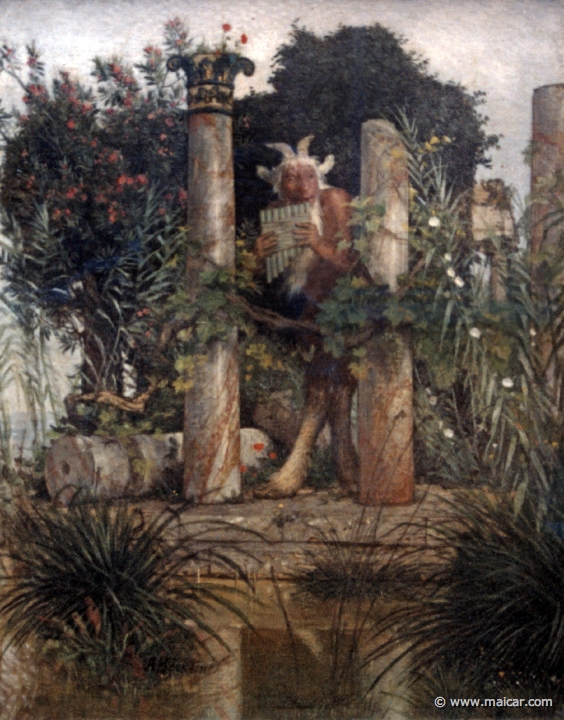
0109: Pan playing the syrinx. Painting by A. Böcklin, 1827-1901. Neue Pinakotek, München.
|
|
|
O goat-foot God of Arcady !
This modern world is grey and old,
And what remains to us of thee ?
…
Then blow some trumpet loud and free,
And give thine oaten pipe away,
Ah, leave the hills of Arcady !
This modern world hath need of thee !
(Oscar Wilde, 1854-1900, "Pan").
|
|
Gods of Hellas, gods of Hellas,
Can ye listen in your silence?
Can your mystic voices tell us
Where ye hide? In floating islands,
With a wind that evermore
Keeps you out of sight of shore?
Pan, Pan is dead.
(Elizabeth Barret Browning, 1806-61, The Dead Pan).
|
|
|
Pan is the god of woods, pastures, and other
landscapes.
God of wild nature
When Pan was born and the nurse saw the face and the beard of the newborn child, she was afraid and fled. For this reason it has been said that irrational terrors (panic) come from Pan. Pan has a goat's feet and two horns, and wears a
lynx-pelt. He is the god of woods and pastures, and
also the mountain peaks and rocky crests are his
domain. He wanders along the hills, slaying wild
beasts. But in the evenings he plays sweet and low
on his pipes of reed, with singing NYMPHS or CHARITES holding him
company. Otherwise, when he is in the company of
the Mother of the Gods (Rhea 1), Pan loves noise and high-pitched songs
Syrinx
Pan fell in love with the Arcadian nymph Syrinx
(an imitator of Artemis both in manners and in appearance), who had until
then eluded the pursuit of both SATYRS and gods. Sirynx
desdained Pan, and spurning his love and prayers,
refused to take him as a sweetheart, who was
neither man nor goat. The god then pursued her, but
she came to the stream of the river Ladon in
western Arcadia, and no longer being able to
escape, she asked to the nymphs of the river to
change her form. And the nymphs, listening to her
prayers, turned her into marsh reeds. So when Pan
wished to hold her, there was nothing left of her
except the reeds and the sound which the air
produced in them. On hearing it, however, Pan was
charmed, and thinking of the nymph, said to himself
in triumph:
"This
converse, at least, shall I have with you." (Pan. Ovid, Metamorphoses 1.710).
And joining reeds of different sizes, he
invented the musical instrument that was named
syrinx after her, or sometimes Pan flute, after the
god himself.
The Pan flute defeated
Pan is also remembered for having competed with
that flute against Apollo's lyre, but the
syrinx was judged by Tmolus to be inferior to Apollo's lyre. On the
occasion, everyone agreed with the judgement except
King Midas, who called it
unjust. And it is for this reason that Midas acquired, by the
will of Apollo, the ears
of an ass, which he tried in vain to conceal under
a turban.
|
|
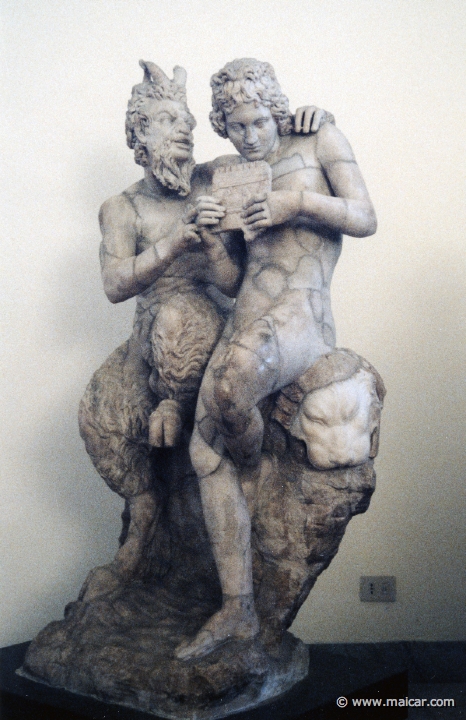
Pan and Daphnis 4, the inventor of the bucolic poem.
7222: Gruppo marmoreo di Pan e Dafni. Collezione Farnese. Forse da un prototipo dello scultore rodio Eliodoro. National Archaeological Museum, Naples.
|
|
Death of Pan
Gods cannot die, immortality being an attribute
of all divine beings. Yet there have been some
exceptions to this rule. One of them is Chiron, who, suffering
from an incurable wound, was granted mortality by Zeus. Another is the first Dionysus, who was
destroyed by the TITANS. Then on the death of Pan a rumour arose in the first century AD, recorded by Plutarch in his The Obsolescence of Oracles (Moralia 419 A-E):
"As for the death among such beings, I have heard the words of a man who was not a fool nor an impostor. The father of Aemilianus the orator, to whom some of you have listened, was Epitherses, who lived in our town and was my teacher in grammar. He said that once upon a time, in making a voyage to Italy, he embarked on a ship carrying freight and many passengers. It was already evening when, near the Echinades Islands, the wind dropped, and the ship drifted near Paxi. Almost everybody was awake, and a good many had not finished their after-dinner wine. Suddenly from the island of Paxi was heard the voice of someone loudly calling Thamus, so that all were amazed. Thamus was an Egyptian pilot, not known by name even to many on board. Twice he was called and made no reply, but the third time he answered; and the caller, raising his voice, said, 'When you come opposite to Palodes, announce that Great Pan is dead.' On hearing this, all, said Epitherses, were astonished and reasoned among themselves whether it was better to carry out the order or to refuse to meddle and let the matter go. Under the circumstances Thamus made up his mind that if there should be a breeze, he would sail past and keep quiet, but with no wind and a smooth sea about the place, he would announce what he had heard. So, when he came opposite Palodes, and there was neither wind nor wave, Thamus, from the stern, looking toward the land, said the words as he had heard them: 'Great Pan is dead.' Even before he had finished, there was a great cry of lamentation, not of one person, but of many, mingled with exclamations of amazement. As many persons were on the vessel, the story was soon spread abroad in Rome, and thamus was sent for by Tiberius Caesar. Tiberius became so convinced of the truth of the story that he caused an inquiry and investigation to be made about Pan; and the scholars, who were numerous at his court, conjectured that he was the son born of Hermes and Penelope."
|


