|
|
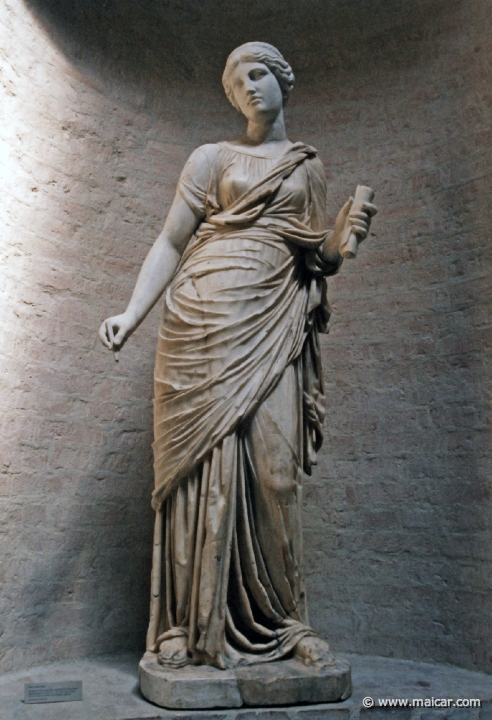
0203: Statue of a Muse. Roman copy after a sculptural group from 130 BC. Completed in 1812 by Bertel Thorvaldsen. Glyptothek, München.
|
|
|
"There is nothing more ancient in the world than language. The history of man begins, not with rude flints, rock temples or pyramids, but with language. The second stage is represented by myths as the first attempts at translating the phenomena of nature into thought. The third stage is that of religion or the recognition of moral powers, and in the end of One Moral Power behind and above all nature. The fourth and last is philosophy, or a critique of the powers of reason in their legitimate working on the data of experience." (F. Max Müller, Contributions to the Science of Mythology).
"I will begin with the Muses and Apollo and Zeus. For it is through the Muses and Apollo that there are singers upon the earth and players upon the lyre; but kings are from Zeus. Happy is he whom the Muses love: sweet flows speech from his lips." (Homeric Hymn to the Muses and Apollo, 1).
|
Don Quijote: "Dios sabe si hay Dulcinea, o no, en el mundo, o si es fantástica, o no es fantástica; y éstas no son de las cosas cuya averiguación se ha de llevar hasta el cabo." (Miguel de Cervantes, Don Quijote de la Mancha, Segunda Parte, Capítulo XXXII).
|
|
Don Quixote: "Heaven knows whether there be a Dulcinea in the world or not, and whether she be a notional creature or not. These are mysteries not to be so narrowly inquired into." (Miguel de Cervantes, Don Quixote, Part II, Chapter XXXII).
|
|
|
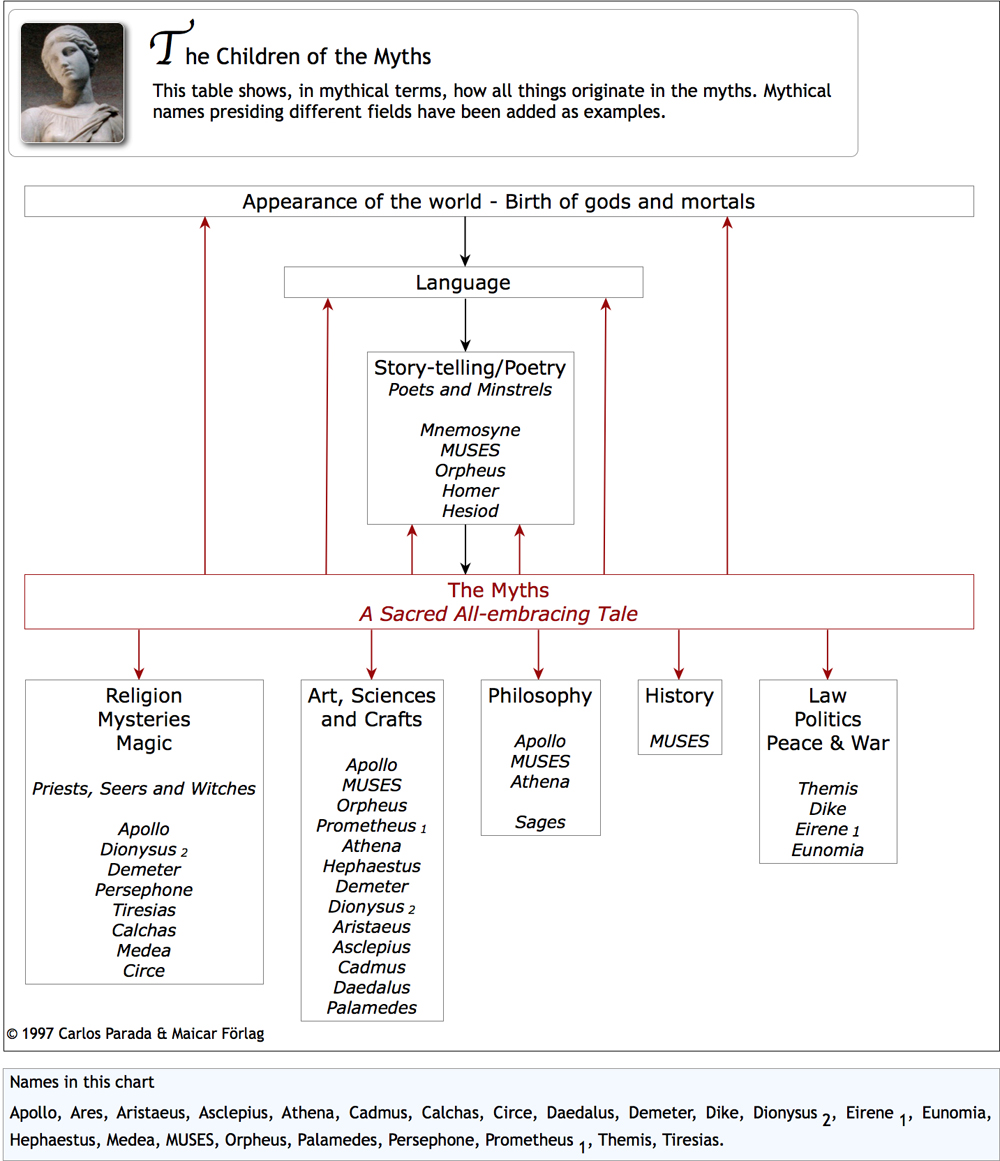
The Children of the Myths are everywhere.
Cradle and preview
The table below describes, in mythical terms,
how all things originate in the myths, which are
the cradle and preview both of those things that
already are, and of those that should be.
Myths and Civilization
Western civilization, which inherited the Greek
myths through Rome, has developed its art,
philosophy, science, technology, and many other
wonderful things, based upon the images and ideals
sketched in the myths, and on the spirit permeating
them. Whatever seems in history to have superseded
the myths has been created, predicted, and
described by them. And if the ideals and prototypes
which the myths, without ever imposing themselves,
have provided for at least 3000 years, were absent,
not only the individual minds would decay but also
the works of institutions and governments would be
impoverished. And if nothing were done to relieve
that destitution, the whole civilization, having
lost both past and future, would finally find
itself on the verge of collapsing and falling into
oblivion.
The Permanent and the Transient
In mythical terms, neither
Peace nor War nor
Justice nor
Discord nor
Love nor Hate, nor many
other things deeply affecting the life of human
beings, are made or invented by transient men. But
instead mortals are called and formed by those
forces that, being more permanent, transcend them
and are immortal compared to them. And both the
transient, which reflects the permanent as objects
reflect invisible light, and the permanent itself,
as well as the results their interaction yields,
were first described and illustrated by the myths.
However, the value and truth of the myths do not
rest in the accuracy of fixed interpretations, but
in their providing all free men and women with the
implements and examples by which they may deepen
their understanding of what it means to be a soul
in human attire.
Belief, Disbelief and the Myths
But however extraordinary, the myths are neither
to be believed, for Belief is blind and noisy, nor
disbelieved, for in Disbelief dwell exhaustion,
despair, and emptiness. And whereas Disbelief
accomplishes nothing, Belief may achieve great
things, good or bad. But when one of them shuts the
mind or the heart, the myths can barely be heard.
For the myths speak, by the power of
Memory, standing on
the golden thread that separates and blends both.
"There is much to be gained by neither believing nor yet disbelieving everything." (Flavius Philostratus, Life of Apollonius of Tyana 3.45).
Reason
Some have thought that Belief, being direct, is
stronger than the myths, whose approach is
indirect, and yet others have thought that Reason
came after the myths in order to correct their
nonsensical ideas. However, both Belief and Reason
are contemporary with the myths, and are also their
children, the former coming and going, and the
latter arguing with itself. For Reason is not, as
it has been suggested, the child of Philosophy, but
Philosophy the child of human reason. And both are
children of the myths. For when
Achilles, nurturing his
wrath, refused to fight, he was approached by his
friends neither by ritual nor magic nor
metaphysical threats nor irrational manipulations,
but by the words of reason, which he left unheard,
and by the king's gifts, which he despised.
Law
And without reason there would not have been any
prudent counsels when the Achaean leaders were
assembled, but instead folly or apprehensiveness
had prevailed. And no idea of law and citizenship
could have been expressed either, as
Nestor declared:
"A clanless,
lawless, hearthless man is he that loves strife
among his own folk."
(Nestor to the
Achaeans. Homer,
Iliad 9.63).
or when Odysseus,
describing the life of the Cyclopes, said:
"Neither
assemblies for council have they, nor appointed
laws, but they dwell on the peaks of lofty
mountains in hollow caves, and each one is lawgiver
to his children and his wives, and nobody cares for
his neighbours." (Odysseus to Alcinous.
Homer,
Odyssey 9.113).
Science
And what is true for Reason and Law is also true for Science. For if all traces of the myths were to be erased, a large number of celestial bodies and creatures living in the world would lose their names, which astronomers and other scientists gave them, taking into account the attributes and characteristics once described by the myths. And this, which is also true in many other fields of knowledge, has been done to such an extent, that if the footprints of the myths were blown away by some wind, not only science or philosophy or law would suffer, but all other human activities as well. And at the end, as less ideas and words would be available, speech itself would decay, and we would find ourselves pointing at things with the forefinger, not knowing how to rediscover the world, describe it, or find a meaning in it.
Art
The myths are the source of all arts regardless
of the casual motive of a particular work. But if
all works of art concerned with the myths
themselves, either by direct or indirect reference,
were eliminated, burned, or destroyed, so that not
one single trace would remain of the myths, an
immense amount of music, paintings, sculptures,
books, and many other pieces of art of all kinds
and all times would vanish, inflicting an
irreparable damage to the whole heritage of
civilization. For in comparison very little would
remain.
Arts, Sciences and Proportion
In such a case, both the sciences and the arts would suffer alike. For arts and sciences always work together and complement each other, at least until the moment when things fall out of proportion. Yet knowing and keeping Proportion, which is one of the most subtle links for harmoniously merging different things, is paramount both in science and art. For both chemist and musician rely on Proportion. And the same may be said of politics, economy, or the human soul. For peace and wealth and happiness and health are all dependent on certain proportions, just as war and misery and folly and sickness come when the sense of proportion is lost.
Proportion and Memory
But Proportion rules not only each activity, but
also the balance among them, thus keeping the
totality healthy. For art cannot be without science
nor science without art, and none of them can exist
without wealth, and wealth is nothing without them,
and everything would be lost without law, and law
would be useless if there were nothing to know and
enjoy. And something similar could be said of
Memory, for upon her
rest both the Myths and the Children of the Myths,
and therefore the whole life, past and future, of
both individuals and societies.
|