Greek Mythology Link - by Carlos Parada, author of Genealogical Guide to Greek Mythology

| Biographies | GROUPS | Places & Peoples | Dictionary | Images | Albums | Topics | Search | Downloads |

Hero and Leander

Hero y Leandro


Hero

Relevant links (other couples)

Hero and Leander were lovers living at each side of the Hellespont.


Hero y Leandro vivían uno en cada orilla del Helesponto.

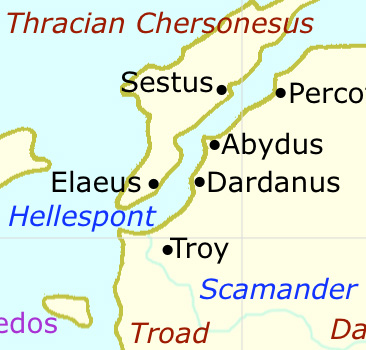
Abydus and Sestus are in the Troad and the Thracian Chersonesus (Gallipoli), facing each other in one of the narrowest points of the Hellespont,

Abidos y Sestos se encuentran en la Tróade y el Quersoneso tracio, frente a frente en uno de los parajes más angostos del Helesponto.


The lovers and their cities

Abydus in the Troad (north-western Asia Minor), and Sestus in the Thracian Chersonesus, are cities facing each other across one of the narrowest points of the strait called Hellespont after Athamas 1's daughter Helle, who once fell from a flying ram into these waters, and drowned. These cities were held during the Trojan War by Hyrtacus' son Asius 1, whom King Idomeneus 1 of Crete killed [see also TROJAN LEADERS].

Hero, a priestess of Aphrodite, lived alone (by the will of her parents), and attended by a single maid, at the edge of Sestus in a high tower by the sea, perhaps the same 'Tower of Hero', south-west of the town that was later known in historical times, but was already a ruin when Augustus was emperor of Rome. By lighting a lamp she turned the tower into a lighthouse which guided her lover to her.

Leander, a young man from Abydus, swam every night guided by the lamp which his mistress lit at the top of the tower, a distance of more than 1300 meters across the Hellespont, from Abydus to Sestus, in order to spend the night with his beloved Hero; and before dawn, Leander returned to his city by the same means. It has been remarked that on account of the rapid currents in the Hellespont, it is easier to cross from Sestus to Abydus than from Abydus to Sestus.

Los amantes y sus ciudades

A las ciudades de Abidos (en Tróade, noroeste de Asia Menor) y Sestos (en el Quersoneso tracio) las separa uno de los lugares más angostos del estrecho del Helesponto, así llamado en recuerdo de Hele, la hija de Atamante 1, que una vez se ahogó en sus aguas al caer del carnero volador que cabalgaba. Estas ciudades pertenecían, en la época de la Guerra de Troya, al hijo de Hírtaco, Asio 1, a quien dio muerte Idomeneo 1, rey de Creta [véase JEFES TROYANOS].

Hero, sacerdotisa de Afrodita, vivía sola (como sus padres lo ordenaron), atendida por una criada,, en una torre cercana al mar cerca de los límites de Sestos. Quizá sea la misma «Torre de Hero», al sudoeste de la ciudad, que aunque identificada en tiempos históricos, estaba ya en ruinas cuando Augusto era emperador de Roma. Encendiendo una lámpara que convertía la torre en faro, Hero orientaba a su amante mientras él cruzaba el estrecho.

Leandro, un joven de Abidos, cruzaba el Helesponto a nado (una distancia de más de mil trescientos metros), ida y vuelta todas las noches, para estar con la amada que lo guiaba con aquella luz. Antes del amanecer, Leandro nadaba de regreso. Alguien señaló que, debido a las rápidas corrientes del Helesponto, es más fácil cruzar de Sestos a Abidos que al revés.

Hero's simple life in Sestus

Before meeting Leander, the young girl lived in chastity, neither entering dances nor other gatherings, Being very beautiful, and apparently believing that

"... at sight of beauty women are envious." [Mus.37]

she also avoided mingling among the girls of her age. Instead, and by the will of her parents, Hero lived retired in a tower by the sea, appeasing Aphrodite and Eros by sacrifices rather than through the delights of the couch.

La sencilla vida de Hero en Sestos

Antes de conocer a Leandro, Hero conservaba su virginidad, renunciando a danzas y reuniones. Como se sabía bella y acaso creía que

«... al contemplar la belleza las mujeres se vuelven envidiosas.» [Mus.37]

evitaba también el andar con otras chicas de su edad. Obedeciendo el deseo de sus padres, vivía retirada en una torre cerca del mar, donde apaciguaba a Afrodita y Eros, no con las delicias del lecho, sino con sacrificios.

'International' festival

A festival was celebrated in Sestus to honour Adonis and Aphrodite. This event resembled the kind of public arrangement that nowadays is called 'international festival'; for people came from many cities, not only from Phrygia, but also from such distant places as Thessaly in northern Greece, Cyprus, or Lebanon. These events, regardless of their purpose, are always appreciated, particularly by the young people, since they offer excellent opportunities to meet some wonderful sweetheart to spent a lovely time with.

Festival «internacional»

Se celebró en Sestos un festival en honor de Adonis y Afrodita, acontecimiento comparable a ciertos «festivales internacionales» de nuestra propia época. Venía gente de muchas ciudades, de Frigia y de países lejanos, como Tesalia en el norte de la Hélade, o como Chipre y Líbano. Tales festivales, cualquiera sea su objetivo, son siempre muy apreciados por los jóvenes, que ven en ellos espléndidas oportunidades de vivir amoríos con algún ser encantador, y pasar así memorables jornadas.

Her beauty

Hero had no plans of her own, except her service as a priestess. But since she naturally flashed lovely radiance from her face, reminding of Selene's white cheeks; and since, as they assert, a meadow of roses appeared in her limbs when she moved; and since from these limbs flowed not three Graces but one hundred, many young men surrendered to her their minds, hearts, and eyes, although they had come to the Sestus' festival to sacrifice to the immortals. And since instant beauty is more sharply perceived than beauty remote, they believed that they had never before seen such an example of delicacy and loveliness, although they had previously investigated beauty in as many cities as they could, and particularly in Sparta, land of ravishing women such as Helen.

Su belleza

Por cierto que Hero no abrigaba, para la ocasión, otros planes que no fueran sus deberes de sacerdotisa. Pero como su rostro proyectaba un resplandor cautivante, evocador de las blancas mejillas de Selene; y como sus miembros, al moverse, sugerían un prado de rosas, del cual fluían, no tres sino cien Gracias, muchos jóvenes le rendían sus pensamientos, corazones y miradas, pese a que habían concurrido al festival de Sestos para rendirle honores a los inmortales. Se percibe la belleza inmediata con más claridad que la remota. Por eso, al verla, creyeron que nunca habían visto nada más delicado y encantador, aunque ya habían investigado la belleza en tantas ciudades como les fue posible, especialmente en Esparta, tierra de mujeres arrebatadoras, como Helena.

Words and silence

Dazzled by Hero's beauty then, many youths lost themselves in words, saying that they would accept instant death if they could first sleep with Hero, or that they would prefer to marry her than to be immortal, or that they never got tired of looking at her. And since while some talk others act, Leander, letting his love drive out his fears, approached Hero with voiceless gestures. This is how Love often introduces himself; for words are too slow when beauty must find its way to the soul, as they say, through the eye. And some, as Hero and Leander, take each other's hands before they have uttered a word.

Las palabras y el silencio

Deslumbrados por la hermosura de Hero, muchos se enredaron en palabras ... Decían que aceptarían gustosos una muerte súbita si sólo pudieran dormir con ella .... O que la preferían como esposa a una inmortal ... O que nunca se cansaban de mirarla ... Pero mientras algunos hablan, otros actúan. Leandro dejó que su amor despidiera sus temores, y se acercó a Hero sin decir palabra. Así se presenta a veces el amor, pareciéndole lerdísimo el habla cuando la belleza urga los caminos del alma. Y algunos, como Hero y Leandro, ya se toman las manos sin haber intercambiado una sola palabra.

Conversation in the temple

Hand in hand Leander led Hero into the temple. There Leander prayed her to take pity on his desire. He kissed her throat. He told her that Aphrodite takes no pleasure in virgins; that he was at her feet shot down by Love; that he declared that she was like a goddess for him. Hero at first protested and threatened him. But, after hearing him, she remained speechless for a while, yet glowing in her heart and trembling at his beauty; and that finally she said:

"Stranger, likely with your words you might rouse even a stone." [Hero to Leander. Mus.174]

A nice thing to hear. But she also reminded him that her parents would not allow her to marry a foreigner, and that if he stayed in the land as an alien, he would not be able to conceal their love, for

"... that same deed that a man does in silence, he hears of in the crossways." [Hero to Leander. Mus.183]

It was then that Leander, conquered by Love, declared:

"... for the sake of your love I will cross even the wild waves." [Leander to Hero. Mus.203]

and told her that he came from the opposite city Abydus. He then bade her to light a lamp from her tower so that he, swimming in the dark, could find his way to her. And he called her lamp his life and the star on which he would keep his watch, forgetting all about Bootes or Orion or other constellations and stars.

Conversación en el templo

Tomados de la mano, Leandro llevó a Hero al templo. Allí le rogó que tuviera compasión de su deseo. Le besó el cuello. Le dijo que a Afrodita le disgustan las vírgenes; que él estaba sus pies derribado por el dios del amor, y que ella, para él, era como una diosa. Protestó Hero al principio y hasta lo amenazó. Pero luego de oírlo, enmudecía mientras ardía su corazón y temblaba ella al contemplar su hermosura. Finalmente dijo:

«Desconocido, con tus palabras podrías hasta mover las piedras.» [Hero a Leandro. Mus.174]

¡Lindo de oir! Pero también le recordó que sus padres no le permitirían casarse con un extranjero, y que si él se quedara a vivir en el país no podría ocultar su amor, pues

«... lo que un hombre hace en silencio, lo oye en las esquinas.» [Hero a Leandro. Mus.183]

Fue entonces que Leandro, vencido por su amor, le dijo

«... por tu amor, cruzaría hasta las olas salvajes.» [Leandro a Hero. Mus.203]

revelando que venía de la vecina ciudad de Abidos. Le pidió entonces que encendiera una lámpara en la torre para que él, nadando en la oscuridad, encontrara el camino. Y añadió que ella era la lámpara de su vida; la estrella que seguiría, olvidándose ya del Guardián de la Osa, de Orión y de toda otra estrella o constelación.

Secret lovers

This is how Hero and Leander became secret lovers, letting the lamp watch over them and their nightly love, as Leander crossed the waves using himself as a vessel. Long sleepless nights they spent together; but before dawn they parted and he again, taking the lamp in the tower as a landmark, swam back to Abydus. No wonder that, during the day, they prayed for darkness to come soon; for while all others slept they found great joy and delight in each other's company.

Amantes secretos

Fue así que Hero y Leandro se amaron secretamente. Dejaban que la aquella luz velara sobre ellos y su nocturno amor, mientras Leandro montaba las olas como un navío. Muchas fueron las noches que sin dormir pasaron juntos. Al alba se separaban, y otra vez nadaba Leandro de regreso a Abidos, avistando siempre la luz para no perderse. ¿Qué sorpresa puede causar que rogaran que la oscuridad cayera pronto si, mientras otros dormían, hallaban ellos delicia en la mutua compañía?

Waiting for the lamp

At dusk Leander spent his time along the shore, awaiting the signal, and when the light faded and Night approached, Hero lit the lamp in the tower. And he burned with the burning lamp on seeing it; and feeling that Aphrodite, who was born in the sea, would protect him, he rushed naked from the beach, flinging his body into the sea. Once in the water, Leander was his own ship, own oarsman, and own escort, always directing his course towards the flaring lamp, which Hero sheltered with her cloak.

Aguardando la luz

Al anochecer, pasaba Leandro largas horas en la costa, esperando la señal, y al llegar la noche, Hero alumbraba la lámpara en la torre. Y al verla, ardía Leandro como la lámpara. Sentía que Afrodita, que nació en el mar, lo protegía, cuando desnudo corría por la playa para tirarse al mar. Una vez en el agua, era Leandro su propio barco, su propio remero y escolta, siempre encaminando el curso en dirección a los destellos de la lámpara, que Hero resguardaba con su manto.

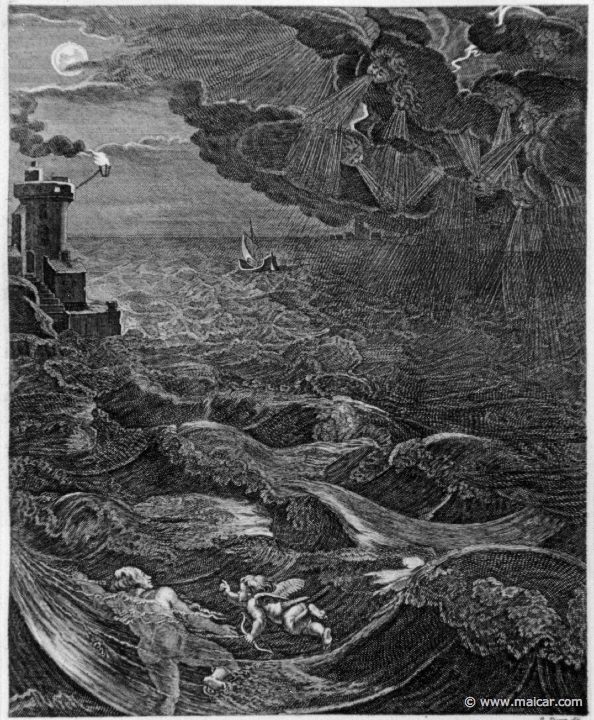
Guided by Love, Leander swims over the Hellespont to meet Hero | Guiado por el amor, Leandro cruza el Helesponto para ver a Hero

Secret union

This is how Leander reached Sestus from Abydus, arriving every night to the opposite coast with hard toil. Once he stood before the tower's portals, she folded her arms around him, and having led him to her chamber, she anointed his body with oil, quenching the smell of the sea. And then she would say:

"Here on my breasts, repose the sweat of your labouring" [Hero to Leander. Mus.271]

before entering into

"the rites of most wise Aphrodite" [Mus.273]

as Musaeus' discretion puts it. And his discernment also tells that this was a wedding without dance, and a bedding without hymns; that Hera, goddess of marriage, was not honoured; that parents did not intone the hymenaeal; that, in few words, no formal rites were performed. In addition, his judiciousness adds that Dawn never saw the bridegroom in the marriage-bed, since Leander, still feeling Hero's embraces, plunged into the sea and swam back to Abydus while still dark. On her side the girl, fearing her parents, lived a maiden by day and a wife by night.

Unión secreta

Con duros esfuerzos unía Leandro Sestos y Abidos, llegando al fin, todas las noches, a la costa opuesta. Llegado frente a los portales de la torre, ella lo abrazaba, y llevándolo a su alcoba, le ungía el cuerpo con aceite para quitarle el olor a mar. Diría ella:

«Reposa en mis pechos el sudor de tu esfuerzo.» [Hero a Leandro. Mus. 271]

antes de celebrar

«los ritos de la sabia Afrodita.» [Mus. 273]

como Museo tan discretamente dice. Su discreción también nos entera de que era ésta una boda sin danzas, y un encamarse sin himnos. Que a Hera, diosa del matrimonio, no se la honró. Que los padres no entonaron himnos nupciales. Que ningún rito formal se celebró. Añade su sensatez que la Aurora nunca sorprendió al novio en el lecho nupcial. Pues se zambullía él en el mar para volver a Abidos mientras aún demoraba la oscuridad, y mientras todavía sentía en su cuerpo las caricias de Hero. Ella, por temor a sus padres, vivía como doncella de día y esposa de noche.

Leander's death

This unstable arrangement did not last more than the warm season. For when winter came, the sea changed and even sailors drew up their ships. Yet Leander's love was not hindered by the new frosty weather, and therefore he soon saw himself borne on the back of fierce waves, which the WINDS arouse when they fight each other: Eurus against Zephyrus 1 and Boreas 1 against Notus. And when one wintry night Leander found himself at sea in the middle of such a windy war, a gust blew out the lamp in Hero's tower, and Leander, being left in the dark without landmarks, lost his way and perished.

Muerte de Leandro

Este inestable arreglo duró lo que la estación estival. Al llegar el invierno, cambió el mar y hasta los marineros atracaron sus barcos. Pero no detuvo el clima glacial al amor de Leandro. Pronto se vio en manos de olas violentas, que los vientos levantaban en sus luchas intestinas: Euro contra Zéfiro, Bóreas contra Noto. En medio de una de esas noches de invierno en que Leandro estaba en el mar en medio de una guerra de vientos, apagó una ráfaga la lámpara en la torre de Hero, y presa de la oscuridad, se desorientó y se ahogó.

Hero follows him

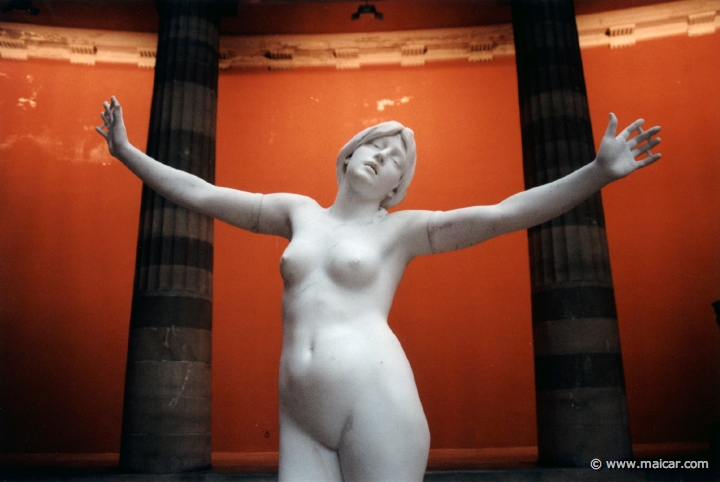
The day after, Leander's body reached the foot of the tower, and when Hero saw him flayed by the rocks, she teared her robe from round her breasts and cast herself down from the tower, her dead body remaining beside his. This is how Hero perished; for human bodies have no wings. Yet those who pass through life together in friendship and love, some say, grow wings of another kind:

"... when they depart from the body, they are not winged, to be sure, but their wings have begun to grow, so that the madness of love brings them no small reward; for it is the law that those who have once begun their upward progress shall never again pass into darkness and the journey under the earth, but shall live a happy life in the light as they journey together, and because of their love shall be alike in their plumage when they receive their wings." [Plato, Phaedrus 256d]

Hero lo acompaña

Al día siguiente, las olas arrastraron su cuerpo hasta el pie de la torre. Al verlo destrozado por las rocas, Hero se desgarró el vestido y se tiró de lo alto de la torre, quedando su cuerpo junto al de él. Así murió Hero, pues no tienen alas los cuerpos humanos ... Pero hay quien dice que alados serán quienes pasan la vida juntos en amor y amistad:

«Al fin de su vida, sin alas aún, pero ya impacientes por tomarlas, sus almas abandonan sus cuerpos, de suerte que su delirio amoroso recibe una gran recompensa. Porque la ley divina no permite que los que han comenzado su viaje celeste, sean precipitados en las tinieblas subterráneas, sino que pasan una vida brillante y dichosa en eterna unión, y, cuando reciben alas, las obtienen juntos, a causa del amor que les ha unido sobre la tierra.» [Platón, Fedro 256d]

Epilogue

No one ever learned about their love, except Hero's old maid, who was the only witness; but those who are remembered for telling this story are Musaeus Grammaticus and the poet Publius Ovidius Naso, who both received it from someone else. Leander's love could be difficult to emulate, but his athletic performance was replayed many years later, in AD 1810, by the English poet Lord Byron, who swam from Sestus to Abydus in one hour and ten minutes, although no priestess of Aphrodite awaited him on the other side.

Epílogo

Nadie supo nunca del amor de Leandro y Hero, excepto la vieja criada, que fue la única que pudo saber de él. Quienes contaron la historia fueron Museo Gramático y el poeta Publio Ovidio Nasón. Ambos deben haberla escuchado de algún otro. El amor de Leandro es difícil de imitar. Pero su hazaña atlética fue emulada mucho después, en 1810 d.C., por el poeta inglés Lord Byron, que nadó de Sestos a Abidos en una hora y diez minutos, aunque no lo esperaba en la otra orilla una sacerdotisa de Afrodita.

Sources
Abbreviations

Musaeus Grammaticus: Hero and Leander; Ov.Her.18, 19; Strab.13.1.22.

Web

GML

| Biographies | GROUPS | Places & Peoples | Dictionary | Images | Albums | Topics | Search | Downloads |

This page belongs to the Greek Mythology Link, a web site created and maintained by Carlos Parada. Except stated otherwise, the material in this site is copyright © Carlos Parada & Maicar Förlag 1997. About, Additions, Backups, Yahoo Group, Addresses, Contact.