|
"Plato, ambitious to
elaborate and adorn the subject of the lost
Atlantis, as if it were the soil of a fair estate
unoccupied, but appropriately his by virtue of some
kinship with Solon, began the work by laying out
great porches, enclosures, and courtyards, such as
no story, tale, or poesy ever had before. But he
was late in beginning, and ended his life before
his work. Therefore the greater our delight in what
he actually wrote, the greater is our distress in
view of what he left undone. For as the Olympieium
in the city of Athens, so the tale of the lost
Atlantis in the wisdom of Plato is the only one
among many beautiful works to remain
unfinished." (Plutarch, Parallel
Lives Solon 32.1-2).
|
|
Atlantis was a large island in the Atlantic Ocean which lay in front of the mouth of the pillars of Heracles (straits of Gibraltar). Their inhabitants became a spiritually ugly race and for that reason Zeus and the gods destroyed them by letting the island be swallowed up by the sea. Atlantis was ruled by a confederation of kings and its power extended over Libya as far as Egypt and over Europe as far as Tuscany. About 8000 years before the Trojan War, Atlantis attempted to conquer the whole of the Mediterranean world but was defeated by the Athens of those remote times and its allies. Later, when the gods perceived that Atlantis was inhabited by an evil race, they let the island be destroyed by the third of the floods which preceded the Flood in the age of Deucalion 1. The first ten kings of Atlantis (five pairs of twins) were all sons of Poseidon and Cleito 2. The first born was Atlas, who was appointed to be king over the rest and after whom the island was called. The legend of Atlantis is not connected to other myths except for the names of Atlas and Poseidon.
Account of the Egyptian priest
According to Plato's account it was
Solon, the
Athenian statesman and poet whom History says lived
600 years after the Trojan
War, the one who brought from Egypt the story
of Atlantis. The very old Egyptian priest who
talked with
Solon was not at all impressed by the ancient stories of the Greeks, such as the one referring to Phoroneus as "the first man," or the legend of the Flood of
Deucalion 1, for these stories, according to his view, were not at all ancient.
Periodical destruction of mankind
This Egyptian priest knew that humankind is periodically destroyed, either by fire or water, or by lesser means. And behind the story of Phaethon 3, the Egyptian said, lies the shifting of the celestial bodies around the earth, which cause destruction by fire on its surface at long intervals. When this happens those living in dry areas or dwelling in mountains suffer destruction more than those living near rivers or by the sea. On the other hand, when the world is flooded, those living in mountains are saved, but those populating the cities near the sea are swept into it by the streams. Things being of this nature, those living by the Nile were spared when the world was destroyed by fire, and when it was destroyed by water they were also spared because rain is scarce in Egypt, the water welling up always from below. In this way, said the Egyptian priest, memories of ancient times could be preserved in this country while all records were destroyed elsewhere. And while in other countries the periodical destruction caused irreparable losses, in Egypt it was possible to keep records of very ancient times. This is the reason why, continued the priest, the Greeks could just remember the Flood of
Deucalion 1, ignoring that many other floods had previously occurred. And in the same way they had lost the memory of that Athens which existed 8000
years before the Trojan
War (which is in our own day said to have taken place about 1200 BC).
Atlantis defeated in war
According to this Egyptian priest, that Athens of old resisted the invasion of the people from Atlantis, an island larger than Libya (name for the whole of northern Africa except Egypt) which lay in front of the mouth of the so called "Pillars of Heracles" (today called "straits of Gibraltar"). The island Atlantis was ruled by a confederation of kings which held power also in surrounding islands. The people of Atlantis had occupied Libya as far as Egypt and southwestern Europe, as far as Tuscany in Italy. And having conquered those regions, they gathered a host to extend their dominion to both Egypt and Greece. The Athenians of old, however, defeated this powerful army.
Atlantis and Athens
destroyed
At a later time, earthquakes and floods destroyed the two opponents, Athens being swallowed up by the earth, and the island of Atlantis by the sea, vanishing for ever. This is why, the Egyptian said, the ocean at the spot where Atlantis once was, became impossible to sail across, being blocked up by the mud created by the large island when it sank.
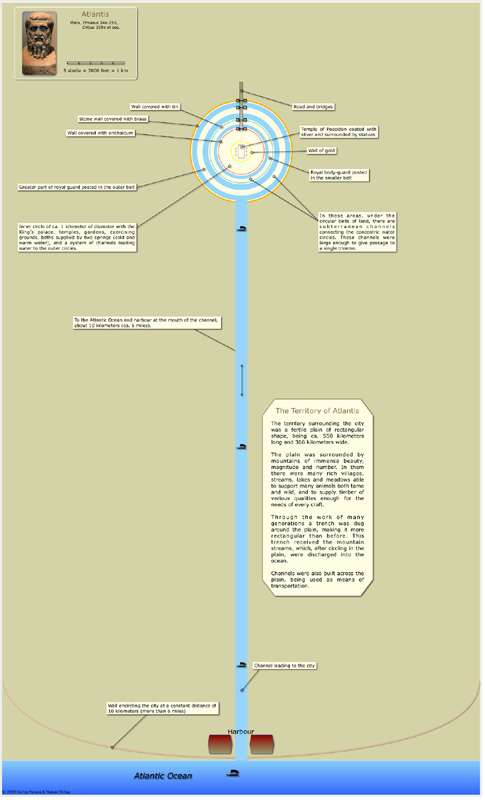
Now, when the gods divided among themselves different regions of the earth, the island of Atlantis was allotted to Poseidon, who settled there the children he had begotten of a mortal woman. In the middle of the island there was a fertile
plain, and in its centre there stood a mountain
where the
autochthons (offspring of the soil) Evenor 4 and Leucippe 6 lived with their daughter Cleito 2. When they died, Poseidon married this young woman, and decided to alter the landscape, making the hill impregnable. And so the god carved circular belts—three of sea and two of land around the hill—isolating it completely, for at that time sailing was unknown. He also brought up springs of warm and cold water, producing all kinds of food.
The ten kings of Atlantis
Poseidon and Cleito 2 had five pairs of twins, who, along with their descendants, ruled the ten provinces into which Poseidon had divided
Atlantis. The island and the ocean were called
after Poseidon's
first-born, Atlas, who was also king over his brothers. The brothers and the descendants of their ten royal houses ruled over many other islands, and also over the Mediterranean peoples living west of Egypt and Tuscany. The ten kings, who governed each his own
province, are said to have assembled every fifth
year and every sixth year, administering the public
affairs and delivering judgement according to the
law that Poseidon handed down to them, and according to records
inscribed in a pillar of orichalcum.
Wealth of Atlantis
The people of Atlantis possessed an immense wealth, having at their disposal all kinds of supplies in endless abundance: metals, timber, animals (both tame and wild), including elephants, a great variety of fruits and vegetables, and many other things. Receiving all these products, they promptly furnished their temples, harbors, and the rest of the country. Around their metropolis, which was at about 10 kilometers (ca. 6 miles) from the sea, they built a circular system of channels and bridges with towers and gates, and circular walls of stone which they coated with brass, tin, and orichalcum.
Atlantis defeated
Atlantis was a flourishing realm. And yet, in
spite of all the power deriving from wealth and
advanced technologies, mighty fleets and large
armies, Atlantis was defeated in war by the
Athens of those remote times. Also, for all the knowledge the people of Atlantis had at their disposal, they were not able to prepare themselves against the natural catastrophe that affected them, nor could they avoid utter destruction. It has also been said that the people of Atlantis degenerated, being unable to live a happy life, and having become spiritually ugly. For this reason, Zeus and
the gods, perceiving how evil this race had become,
inflicted punishment upon them and let them be
swallowed up by the sea.
|