Perseus 1
Περσεύς |
|
|
|
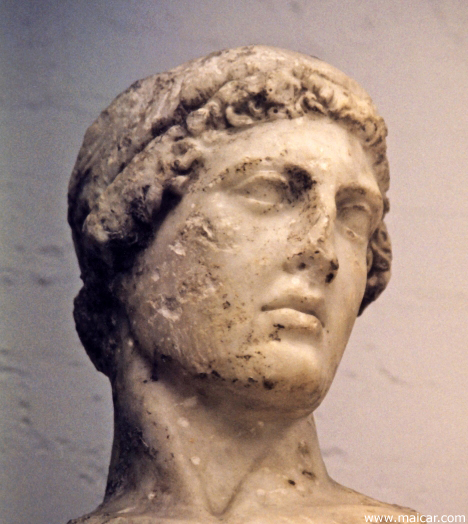
Perseus 1. 7933: Head from a statue of the hero Perseus. Marble. Roman copy of a lost original of the mid-5th century BC, thought to be the Perseus by Myron. British Museum, London.
|
|
|
|
|
|
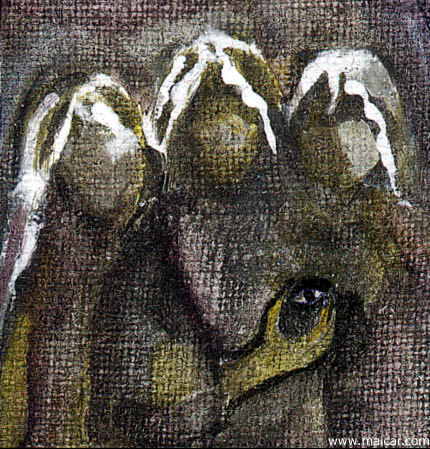
The GRAEAE. Painting by C. Parada (1989).
|
|
Perseus 1 was, as a child, cast into the sea in a chest together with his mother, whom Zeus had visited in the form of a stream of gold when she was held isolated. By accident, they say, Perseus 1 killed his grandfather, the man who had sent him and his mother into exile. Perseus 1 beheaded Medusa 1, and later founded the city of Mycenae, where he became
king.
Prophecy and Birth
When Danae's father
King Acrisius of Argos once questioned the oracle, it replied that Danae would give birth to
a son who would kill him. Fearing that, he built a
brazen chamber under ground where he guarded Danae. But Zeus had intercourse with
her in the shape of a stream of gold which poured
through the roof into the girl's lap. When her
father afterwards learned that she had got a child,
he would not believe that she had been seduced by Zeus, and putting her with the child in a chest, he cast it into the sea. However, mother and child did not perish; for the chest was washed ashore on the island of Seriphus, which is one of the islands called Cyclades, where Polydectes 1, its colonizer, was king.
|
|
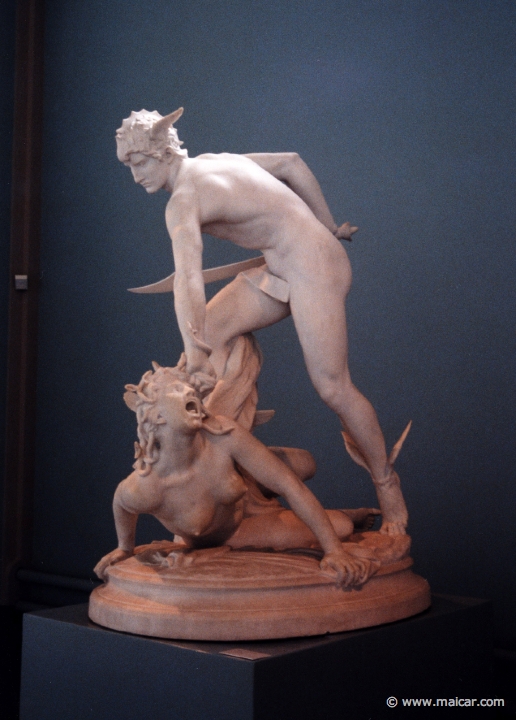
4934: Perseus beheads Medusa. Statue by Laurent Honoré Marqueste, 1875-1903. Glyptotek, Copenhagen.
|
|
Uncomfortable person
Polydectes 1 fell in love with Danae but could not be with her because of Perseus 1. And since a good method to get rid of unconfortable persons is to give them a dangerous assignment far away, Polydectes 1 sent young Perseus 1 to fetch and bring back the head of Medusa 1, and so Perseus 1 departed under the guidance of Hermes and Athena.
The quest
In order to find his way, Perseus 1 met the GRAEAE, who were sisters of the GORGONS and old women from birth. The three GRAEAE had but one eye and one tooth, which they passed to each other in turn. They would not tell anything, but Perseus 1, taking their tooth and eye, compelled them to show him the way to the NYMPHS, who
had the winged sandals and a wallet (kibisis). So
when the GRAEAE had shown him the way, he gave them
back the tooth and the eye, and coming to the NYMPHS got what he
wanted.
The death of Medusa 1
Perseus 1 slung the wallet about him, fitted the sandals to his ankles, and put the Helmet of Hades on his head, because
wearing it he saw everyone, but himself was
invisible. And having received from Hermes an adamantine
sickle, he flew to the ocean and caught the GORGONS asleep. With Athena guiding his hand
and himself looking on a brazen shield, where he
could see the image of Medusa 1, he beheaded her, and put the head in the wallet. Perseus 1 proceeded in this way because whoever looked directly at Medusa 1 was instantly turned into a stone. When their sister was dead, the other two GORGONS pursued him, but
because of the helmet that made him invisible, they
could not see him, even less find him.
Andromeda released
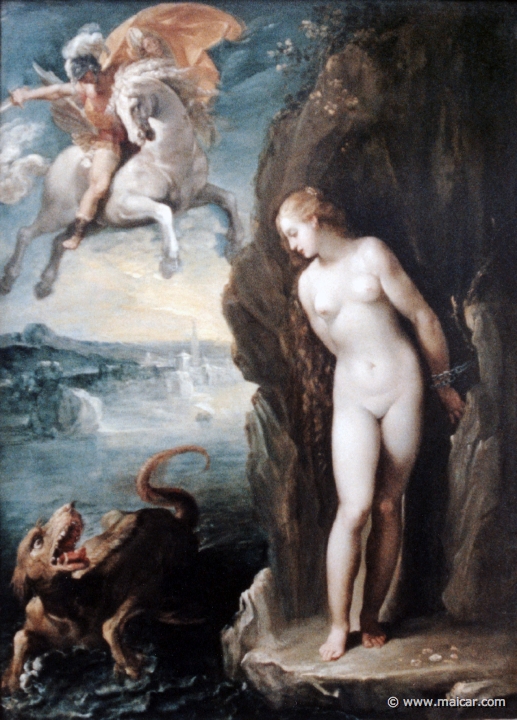
Perseus 1 arrived then to Ethiopia where he found the king's daughter Andromeda set out to be the prey of a sea monster, a situation that had been caused by the boasts of her mother Cassiopea 2 against the NEREIDS. For
she had said that she was better than them all, and
for that reason the NEREIDS felt angry, and Poseidon, sharing their
wrath, sent a flood and a monster to invade the
land. Andromeda then
was exposed to the monster in order to appease both Poseidon and the NEREIDS. Seeing this girl in such a distress, Perseus 1 fell in love with her, and promised King Cepheus 1 that he would kill the monster if he would give him the rescued girl to wife. The king agreed, and Perseus 1 slew the monster, releasing Andromeda. However, her uncle, who had been betrothed to her, plotted against him. But Perseus 1, who now owned an extraordinary weapon, discovered the plot, and by taking out of the wallet the head of Medusa 1 and showing it
to the disappointed lover, he turned him into a
stone.
The Return
|
|
2308: Perseus rescues Andromeda. Painting by Giuseppe Cesari called Il Cavalier d'Arpino, 1568-1640. Gemälde Galerie Kulturforum, Berlin.
|
|
Perseus 1 came back to Seriphus only to discover that Polydectes 1 behaved like a cruel ruler. And once again, remembering his weapon, he entered the palace and showed the king and his friends the head of Medusa 1, and all who
saw it were instantly turned into stone. After
this, he gave all objects he had borrowed to their
respective owners, and the head he gave to Athena, who inserted it
in her shield. That is why some say that Medusa 1 was beheaded
for Athena's sake,
because Medusa 1 used to
match herself with Athena in beauty.
Prophecy fulfilled
When all this was accomplished, Perseus 1 went with Danae and Andromeda first to Argos and later to Larissa to compete in athletic games. In the course of the competition, Perseus 1 killed King Acrisius of Argos by accident, the
same man to whom the oracle had said that his
daughter would give birth to a son who would kill
him. This is how, during the games, the oracle was
fulfilled.
Some say, however, that Acrisius was obssessed with the oracle, and that when he discovered that Perseus 1 and Danae were staying at Polydectes 1's court, he went to get them. At his arrival, Polydectes 1 interceded for them, and Perseus 1 was made to swear that he would never kill his grandfather. Acrisius, however, had to stay there because of a storm, and in the meanwhile Polydectes 1 died. It is told that at his funeral games the wind blew a discus from Perseus 1's hand at Acrisius' head killing him. At his grandfather's death, Perseus 1 went to Argos and took possession
of Acrisius' kingdom.
Foundation of Mycenae
But perceiving that the oracle was fulfilled, he
buried Acrisius, and being ashamed to claim the
inheritance (Argos) of the man he had killed, Perseus 1 went to Megapenthes 2 at Tiryns, and effected
an exchange of kingdoms with him, surrendering Argos into his hands. So Megapenthes 2 reigned over the Argives, and Perseus 1 reigned over Tiryns.
Having taken over in this city, he also founded Mycenae.
Death and immortality Perseus 1 is said to have being killed by Megapenthes 2, "on account of the death of his father", as someone puts it. Megapenthes 2 is a son of Proetus 1 by Stheneboea, that is, half-brother of Perseus 1. Perseus 1 is also said to have been made immortal and placed among the stars.
Another with identical name Perseus 2 is a son of Nestor. |
| Family |
|
|
|
|
|
|
|
|
|
| |
|
|
|
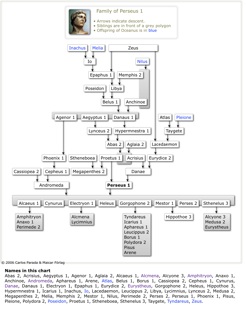
Danae is the daughter of Acrisius and Eurydice 2, or of Acrisius and Aganippe 2. Eurydice 2 is the daughter of King Lacedaemon, after whom the region about Sparta is named.
Lacedaemon is the son of Zeus and the
Pleiad Taygete.
Acrisius is son of Abas 2, son of Lynceus 2, the only one among the sons of Aegyptus 1 who was not killed by his wife during the fatal wedding night (see DANAIDS). Acrisius quarrelled with his twin brother Proetus 1 while they were still in the womb, and when they were grown up they waged war for the kingdom. Acrisius won the war and drove Proetus 1 from Argos (see also Bellerophon).
|
|

Andromeda
|
- Perses 2
- Alcaeus 1
- Sthenelus 3
- Heleus
- Mestor 1
- Electryon 1
- Gorgophone 2
- Cynurus
|
For Andromeda see
main text above. Andromeda was placed
among the stars by the favor of Athena commemorating also Perseus 1, who saved her.
Perses 2 was born in Ethiopia while Perseus 1 was still there. His parents left him at the court of Cepheus 1, Andromeda's father. It
is said that the kings of Persia are descended from
him.
Alcaeus 1 is the father of Amphitryon, the man
who married Alcmena,
mother of Heracles 1.
Sthenelus 3 succeeded Electryon 1 in the throne of Mycenae and Tiryns. When Amphitryon accidentally killed Electryon 1, Sthenelus 3 laid hold of this pretext to banish Amphitryon from the
whole of Argos, while he
himself seized the throne of Mycenae and Tiryns. Amphitryon settled in Thebes.
Heleus is known for having supported Amphitryon against
the Taphians, who inhabited the islands off the
coast of Acarnania. Heleus founded the city of
Helos, near Sparta, after
which the Helots were called.
Mestor 1 married Lysidice 2, a daughter of Pelops 1 and Hippodamia 3. Lysidice 2 gave birth to Hippothoe 3, mother of Taphius, who colonized the island of Taphos, off the coast of Acarnania in western mainland Greece. Taphius' son Pterelaus was king of Taphos at the time when Amphitryon ravaged this and other islands of the Taphians. Because of these family links, the sons of Pterelaus had claims over the kingdoms under Mycenaean rule, but were killed by Electryon 1.
Electryon 1 succeeded Perseus 1 in the throne of Mycenae. Amphitryon killed Electryon 1 by accident, as it is told; he threw a club at a cow, but it rebounded from the cow's horns, and striking Electryon 1, killed him. Amphitryon married Electryon 1's daughter Alcmena, mother of Heracles 1.
Gorgophone 2 is said to have been the first woman who married a second time. She is now buried in Argos, but during her lifetime she first married King Perieres 1 of Messenia, the son of Aeolus 1, according to
some. Some affirm that she is the mother of Tyndareus (Leda's husband), and of Icarius 1, the father of Penelope, Odysseus' wife. She then married Oebalus 1, who some say was son of Perieres 1. Others say that Perieres 1 and Oebalus 1 were brothers, and that King Cynortes of Lacedaemon was their father. Cynortes was son of Amyclas 1, founder of Amyclae near Sparta and son of
Lacedaemon, the son of Zeus and the Pleiad Taygete.
Cynurus is the eponym of the Cynurians, an
Argive tribe.
|
|
|
|
|
|
|
Genealogical Charts
Names in this chart: Abas 2, Acrisius, Aegyptus 1, Agenor 1, Aglaia 2, Alcaeus 1, Alcmena, Alcyone 3, Amphitryon, Anaxo 1, Anchinoe, Andromeda, Aphareus 1, Arene, Atlas, Belus 1, Borus 1, Cassiopea 2, Cepheus 1, Cynurus, Danae, Danaus 1, Electryon 1, Epaphus 1, Eurydice 2, Eurystheus, Gorgophone 2, Heleus, Hippothoe 3, Hypermnestra 1, Icarius 1, Inachus, Io, Lacedaemon, Leucippus 2, Libya, Lycimnius, Lynceus 2, Medusa 2, Megapenthes 2, Melia, Memphis 2, Mestor 1, Nilus, Perimede 2, Perses 2, Perseus 1, Phoenix 1, Pisus, Pleione, Polydora 2, Poseidon, Proetus 1, Stheneboea, Sthenelus 3, Taygete, Tyndareus, Zeus.
|
|
|
| Related sections |
|
|
|
Sources
Abbreviations |
Apd.2.4.1-5; Dio.4.9.1;
Hes.SH.216; Hyg.Ast.2.12;
Hyg.Fab.244; Pau.2.16.3, 3.2.2, 3.20.6;
Pin.Pyth.10.45.
|
|
|


