|
|
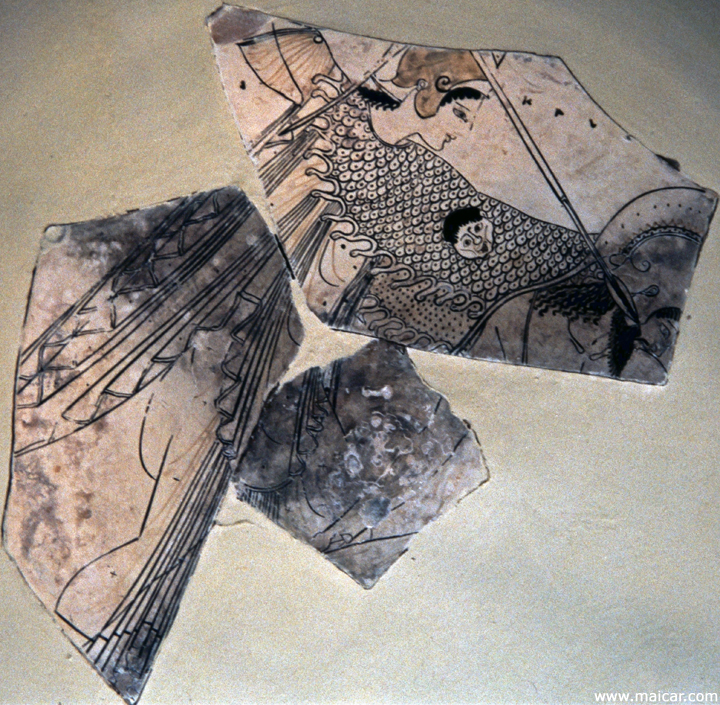
6508: Athena in the Gigantomachy. Parts of a white-ground kylikes. Early 5C BC. Archaeological Museum of Eleusis.
|
|
What "getting acquainted" may mean
We'll first try to clarify the meaning that the expression "getting acquainted" may have in this context:
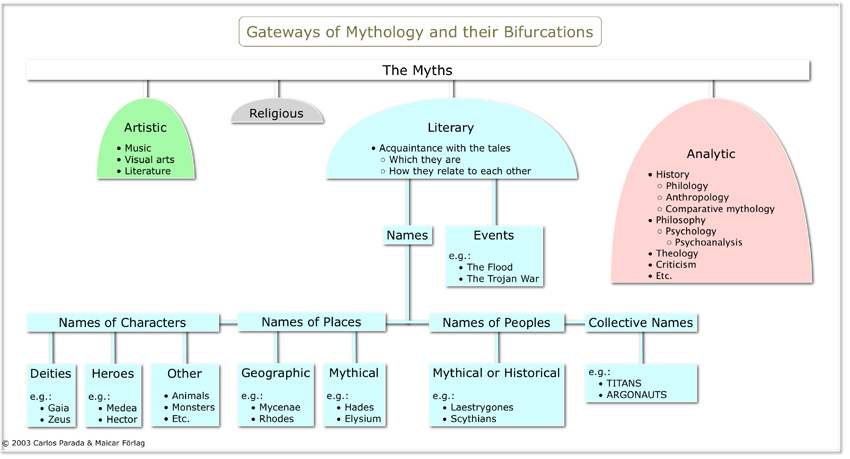
In a practical sense, I mean by "acquaintance" a general knowledge of the tales of mythology, including how they relate to each other. This concept includes neither analysis nor interpretation of the myths nor plunging too deep into one tale or another. In another sense, the expression "getting acquainted" has further implications that deserve elucidation:
First of all, let us remember that we naturally investigate what we ignore, and not what we already know; accordingly, we set out to study the myths not because we feel we know them but because we feel we know nothing or very little about them. I mention this obvious circumstance because I believe that we should bear in mind that, in this respect, we are not in the same position as our remote ancestors, who may be assumed to have made their acquaintance with the myths more or less in the same way one learns one's mother tongue, and consequently did not have to study them in any way.
You are probably aware that students—as well as the general public—are often believed to have been better acquainted with the myths decades or centuries ago than they are today. And you have probably noticed that although the collection of facts and theories gathered by scientific research during the 19th and 20th centuries could be assumed to be the largest ever, we nevertheless remain under the impression that the acquaintance with the myths was more widespread in the past. From this apparently curious circumstance it could be derived that the amount of facts and theories collected stands in inverse proportion to the actual knowledge that society and its members might gain on the subject, or make use of. Some may find that curiosity and its resulting epistemological dilemma rather disquieting, but I shall not scrutinize either of them, since it would lead us too far away from our subject.
Instead (and remaining closer to the topic of acquaintance) let us just consider that the myths went through their golden age some 3000 years ago, and that it is not unreasonable to assume that the men who lived in that remote age that defies our memory, diverged substantially from us in their way of approaching both the physical and metaphysical aspects of the world.
We may attempt to examine the differences of approach between "mythical man" (that man from an almost irretrievable past) and "analytical man" (an expression alluding to some basic traits of contemporary man), by examining the nature of their respective works:
Studying the myths, explaining them, interpreting them, elaborating theories concerning their origin, analyzing them, revealing their allegories, exposing their symbols, their rational aspects, historical roots, ritual connections, structural patterns, psychological meanings, social or moral implications, etc, are some of the tasks of the analytic man. To receive and transmit the myths, to perceive through them both beauty and significance, to "live in the myth," as Kerényi put it, might have been some of the habits of mythical man, a species to be considered extinguished. Taken as paradigms, neither can the mythical man think analytically, nor the analytic man mythically.
From this difference of approach and temperament we have seen a most categorical discrepancy arise between the two men: the analytic man asserts that the mythical man invented the myths, whereas the mythical man affirms that the myths were handed down to him by the gods. Since the myths are the ground upon which the culture and enlightenment of several societies flourished, this controversy is not irrelevant. Yet, we are not going to attempt any reconciliation of the arguments, limiting ourselves to a few observations that could help us to better understand our own relative position as men and women living in an analytic era:
First of all, this disagreement reveals that whereas for mythical man the myths constitute both an internal and external reality, for the analytic man they are mainly an external object. Secondly, we notice that the claim of mythical man to divine inspiration does not allow verification, and that we are therefore forced to regard him as "a creator," "a maker," or "an inventor." Thirdly, we perceive that the position of the analytic man in this context resembles that of the reviewer or critic, in the sense that he does not create or invent any myths, but limits himself to studying them in one way or another.
Accordingly, when acquainting ourselves with the myths, we should bear in mind that, as humans belonging to an analytic age, we are mainly reviewing the creative work of ancient men, and that, in this context, the mythical man remains the creator. The analytic man, on the other hand, performs the part of the reviewer, and he may perform it with precisely that degree of humility which his own personal disposition might allow him to call forth as he contemplates those creations of the past which have sustained the spiritual life of generations and the art of ages, up to our time.
On the reasons to study the myths
I will not describe at length the reasons why we should read and study the myths, since I assume that you have heard them on many occasions. Let it therefore suffice with a short enumeration:
It has been asserted that the Greek myths are at the dawn of Western civilization, that Homer is the author of the first work of literature that Western civilization may count as its own, that large sections of Western culture and art—music, painting and literature—found their source of inspiration in the tales of mythology, and that the Greek myths are concerned with fundamental and imperishable life issues.
What I now wish you to notice with regard to these assertions (for we are not going to examine any of them) are the values that such a list of merits endorses, irrespective of the accuracy of the assertions themselves:
First, the value we attribute to memory for keeping an identity. Second, the importance of identity itself, that is, the benefits we attribute to that coherence through time which results in a sort of sameness, "equability of countenance," or harmonic integration of parts. Third: the importance of beauty in enhancing our lives. Fourth, the usefulness we attribute to the "imperishable life issues" for acquainting us with the human condition, and for influencing and improving our view of life and the world.
If you ponder over these values, you may sense that they are interrelated as parts of a unity, so that if one element were modified or abandoned, the others would follow. For example, during long periods of time art was considered important because it was regarded as the instrument of beauty and significance, satisfying both aesthetic and ethic needs. More recently, however, art has been regarded rather as a vehicle of self-expression or as a means for conveying messages of a transitory nature. Such a vital change of orientation naturally affects both the aesthetic dimensions of art and its ethic contents. But it necessarily affects any other aspect as well, since you, conversely, could argue that the change of direction observed in the arts derives from a significant modification of our identity, which in turn has to be the result of an alteration or diminution of our memory.
We are not going to plunge deeper into these difficult matters. I mention them mainly to illustrate how the myths are concerned with any significant aspect of life, and we may leave them as they stand for further reflection on a later occasion. Let us just recall, for the purpose of rounding off and since I mentioned memory several times, that in the context of the myths one cannot insist enough on the role attributed to Memory: When the poet says "Tell me Muse … " or "Sing goddess…", he is addressing the daughters of Memory (Mnemosyne), whom he regards as the owners of all tales and the source of his inspiration.
Some modern books
I will now briefly address the issue of bibliography. The suggested bibliography will also be, to begin with, as brief as possible. For we just wish to get acquainted with the myths. And as I said before, "acquaintance" does not include analysis or interpretation of the myths or plunging too deep into one tale or another, but only a general knowledge of the tales of mythology and of how they relate to each other.
Besides the material provided by the Greek Mythology Link and other sources on the Internet, the tales may be read in a number of books. One of them could be The Greek Myths by Robert Graves. This work has been criticized, sometimes severely, for diverse reasons; in particular, the interpretations appended by the author have not been appreciated by modern scholarship. On the other hand Graves' book is fairly well organized, and narrates a large number of myths in various versions, with sources included. The more recent Classical Mythology by Morford & Lenardon is also a good alternative or complement. There are long quotations from original sources, a varied selection of myths, tables, maps, illustrations, and an attractive chapter called "The Survival of Classical Mythology".
In addition, the complexity of the material demands a dictionary: a good choice is Pierre Grimal's Dictionary of Greek & Roman Mythology, which relates the anecdotes with many details, has a large amount of entries, and includes many references. Naturally, the list could be made both longer and different, but the works mentioned should be enough for a good start (see also Bibliography, Modern Authors).
Some ancient authors
The above mentioned volumes are normally classified as "secondary sources", that is, they depend on "primary" or "original" sources, which consist of the works of ancient authors (poets and mythographers) from the period c. 800 BC - c. AD 600. Among the most ancient are the works of Homer and Hesiod (see Bibliography, Ancient Authors). The original language of most of these works is Greek, and later also Latin (for example Statius and Ovid), but English translations are available in the Loeb Classical Library and other editors as well (Spanish-speaking readers may refer to Biblioteca Clásica Gredos, and francophones to the editions of Les Belles Lettres). Several of these authors may be consulted on line through the Perseus Project and other web sites.
A quantitative hierarchy may be established among the ancient authors by attempting to measure the amount of mythological data each of them provides. Such an attempt yielded the following results (for the first four—the complete list is at Bibliography.
Apollodorus, the author of the Library, is by far the most informative: c. 19% of all we know about the myths comes from him. Yet about Apollodorus himself very little is known, and the identity of this mythographer, who probably flourished around AD 100, is uncertain. After a Theogonical introduction, Apollodorus goes through the description of several mythological families, such as that of Deucalion, that of Inachus, Atlas, etc. This work, including its Epitome, covers the Trojan War, the Returns of the Achaean leaders, and the wanderings of Odysseus. It is an indispensable work for anyone wishing to follow the many details of the myths in a single, clear text. In the Loeb edition, abundant notes by translator J. G. Frazer compare Apollodorus' versions with those of other mythographers.
After him, Pausanias and Hyginus share a second place: c. 12% each.
Pausanias (fl. c. AD 150) was a traveller and geographer. His Description of Greece, written with charm and a sharp mind, acquaints the reader with cities, monuments and other landmarks from Laconia to Phocis, besides retelling a fair number of mythological stories, several of them with many details, as in the case of the account of the return of the Heraclides.
Hyginus (before AD 207) is yet another mythographer that has not been identified so far. The Fabulae, and also a manual of astronomy, Poetica Astronomica, based on Greek mythological accounts, are the two works attributed to him. Many interesting versions may be found in both compilations.
Next comes another evasive author: Homer (c. 750 BC). He represents c. 8%, including, besides the Iliad and the Odyssey, the Homeric Hymns. These four authors, whose lives are as immersed in darkness as that of the myths, stand thus for c. 50% of all mythological data. But other authors, though representing smaller percentages, are sometimes the only ones to narrate certain myths, and among these Hesiod (4%) deserves a special mention for the completeness of his Theogony, a short poem that describes the origin of the gods, and how the different generations of gods are related to each other (see table Theogony).
The general view
A first acquaintance with the myths may be made using secondary sources alone, but further study will require the original ones. Yet, when studying the myths, it is important to acquire a general view, and in this regard the secondary sources may prove to be an important aid.
The general view reveals that a network of relationships and events stretches across the mythical body, building stories within stories. It also allows us to establish a mythical chronology, showing which events took place first and which later. The general view provides one of the pleasures when reading mythology, by unveiling the complex network and the intersections where one story meets another. I'll give some examples of this interesting feature:
Once an oracle declared to Catreus (a king in Crete) that he would be killed by his own son. This prophecy was kept secret, but later it came to the knowledge of Catreus' son Althaemenes, who, not wishing to become the murderer of his own father, emigrated to Rhodes. Years later, however, Catreus, wishing to give the throne to his son, came unannounced to Rhodes, where he was unwittingly killed by Althaemenes, who believed him to be an invader. This is how Catreus died and the oracle was fulfilled. Another part of the story relates the emigration of Althaemenes, and how he settled in his new home with his sister, whom he kicked to death for having lost her virginity to a stranger, perhaps a god.
This story is told by Diodorus and Apollodorus. We know that Catreus' body was at some point ferried back from Rhodes to Crete, where the funeral—a decisive episode of Catreus' story—took place. But this episode is omitted in the self-contained story of the emigration of Althaemenes. It is instead in another story that we learn of Catreus' decisive though passive role: Because Catreus was Menelaus' grandfather, the latter sailed to Crete to perform the obsequies of the former, but he did so precisely at the moment when Paris, visiting Sparta, was his guest. And while Menelaus was attending the funeral, Paris seduced his wife Helen and fled with her to Troy. The funeral of Catreus thus appears as a decisive component in the sequence of events that led to the Trojan War, but his death is narrated in quite another context and without mentioning the circumstances surrounding his coming funeral (see at Trojan War: Connected Events how several independent courses of action come together to make the Trojan War possible).
We may again refer to the otherwise inconspicuous Catreus (only Apollodorus, Pausanias, and Diodorus mention him) to illustrate how the myths quickly ramify. The name of Catreus is related to some interesting characters (leaving for the moment his famous parents aside). One of them is Nauplius, who is said to have married Catreus' daughter Clymene. Nauplius may lead us to the great naval catastrophe suffered by the Achaeans at cape Caphareus on their return from Troy after the war. The reasons for this shipwreck could in turn be traced to at least two different stories: one of them narrates the fate of Nauplius' son Palamedes at Troy; the other reports the rape of Cassandra by Ajax as well as other outrages committed by the Achaeans during the sack of Troy. The story of Palamedes is in turn intertwined with Odysseus' reluctance to go to war and the episode of The Oath of Tyndareus, which in turn involves the names of Penelope, Helen and the many suitors of the latter, kings and princes of Hellas. Nauplius is also said to have induced Clytaemnestra and other wives of the Achaeans to take lovers, which led to sedition and bloodshed in several cities (for example the murder of Agamemnon, and the vengeance of Orestes). But Nauplius, who lived several generations, was also the son of Amymone, one of the Danaids, which introduces the story of the girls that murdered their husbands on their wedding night, the emigration of Danaus from Egypt, and ultimately the story of Danaus' ancestor Io, who turned into a cow after being seduced by Zeus and wandered throughout the world, visiting Prometheus when he was chained in Caucasus. We could now return to Catreus and take a look at his parents Minos and Pasiphae, the king and queen that kept the Minotaur inside the labyrinth conceived by Daedalus, the architect who constructed wings to fly with, which became the death of his son Icarus. And Daedalus leads us to Catreus' sister Ariadne and Theseus, and Theseus may lead us to Medea, and Medea to the Argonauts, among which was Orpheus, otherwise better known for his descent to the Underworld, where he went looking for his wife Eurydice. Etc …
With these examples I have been trying to illustrate how the mythical tales unfold like a fractal from almost any point, and connect to each other ingeniously. You'll certainly find isolated anecdotes as well, but still the myths could be described as a tale composed of tales, composed of yet other tales.
This and other astounding features usually raise the questions of how the myths were put together and by whom; for although only fragments of the mythical edifice have reached us, it is difficult to contemplate it without amazement. These questions are beyond the scope of this page, but we may nevertheless quote certain pertinent words of Friedrich von Schelling (1775-1854) that remind us of the greatness and power of the myths:
"To create a mythology, to give it that credibility and reality in the thought of men which it needs in order to achieve even that degree of popularity which makes it poetically useful—this is something which goes beyond the power of any individual to accomplish." (Philosophy of Mythology).
Genealogy
The unfolding nature of the mythical tales brings about the subject of genealogy, which is one of the pillars of the myths. First of all it appears before us as a sort of skeleton that keeps the mythical flesh together. We can follow, through the myths, many generations of men with few interruptions, which also allows us, as I have already mentioned, to establish a Mythical Chronology.
Second, when considering the importance of genealogy in the mythical context, one should bear in mind that, according to the myths, the world—the universe or cosmos—does not come into existence as the result of the work of a constructor, a demiurge, or a god-creator, but through love and intercourse. The mythical mind avoids the conceptual divorce between creation and procreation, establishing that the different parts of the cosmos (physical or psychical) are divinities. So for example the Earth (Gaia) and Sky (Uranus) are simultaneously tangible realities and deities endowed with the kind of power and intelligence that is the exclusive attribute of the divine. For the mythical mind the world is not a lifeless stage where actors perform their deeds, but instead the stage and the actors at the same time. This is why the myths make no difference between Cosmogony and Theogony, or between the Cosmos and the gods. For the gods create new segments of Cosmos by consorting with each other, and these new segments, being gods, are both created and procreated. In the context of the myths then, neither Theogony can be separated from Cosmogony, nor Creation from Procreation, nor Genealogy from Genesis. Arnold Toynbee, in his A Study of History might have reflected mythically when he asserted that
"… creation is the outcome of an encounter, and genesis is a product of interaction …"
A third aspect is that genealogy plays an important role to endorse the mythical nature of a tale. In order to understand this aspect, we must keep in mind that the foundation of the myths lies in divine presence. A tale lacking divine presence may win acceptance as a myth for being associated with the same cultural tradition, but this kind of tale is normally regarded as having a lesser mythical value, and also scholars usually degrade it, as it were, to the category of a free-standing Legend or a free-standing Folk tale, mainly for lacking that quality. Divine presence is obviously not lacking in the "Divine myths", since in such myths the gods themselves are the protagonists. But in the "Heroic myths"—that is, the tales related to kingdoms on earth, heroes and heroines—divine presence must be acknowledged in some way or another, and that is done either through divine intervention in human affairs, or by any kind of reference to the gods, or else by a genealogy establishing descent from the gods.
However, genealogy is one of the most uncertain mythological components, and not seldom several versions must coexist, both in the "Divine" and the "Heroic" myths. The traveller Pausanias observed this fact, and reminds us that
"The legends of Greece generally have different forms, and this is particularly true of genealogy." (Description of Greece 8.53.5).
Some of these versions could sometimes seem unlikely or even laughable, as when a certain girl's sister is described as the grandmother of her own brother-in-law. Genealogical issues have also constituted a pretext for pedantry (both around lineage and education), and along with other silly questions, such as the song of the Sirens, the colour of someone's eyes, or the number of ships in some fleet, have been believed, by those able to make a quiz of anything, to be far-reaching with regard to the knowledge of the myths.
There's no need to be discouraged by the many versions or other apparent weaknesses. For you may notice that variations in the myths (which could appear even in the writings of the same author), and contradictions (which affect the surface of the myths rather than their kernel), enliven the myths by subordinating factual consistency to a varied range of possibilities while remaining in one piece. You may even come to perceive them as beneficial, since they invite understanding in several layers, and allow the subjective reorganization of the material. In addition, the artistic and psychological consequences of such a feature, observable in life but generally absent in pure fiction, are curiously not diminished if its causes are unveiled, for example, by proving that it is the result of interpolations, errors, or late additions.
|